

By Prosper Shaked, Florida personal injury attorney. Published: November 5, 2026.
After an injury at an Airbnb, the claim usually runs against the host and anyone else who controlled the property, not against Airbnb. It is paid, if at all, by the host liability insurance in Airbnb’s AirCover, by the host’s own policy or by another party’s insurance. Airbnb’s host liability insurance has a total limit of one million dollars per Airbnb stay booked through Airbnb, with exclusions, and the claim is started through Airbnb’s insurance form, which the host, you or your lawyer can submit. Under Florida law, for a negligence claim, you have two years from the date of the injury, in most cases, to file a lawsuit. In almost every case I handle, the claim is against the host, not Airbnb, so my first letter goes to the host through the platform asking for the AirCover claim, and I save the listing, check the host’s license and registration, and ask for the host’s own policies.
Key terms
The six terms this article uses
Host. The person or company that lists the rental on Airbnb and runs the stay. The host may own the property, or may run it for an owner who does not deal with guests.
Invitee. A visitor who is on the property by invitation, such as a paying guest. The person in control must use reasonable care to keep the property reasonably safe and warn of hidden dangers it knows about or should know about.
AirCover host liability insurance. AirCover for Hosts is Airbnb’s name for the protections it gives a host on a stay booked through Airbnb. The part that matters to a hurt guest is the host liability insurance inside it, which covers the host’s legal responsibility for a covered injury.
Adjuster. The person an insurance company appoints to investigate and handle a claim. For the host liability insurance, a third-party adjuster appointed by the insurer handles the claim, and works for the insurer, not for you.
Premises liability. The law of injuries caused by the unsafe condition of property that someone else owns or controls, such as a wet floor, a loose railing or an unfenced pool.
Statute of limitations. The deadline to file a lawsuit. Once it passes, the claim is usually lost however strong it was. Under Florida law, for a negligence claim, it is two years from the date of the injury, in most cases.
What should you do after you are hurt at an Airbnb?

If someone is badly hurt, call 911. If you smell gas or smoke inside, get everyone out first, then call. Medical care comes first; the rest can wait until everyone is safe.
- Get medical care, and tell the doctor where it happened. Go to urgent care or an emergency room the same day if you can, and tell the doctor you were hurt at a rental and how. Keep every record, bill and receipt.
- Tell the host and Airbnb in writing, in the app. Message the host in the Airbnb app with what happened, where and when, and report it to Airbnb in the app, even if the host asks you not to report it. You can also call Airbnb at +1-415-800-5959, but put the report in writing.
- Photograph the spot before anyone fixes it. Take pictures and video of the floor, stair, railing, pool gate or fixture that hurt you, close up and from across the room, and of any warning sign or the lack of one. Photograph your injuries too, and again as they change.
- Save the listing, the booking and every message. Screenshot the listing, its photos, its house rules and its reviews now, because they can change. Save the booking confirmation showing who booked and for which dates, and keep every message with the host and Airbnb, including your own first messages. If someone else made the booking, ask that person to save the booking record and to send the written report with you.
- Get the names and numbers of everyone who saw it. Other guests, a neighbor, a cleaner or a building worker. Write down what each person actually saw, and whether they saw how you were hurt or only what came after.
- Ask the host to report it to Airbnb’s insurer. Ask the host, in writing, to submit Airbnb’s liability insurance intake form for your injury and to leave the spot as it is, apart from anything needed to make it safe. Save the reply. If the host will not, the same form takes a report from you or your lawyer.
- Do not give a recorded statement before you get advice. If an adjuster calls, take the name, the company and the claim number and say you will call back. Do not sign anything or authorize all your medical records until you know what you are agreeing to.
Who is responsible for an injury at an Airbnb?
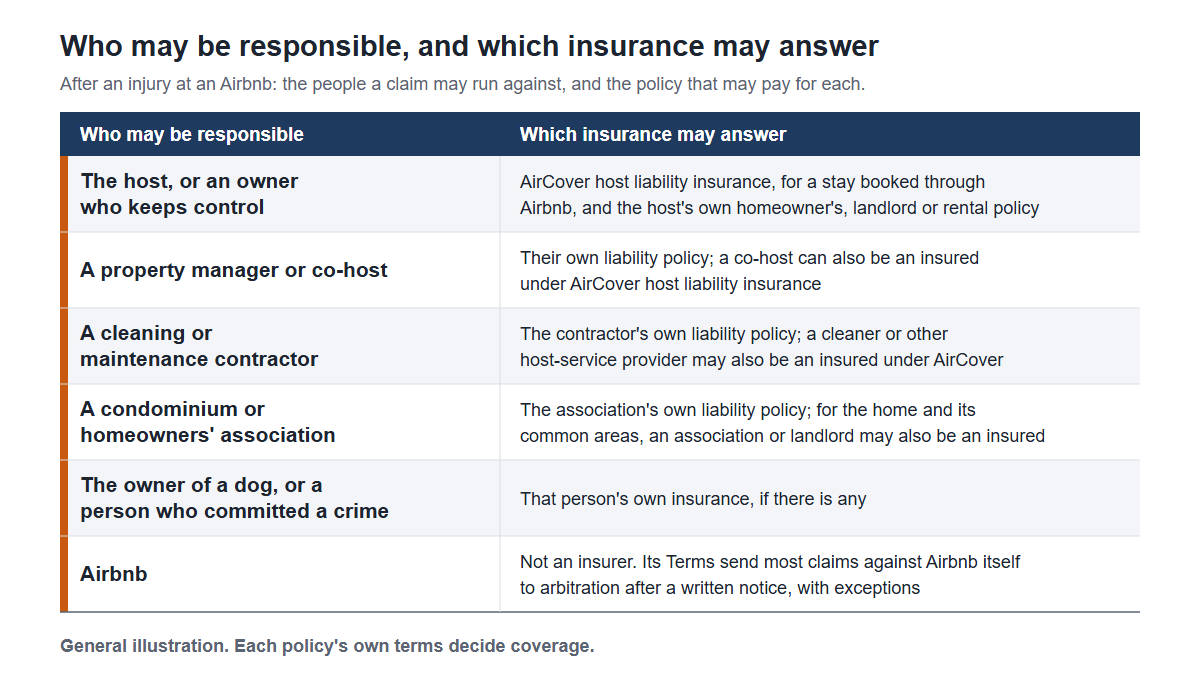
The claim runs against whoever controlled the place and whose failure to use reasonable care to keep it safe caused your injury. Florida courts have treated a paying guest as an invitee, and the host must use reasonable care to keep the property reasonably safe and to warn of dangers it knows about, or should know about, that you cannot see. More than one person can share that duty:
- The host, the person or company that runs the listing, whether or not it owns the property.
- The owner, where the owner is someone else and still controls repairs or the building.
- A property manager or co-host who maintains the rental, handles repairs or checks the place between guests.
- A cleaning or maintenance contractor whose work created the hazard, such as a floor left wet or a railing put back loose.
- A condominium or homeowners’ association, for a pool, elevator or stairway it controls.
- The owner of a dog that bit you. Under Florida law the dog’s owner is responsible for a dog bite to a guest lawfully on the property, even if the dog never bit anyone before, with narrow exceptions; whether a host who does not own the dog also answers turns on what the host knew and could control.
- A person who committed a crime there, such as an assault or a break-in. Whether the host’s locks, lighting and access were reasonable is a separate negligent security question.
The hazard decides where the questions start. A fall on defective or broken stairs turns on what the host knew or should have known about the stair. A drowning or near-drowning turns on the gate, the cover, the alarm and who controlled the pool.
In one vacation rental fall I know of, the person sued disputed owning the rental, pointed to a separate property manager and said another guest had made the booking, and the one witness to the wet floor had seen it the next morning, not the fall. Sorting out who owned, managed and listed the rental starts with the booking record, not with assumptions.
Airbnb itself is usually not on that list; the first question in the FAQ below says why.
Does Airbnb’s insurance cover a guest’s injury?
Sometimes, through the host. Airbnb’s AirCover for Hosts includes host liability insurance of up to one million dollars per Airbnb stay for covered guest injuries, underwritten by a third-party insurer. It applies only to stays booked through Airbnb, it has exclusions, and claims are handled by an adjuster the insurer appoints under the policy’s terms, so the host’s own homeowner’s or landlord policy often matters as much.
The insurance covers the host’s legal responsibility for an accident during the stay; it is not a fund that pays every injured guest. Airbnb’s program summary lists exclusions a guest’s claim can meet, among them assault or sexual assault by an insured person, such as the host or someone else the policy covers, injury the host intended or should have expected, communicable disease, mold or bacteria, injuries connected to cars and most boats, with the exceptions the summary lists, and punitive damages, except where the law allows them to be insured. The summary says the list “is not exhaustive”.
Airbnb tells hosts to submit its liability insurance intake form when they learn of an injury, and the same form takes a report from a guest or a guest’s lawyer. Airbnb says it checks the information, sends it to the insurer if nothing is missing, and after that “a third-party claims adjuster appointed by the insurer will get in touch” and handles the claim under the policy. A report is not a claim the insurer has accepted. You prompt it by telling the host and Airbnb in writing, and you can submit the form yourself if the host will not. A host can also opt out of the host liability insurance, so whether it was in place for your stay is something to confirm, not assume.
The host’s own insurance is the other place to look. A host’s homeowner’s policy often excludes or limits business use, and renting to paying guests is often treated as business use, so the policy that answers may be AirCover, a landlord or short-term rental policy the host bought, or a commercial policy, and sometimes more than one. Miami-Dade County makes the point itself: in its unincorporated areas, the vacation rental application acknowledges that a standard homeowner’s policy may not cover guests.
How do you make the claim, and to whom?
You make it in writing, to the host and to Airbnb through the app, so you have a dated copy of both reports, and you ask the host to submit the AirCover liability claim. If the host has its own homeowner’s, landlord or short-term rental policy, ask the host for that insurer’s name and the claim number. If the host does not answer or refuses to report it, keep the record of your requests; the claim against the host does not depend on the host’s cooperation, and in my cases I put the host and every insurer I can identify on notice myself.
Once a claim is open, expect a call from an adjuster asking for a statement, your medical records and an authorization to collect more. That is the insurer’s investigation, and step 7 above applies to it.
Keep each track separate. In one rental injury claim, three tracks ran side by side and looked alike to the guest: the platform’s safety and support team, the insurer’s investigation of the injury, and the host’s own request to be paid for damage to the property. Keep the messages and photos of each track together, apart from the others, and keep your own early messages, even the friendly ones.
A claim against Airbnb itself is a different matter. For users living in the United States, Airbnb’s Terms of Service send most disputes with Airbnb to a written notice mailed to Airbnb and a 30-day negotiation period first, then to binding arbitration on an individual basis; an individual claim of sexual assault is among the exceptions, and reporting the injury in the app is not that notice. Those terms govern a dispute with Airbnb; by themselves they do not send your negligence claim against the host to arbitration, though the Terms and any separate agreement you accepted with the host are still part of what gets reviewed.
What can the claim include?
The claim is for what the injury cost you and what it did to you: medical bills now and later, lost income, and losses that come without a receipt, such as pain, mental anguish and the things you can no longer do. Together these are compensatory damages. Punitive damages, which punish rather than repay, are rare, and the host liability insurance excludes them except where the law allows them to be insured. What a claim is worth does not come from an average; it turns on the injury, the treatment and the proof.
How long do you have to file?
Under Florida law, for a negligence claim, you have two years from the date of the injury, in most cases, to file a lawsuit (section 95.11(5)(a)). The clock runs from the injury under section 95.031, so it starts while you are still at the rental or on the way home, not when the adjuster calls, and reporting the injury or talking to an adjuster does not, by itself, stop it. If the injury caused a death, a wrongful death case has its own two-year rule (section 95.11(5)(e)).
What if you were partly at fault?
Under Florida law, in a negligence claim, if you are found more than 50 percent at fault for your own injury, you recover nothing; at 50 percent or less, your recovery is reduced by your share (section 768.81(6)). That is Florida’s modified comparative negligence rule.
What can a lawyer do that you cannot do alone?
You can report the injury, keep the records and answer the adjuster’s questions yourself. What you cannot easily get alone, or cannot easily put together, is what the claim turns on: the host’s own insurance policies, the rental’s license and registration history, the listing as it read before it was edited, and the answers of the manager, the contractor or the association. When the injury is serious, those pieces often decide the claim, and finding who answers, getting their policies and the earlier listing records, and connecting them to the injury is what a lawyer does with these claims.
In almost every case I handle, the claim is against the host and whoever else controlled the property, not against Airbnb. A claim against Airbnb itself is rare, it runs into Airbnb’s arbitration terms, and there is usually no reason to pursue it, because the host’s coverage is usually what answers the claim. My first letter goes to the host through the platform, so it sits in the booking record with a date on it, and it asks the host to submit the AirCover liability claim and to leave the spot as it is, apart from anything needed to make it safe. The same week, I save the listing, its photos and its reviews before they change. I check whether the host held Florida’s vacation rental license and whatever registration the city or county requires, because a host who skipped them has given the claim a fact. And I ask for the host’s own policies, because the homeowner’s policy often matters as much as AirCover.
Frequently asked questions
Can I sue Airbnb, or only the host?
Usually only the host, and whoever else controlled the property. Airbnb’s Terms of Service say it does not own, control, offer or manage any listing and is not a party to the contract between the host and the guest, and a claim against Airbnb itself turns on Airbnb’s own conduct. Such a claim is rare, it runs into Airbnb’s arbitration terms, and there is usually no reason to pursue it, because the host’s coverage is usually what answers the claim.
What if the host has no insurance, or the policy does not cover rentals?
The claim does not disappear; what changes is where the money may come from. If you booked through Airbnb, the host liability insurance inside AirCover may still answer, subject to its terms and exclusions, unless the host opted out. A manager, a contractor or an association may have its own policy, and a host without insurance can still be answerable for the claim. AirCover does not apply to a stay booked on another site; if it was Vrbo, see how to file an injury claim on a Vrbo rental.
Can I still make a claim after I check out and go home?
Yes. Checking out does not end the claim, and much of it can be handled in writing and by phone from wherever you live. If you have not reported the injury yet, tell the host and Airbnb in writing now, and keep your medical records, the booking and every message. Under Florida law, the deadline to file a negligence lawsuit is still two years from the date of the injury, in most cases; if the rental was outside Florida, a different deadline may apply, so ask before you rely on this one.
What if I was hurt at the rental’s pool?
The same steps apply: get care, report it in writing, and photograph the pool, the gate, the fence, the cover and any alarm before anything changes. Who may answer depends on who controlled the pool and whether that person’s failure to use reasonable care caused the injury: the host for a private pool at the house, a condominium or homeowners’ association for a shared pool it controls, and sometimes both. If a child went under the water, get medical care at once.
Does it matter that I accepted Airbnb’s terms when I booked?
Not by itself. Airbnb’s Terms of Service govern your dispute with Airbnb: for users living in the United States they send most claims against Airbnb itself to a written notice and then to binding arbitration, with exceptions, and they say Airbnb is not a party to the contract between the host and the guest. Nothing in Airbnb’s arbitration terms, by itself, sends a negligence claim against the host to arbitration; the Terms and any separate agreement with the host are still read as part of the claim.
Will Airbnb pay my medical bills right away?
Do not count on it. Airbnb’s Terms of Service say it is not an insurer, and the host liability insurance inside AirCover covers the host’s legal responsibility for a covered injury, with an adjuster the insurer appoints investigating and handling the claim, which takes time. Get the care you need now, using your own health insurance if you have it, and keep every bill and record, because they become part of the claim.
If you were hurt at an Airbnb, I start with the listing, the booking record and every policy that may answer, and I talk to you myself. You can reach me through my attorney page or the form on this page.
Reviewed by Prosper Shaked, Florida personal injury attorney, who represents injured people in car, truck and motorcycle accident, premises liability, medical malpractice and wrongful death cases from his office in North Miami Beach.
Statutes cited: section 95.11, section 95.031, section 767.04 and section 768.81, Florida Statutes (2026). Airbnb sources: Help Center article 937, Host liability insurance; the Host Liability Insurance Program Summary (article 3145, last updated June 30, 2026); the Terms of Service (article 2908, last updated February 5, 2026); article 1542, Contact Airbnb customer service for help, all read November 4, 2026; and Airbnb’s liability insurance intake form, read November 5, 2026. County source: Miami-Dade County Code section 33-28. Checked against the 2026 Florida Statutes on November 5, 2026.