

By Prosper Shaked, Florida personal injury attorney. Published: November 3, 2026.
Compensatory damages pay for what an injury cost you and what it did to you: economic losses such as medical bills and lost income, and non-economic losses such as pain and suffering. Punitive damages are different: they punish the defendant and deter others, and they are rare. In Florida a claim for them needs the court’s permission first and, at trial, clear and convincing evidence of intentional misconduct or gross negligence. In the ordinary case they are capped at three times the compensatory damages awarded to each claimant, or $500,000, whichever is greater, and the cap does not apply to a defendant who was impaired by alcohol or drugs at the time. I ask for punitive damages only where the conduct was criminal or grossly negligent, such as racing or driving under the influence, and only when the evidence is there; in an ordinary crash, I do not plead them.
Key terms
The six terms this article uses
Compensatory damages. The money awarded to pay for what an injury cost and did to the injured person. They come in two kinds, economic and non-economic, and together they are the core of an injury claim.
Economic damages. The financial losses: past and future lost income, medical and funeral expenses, lost support and services, property losses and repair costs, and any other economic loss that would not have happened without the injury.
Non-economic damages. The losses that are not financial: pain and suffering, inconvenience, physical impairment, mental anguish, disfigurement and loss of capacity for enjoyment of life. The list comes from the medical negligence chapter of the statutes.
Punitive damages. Also called exemplary damages. Money awarded to punish a defendant for intentional misconduct or gross negligence and to deter others, not to pay for the injured person’s loss.
Gross negligence. Conduct so reckless or so wanting in care that it amounts to a conscious disregard of, or indifference to, the life, safety or rights of the people exposed to it.
Clear and convincing evidence. A standard of proof higher than the “more likely than not” standard that decides most civil claims. It is the standard the jury applies at trial to a claim for punitive damages.
What are compensatory damages?

Compensatory damages pay for the harm itself: they put a number on what the injury took from you. They come in two kinds, economic and non-economic, and the two are proved differently.
Economic damages are the financial losses, and section 768.81 lists them. They are past lost income and future lost income reduced to present value; medical and funeral expenses; lost support and services; and the replacement value of lost personal property. The list also covers the loss in appraised fair market value of real property, the cost of construction repairs, and any other economic loss that would not have occurred but for the injury. Economic damages are proved mostly with documents, such as pay records for the lost income and the medical bills and records for the treatment.
Non-economic damages are the losses that are not financial. Section 768.81 uses the term without defining it. The medical negligence chapter defines it, in section 766.202(8): pain and suffering, inconvenience, physical impairment, mental anguish, disfigurement, loss of capacity for enjoyment of life, and other nonfinancial losses. These losses have no bill or receipt, so they are proved through testimony: the injured person, the family and friends who saw the change, and the doctors who treated the injury.
When an injury causes a death, section 768.21 lists what the survivors and the estate can recover in a wrongful death case, such as the family’s lost support and services.
Florida’s statutes set no general cap on non-economic damages in an ordinary injury case. The Legislature wrote caps on non-economic damages for medical malpractice cases into section 766.118. In Estate of McCall v. United States (2014) the Florida Supreme Court struck down the section’s cap on non-economic damages in wrongful death cases, and in North Broward Hospital District v. Kalitan (2017) it struck down the personal injury caps in subsections (2) and (3). Those provisions still appear in the statute’s text.
What are punitive damages, and what are they for?
Punitive damages are not a measure of what you lost. They are an amount a jury can award on top of compensatory damages. Their purpose is to punish a defendant for intentional misconduct or gross negligence and to deter the same conduct by others. They are also called exemplary damages.
Punitive damages are rare, because the law reserves them for conduct far worse than ordinary carelessness; the next section explains what that takes. Even when the evidence meets the standard, the jury does not have to award them; the decision is left to the jury’s discretion.
Where the cap applies, the jury that decides punitive damages is not told about it: section 768.73 says the jury may be neither instructed nor informed about the section. The same section also generally allows only one punitive award for the same act or course of conduct. If a defendant shows before trial that punitive damages were already awarded against it for that conduct, it usually cannot face a second award.
Who can ask for punitive damages, and what do you have to prove?
An injured person cannot simply write punitive damages into a lawsuit. Under section 768.72(1), the claim is not allowed until the injured person shows evidence, already in the record or offered to the court, that gives a reasonable basis for recovering punitive damages. The injured person asks the court for permission to amend the complaint and add the claim. Until the court permits it, there is no discovery of the defendant’s financial worth.
That first step changed in 2026, though the statute did not. In June 2026 the Florida Supreme Court decided Perlmutter v. Federal Insurance Co. and settled how judges handle the request. At that stage the judge looks only at the injured person’s evidence, reads it in the injured person’s favor, and does not weigh it or consider evidence the defendant offers against it. The question is whether a reasonable person could conclude from that evidence that the defendant’s conduct meets one of the two definitions below; where the claim is against a company for an employee’s conduct, the same test is applied to the company rule described below. The clear and convincing standard applies at trial, not at the door. The amended complaint still has to plead a claim that punitive damages can attach to; what the judge weighs at the door is the evidence behind it.
At trial, section 768.72(2) allows punitive damages only if the jury finds, on clear and convincing evidence, that the defendant was personally guilty of intentional misconduct or gross negligence. The statute defines both:
- Intentional misconduct: the defendant had actual knowledge that the conduct was wrong and that injury or damage to the claimant was highly probable, and despite that knowledge intentionally went ahead with it, resulting in injury or damage.
- Gross negligence: the defendant’s conduct was so reckless or so wanting in care that it amounted to a conscious disregard of, or indifference to, the life, safety or rights of the people exposed to it.
The courts describe the negligence that supports punitive damages as akin to the conduct involved in criminal manslaughter; ordinary carelessness, however costly, does not reach it.
A company does not owe punitive damages just because its employee might. Under section 768.72(3), the employee’s conduct must meet the same test, and one of three things must also be true. The company actively and knowingly took part in it; its officers, directors or managers knowingly condoned, ratified or consented to it; or the company’s own gross negligence contributed to the injury. The courts read that rule narrowly: the person who took part, condoned or approved has to be high enough in the company that his acts count as the company’s own, not a shift supervisor or a mid-level manager. In the ordinary case, section 768.725 then splits the proof at trial in two. The right to punitive damages must be proved by clear and convincing evidence, and the amount by the greater weight of the evidence.
The appellate decisions show where the line has fallen in car cases. Driving while intoxicated, with evidence that the driver was actually impaired, has long been treated as conduct that lets a jury consider punitive damages without more; drinking or drug use without evidence of impairment at the time has not been enough. A phone in the driver’s hand, by itself, does not qualify; the courts look for some additional act that shows a conscious disregard for others. Breaking a traffic or licensing law by itself does not either, whether it is driving on the wrong side of the road or driving on an expired license. Speed alone does not, but speed combined with the conditions on the road and warnings the driver ignored can.
I do not plead punitive damages in an ordinary crash. An ordinary crash is a negligence case, however serious the injury, and the compensatory claim is the case. I plead them where the conduct was criminal or grossly negligent: racing, driving under the influence, or a lack of care for human life that shows no regard for anyone else on the road. What a case like that turns on is two things, what the defendant did and what the injury is: a drunk driver who kills someone or puts someone in a wheelchair is exactly the case where the conduct and the injury together call for a punitive claim. When I see that conduct, I ask the court for leave only once the evidence is there, because the judge looks at the evidence I can show, not at what the complaint says.
How much can punitive damages be in Florida?
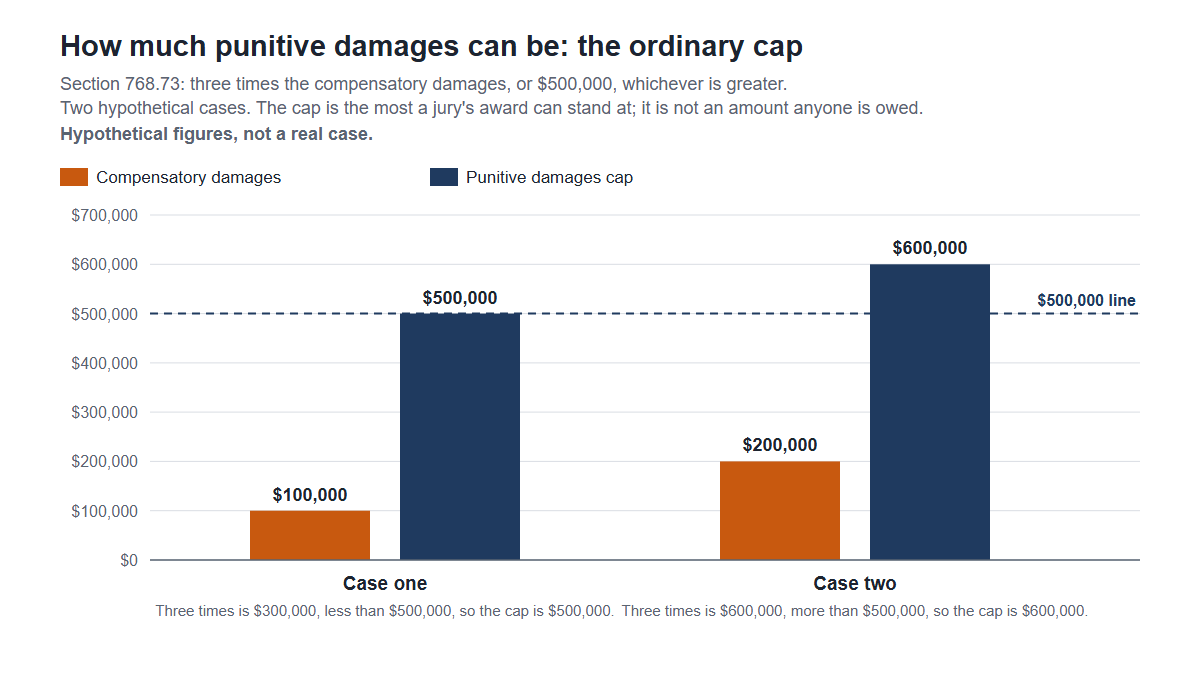
Section 768.73 sets three tiers. In the ordinary case, punitive damages may not exceed three times the compensatory damages awarded to each claimant, or $500,000, whichever is greater.
The second tier is higher: four times the compensatory damages awarded to each claimant, or $2 million, whichever is greater. It applies where the jury finds the conduct was motivated solely by unreasonable financial gain. A managing agent, director, officer or other person who makes policy for the defendant must also have actually known that the conduct was unreasonably dangerous and highly likely to cause injury.
There is no cap under section 768.73 where the defendant, at the time of the injury, had a specific intent to harm the claimant and did harm the claimant.
Two hypothetical cases show how the first tier works; the figures are not from a real case. In the first, a jury awards $100,000 in compensatory damages. Three times that is $300,000, which is less than $500,000, so the $500,000 figure is the greater of the two and the cap is $500,000. In the second, the jury awards $200,000 in compensatory damages. Three times that is $600,000, which is more than $500,000, so three times is the greater of the two and the cap is $600,000.
The figures are different for a nursing home resident’s claim, which a separate statute governs.
When do the caps not apply?
The exception a Miami reader is most likely to meet is the drunk driver. Under section 768.736, the caps do not apply to a defendant who, at the time of the act or omission, either had his normal faculties impaired by alcohol or drugs or had a blood or breath alcohol level of 0.08 percent or higher.
The caps also do not apply where the defendant, at the time of the injury, had a specific intent to harm the claimant and did harm the claimant, under section 768.73(1)(c).
Removing the cap does not mean an insurance company will pay. Florida public policy does not allow liability insurance to pay punitive damages assessed against a person for his own wrongful conduct, so a punitive award against a drunk driver is, as a rule, his to pay personally. Where someone else, such as an employer or the owner of the car, is liable only because the driver was acting for him and is not personally at fault, that public policy does not bar insurance from covering the vicarious share. Whether a particular policy does is a separate question.
A resident’s claim against a nursing home runs under the nursing home statute’s own punitive damages sections, sections 400.0237 and 400.0238, with their own standard and their own, higher limits. Abuse of an elderly person under chapter 415, of a developmentally disabled person, or of a child has a separate rule under section 768.735: an award above three times the compensatory damages is presumed excessive, and the claimant must show the court by clear and convincing evidence that the higher award is not. Other exceptions exist in particular kinds of cases.
Does your own fault reduce compensatory and punitive damages?
Florida’s comparative negligence rule, in section 768.81(2), applies in a negligence case, the kind that section covers, and reduces the economic and non-economic damages for an injury in proportion to the share of the fault that was yours. Under that rule, if you are found more than 50 percent at fault, you recover nothing; a medical negligence claim is outside that bar. The proportional reduction is written for compensatory damages: it names economic and non-economic damages and says nothing about a punitive award.
Are compensatory and punitive damages taxed?
Under section 104(a)(2) of the Internal Revenue Code, damages received on account of personal physical injuries or physical sickness are excluded from gross income, whether they come by settlement or by verdict, apart from medical expenses you deducted in an earlier year. The same subsection excepts punitive damages, so a punitive award is taxable. How a particular settlement is written up can matter, so before you treat any part of a recovery as tax-free, have a tax professional look at the settlement papers.
What should you take from all of this?
For most injured people, the compensatory claim is the case. It is what gets documented and valued: the treatment and what it cost, the lost income, and the way the injury changed daily life. In a car accident case, as in most injury cases, punitive damages are the exception. When they are available, they change what the defendant faces, not what you lost, and they do not replace the work of proving the compensatory claim. I raise punitive damages only when the conduct and the evidence call for them.
Frequently asked questions
Are punitive damages common in Florida injury cases?
No. Most injury cases are about negligence, and punitive damages require far more. At trial, the injured person must prove by clear and convincing evidence that the defendant was personally guilty of intentional misconduct or gross negligence. The courts compare gross negligence to the conduct involved in criminal manslaughter. The claim cannot even be added to a lawsuit until the court permits it on a showing of evidence.
Can I get punitive damages against a drunk driver?
Yes, if the evidence shows the driver was actually impaired: Florida courts have long treated driving while intoxicated as conduct that lets a jury consider punitive damages without more. The caps do not apply to an impaired defendant. Under section 768.736, that is one whose normal faculties were impaired by alcohol or drugs, or whose blood or breath alcohol level was 0.08 percent or higher, at the time of the act or omission. Drinking or drug use without evidence of impairment at the time of the crash has not been enough.
Does the drunk driver’s insurance pay punitive damages?
Not for the driver’s own conduct. Florida public policy does not allow liability insurance to pay punitive damages assessed against a person for his own wrongful conduct, so an award against a drunk driver is, as a rule, his to pay personally. Where an employer or the car’s owner is liable only vicariously and is not personally at fault, public policy does not bar coverage of that share. Whether a particular policy covers it is a separate question.
Are my damages taxed?
Compensatory damages for a physical injury generally are not, and punitive damages are. Under section 104(a)(2) of the Internal Revenue Code, damages received on account of personal physical injuries or physical sickness are excluded from gross income, but the same subsection excepts punitive damages. How a particular settlement is written up can matter, so before you treat any part of a recovery as tax-free, have a tax professional look at the settlement papers.
Is there a cap on pain and suffering in Florida?
Not in an ordinary injury case: Florida’s statutes set no general cap on non-economic damages such as pain and suffering. In Estate of McCall v. United States (2014) the Florida Supreme Court struck down the cap in section 766.118 on non-economic damages in medical negligence wrongful death cases, and in North Broward Hospital District v. Kalitan (2017) it struck down the personal injury caps in subsections (2) and (3). Those provisions still appear in the statute’s text.
What if I was partly at fault?
In a negligence case, the kind section 768.81 covers, your compensatory damages are reduced by your share of the fault for the injury: the reduction applies to the economic and non-economic damages for the injury your own fault contributed to. In such a case, if you are found more than 50 percent at fault, you recover nothing; a medical negligence claim is outside that bar. The proportional reduction names economic and non-economic damages and says nothing about a punitive award.
If you were hurt by someone driving drunk, racing or acting with no regard for anyone’s safety, I will look at whether the evidence supports punitive damages and tell you plainly whether it does. You can reach me through my attorney page or the form on this page.
Reviewed by Prosper Shaked, Florida personal injury attorney, who represents injured people in car, truck and motorcycle accident, premises liability, medical malpractice and wrongful death cases from his office in North Miami Beach.
Law cited: section 768.72, section 768.725, section 768.73, section 768.735, section 768.736, section 768.81, section 768.21, section 766.118, section 766.202, section 400.0237 and section 400.0238, Florida Statutes (2026); 26 U.S.C. § 104(a)(2); Perlmutter v. Federal Insurance Co., 434 So. 3d 681 (Fla. 2026); Federal Insurance Co. v. Perlmutter, Nos. 4D2022-1558, 4D2022-1560 and 4D2022-1562 (Fla. 4th DCA Oct. 7, 2026); Estate of McCall v. United States, 134 So. 3d 894 (Fla. 2014); North Broward Hospital District v. Kalitan, 219 So. 3d 49 (Fla. 2017); U.S. Concrete Pipe Co. v. Bould, 437 So. 2d 1061 (Fla. 1983); Ingram v. Pettit, 340 So. 2d 922 (Fla. 1976); Glade v. Govey (Fla. 4th DCA July 8, 2026); Robertson v. Antoine (Fla. 4th DCA 2025). Checked against the 2026 Florida Statutes on November 3, 2026.