

By Prosper Shaked, Florida personal injury attorney. Published: October 28, 2026.
A car’s event data recorder, often called its black box, saves a few seconds of speed, accelerator and braking data when a crash sets it off, and that record can prove or disprove what each driver says happened. An airbag deployment locks the record, but a smaller crash can be overwritten by a later one. A repair, a total loss or a trip to the scrapyard can destroy it, so the data has to be pulled early. Under federal law the data belongs to the car’s owner, and with narrow exceptions anyone else needs the owner’s consent or a court’s permission to read it. I do not download every car, but when the drivers’ accounts conflict and the injury is real, my firm advances the cost of a professional download, from both cars where I can get access, before I take a position on fault.
Key terms
The six terms this article uses
Event data recorder. A function, usually built into the car’s airbag control module, that saves a short record of driving data when a crash or a hard jolt sets it off. Under the federal definition it does not record sound or video.
Deployment event. A crash that fires a front airbag, or a side airbag in cars that record sideways impacts. Federal rules require the recorder to lock that record so later events cannot overwrite it.
Non-deployment event. A crash or jolt that sets off the recorder without firing an airbag. Its record can be overwritten by a later event.
Delta-V. The change in the car’s speed during the impact itself, measured over roughly the first quarter of a second. It is a standard measure of how hard a crash was.
Retrieval tool. The equipment and software used to read the recorder. Every manufacturer whose cars have one must make sure a retrieval tool is commercially available.
Spoliation. The loss or destruction of evidence that should have been kept.
What is a car’s event data recorder, and does my car have one?

An event data recorder is not a separate box with a tape inside. In most cars it is a function of the airbag control module, the computer that decides when to fire the airbags. While the car is on, the module watches the car’s speed, pedals and sensors, and when a crash or a sharp jolt crosses its threshold, it saves the few seconds around that moment.
Almost every new car has one. The National Highway Traffic Safety Administration estimates that about 99.5 percent of model year 2021 cars and light trucks were equipped with one. Federal law does not require a car to have a recorder. But 49 C.F.R. Part 563, the federal regulation on event data recorders, sets what the recorder must capture in any car, SUV, pickup or van up to 8,500 pounds built on or after September 1, 2012 that has one. Those cars must also say so in the owner’s manual, so the manual is the quickest place to check.
What does it record, and for how long?
The recorder does not run a continuous log of your driving. It keeps a rolling buffer that constantly overwrites itself, and it saves that buffer only when something sets it off: a change in speed of about 5 mph within 0.15 seconds, or an airbag firing.
Under Part 563, every recorder in a car the rule covers must save at least:
- the car’s speed, how far the accelerator was pressed and whether the brake pedal was pressed, for the 5 seconds before the crash, at 2 readings a second;
- the change in speed during the impact (delta-V), measured every hundredth of a second;
- whether the driver’s seat belt was buckled;
- when each front airbag fired;
- whether the crash involved more than one impact, and the time between them;
- a running count of ignition cycles, roughly how many times the car had been started, at the time of the crash.
Five seconds is not much. In 2024 the agency lengthened the required window to 20 seconds before the crash at 10 readings a second. In 2026 it phased that change in: a quarter of each maker’s cars must meet it from September 1, 2028, and all of them from September 1, 2031. Most cars on the road today will keep recording the shorter window for years.
The recorder does not record sound, video or where the car was.
What locks the record, and what can erase it?
Under the federal rule, when a front airbag fires, or a side airbag in a car that records sideways impacts, the recorder must lock that event so nothing can overwrite it. A crash that does not set off the airbags is treated differently: the recorder keeps it, but once its memory is full, a later event can replace it. A later impact hard enough to set off the recorder can wipe out the record you needed.
In practice, the bigger danger is to the car itself. The data lives in the module, so it is only as safe as the car:
- Repair. After an airbag deployment, a body shop may replace the airbag control module, and if the old one is thrown away, the data goes with it.
- Total loss. The insurer usually takes the car, and it goes to a salvage yard or an auction.
- Sale or scrap. Once the car is sold, crushed or shipped out of the country, the data is gone or out of reach.
That is why the first thing to protect after a serious crash is not the data, it is the car.
Who owns the data, and who can read it?
Under the Driver Privacy Act of 2015, the data in a car’s event data recorder belongs to the car’s owner, or to the person leasing it if the car is leased. No one else may read it unless:
- a court or other judicial or administrative authority authorizes it;
- the owner or lessee consents in writing, electronically or in a recorded statement, including consent given for a repair or under a subscription agreement;
- it is part of a federal crash investigation by the National Transportation Safety Board or the National Highway Traffic Safety Administration, with the owner’s identity kept out;
- it is needed for an emergency medical response to the crash; or
- it is used for traffic safety research, with the owner’s identity kept out.
That list applies to the police and to the other driver’s insurance company the same as anyone else: without the owner’s consent, they need authorization from a court or other judicial or administrative authority. Florida has no statute of its own on event data recorders; the federal act governs.
How is the data downloaded, and what does it cost?
A trained technician reads the recorder with a commercial retrieval tool, usually by plugging into the diagnostic port under the dashboard. When the car is too damaged to power up, the technician can often take the module out and read it directly. The download produces a report of the recorded values, which an accident reconstruction expert can then read against the damage, the scene and the drivers’ accounts.
I do not order a download in every case. When nobody disputes how the crash happened, or an independent witness or a video already shows it, the data usually adds nothing the case needs. I get it when the drivers’ accounts conflict and the evidence does not settle it: a he-said, she-said in a serious crash, where my client is certain the other driver’s story is wrong. An independent witness usually settles it, but if fault is still seriously disputed even then, I sometimes get the data anyway. When I believe my client’s account and the injury claim is real, the cost of the download is worth paying to prove it.
Published prices from Florida data-recovery firms start at about $400 to $500 to download a passenger car. Heavy trucks and infotainment and telematics systems run about $1,200 to $1,500, some makes that need special tools cost around $1,500, and rush work and travel cost more. In the cases where it matters, my firm advances that cost and gets the download done before the car is repaired, sold or scrapped.
What other data can be pulled from a car after a crash?
The airbag module is not the only part of a car that keeps a record:
- Driver-assistance systems. On some makes, the systems behind automatic emergency braking and lane keeping keep their own history of hard-braking, steering and collision-warning events, and some save still frames from the forward collision-avoidance camera. That data is often pulled with the manufacturer’s own software, separately from the crash data, and it can show what the recorder cannot: the road ahead.
- Infotainment and telematics. Depending on the system, the touchscreen and the car’s connected services can hold the time and place of events, which phones were connected and when, navigation history, and hard braking or acceleration even when no crash was recorded. It is usually a separate download, and it costs more.
In a truck accident, the data that matters often sits in the engine’s control module instead, a different device that records different things and can be lost if the truck is moved or restarted.
Do insurance companies check the event data recorder?
Not automatically, and not without permission. Because the data belongs to the car’s owner, the other driver’s insurance company cannot download your car without your consent or legal authorization such as a court order, and your insurer cannot download theirs either.
Your own insurer can ask for the data too: most auto policies require you to cooperate with the company’s investigation of a claim, and the company may ask for your consent to a download.
When your insurer declares your car a total loss and pays you for it, the title usually passes to the insurer, and with the car goes the data. That is why I ask about the car’s recorder before a total loss is settled, not after.
How can the data prove who was at fault, and what can it not show?
In a disputed car accident claim, the recorder is often the only witness with no stake in the outcome. The police crash report mostly records what the officer was told and saw after the fact. The recorder records what the car was doing in the seconds before it happened: how fast it was going, whether the driver was on the accelerator or the brake, and whether it was moving at all.
A client of mine was hit while making a protected left turn at a Miami intersection. The officer issued no citation, and the report listed conflicting statements from both drivers with no independent witness, which left the other driver’s insurer free to deny liability and blame my client for running a red light. We had her car’s event data recorder professionally downloaded. The data showed she had come to a full stop before the turn, then accelerated steadily from one to seventeen miles per hour over four seconds, braking only in the final half-second before impact.
That pattern fits a driver proceeding on a green arrow, not one trying to beat a red light. An analysis of the footage from her car’s own camera showed the arrow was green, though glare made it look white to the eye. The carrier reversed its denial.
The data does not take sides. In one case, two cars collided at an intersection controlled by stop signs, and each driver said the other one never stopped. The other car’s recorder showed its speed never reached zero: the driver eased off the brake while still rolling and then accelerated into the intersection. My own client’s car told a harder story. It showed a steady speed with no braking until less than a second before impact, so she had not stopped either. Her car’s collision-avoidance camera had also saved black-and-white still frames, and they showed something no report mentioned: another car waiting at the opposite stop sign, a witness nobody had named. I sat down with her and went through her own car’s data, and I told her the data would not support her account. That is why I download my own client’s car, not only the other driver’s, before I take a position on fault with anyone.
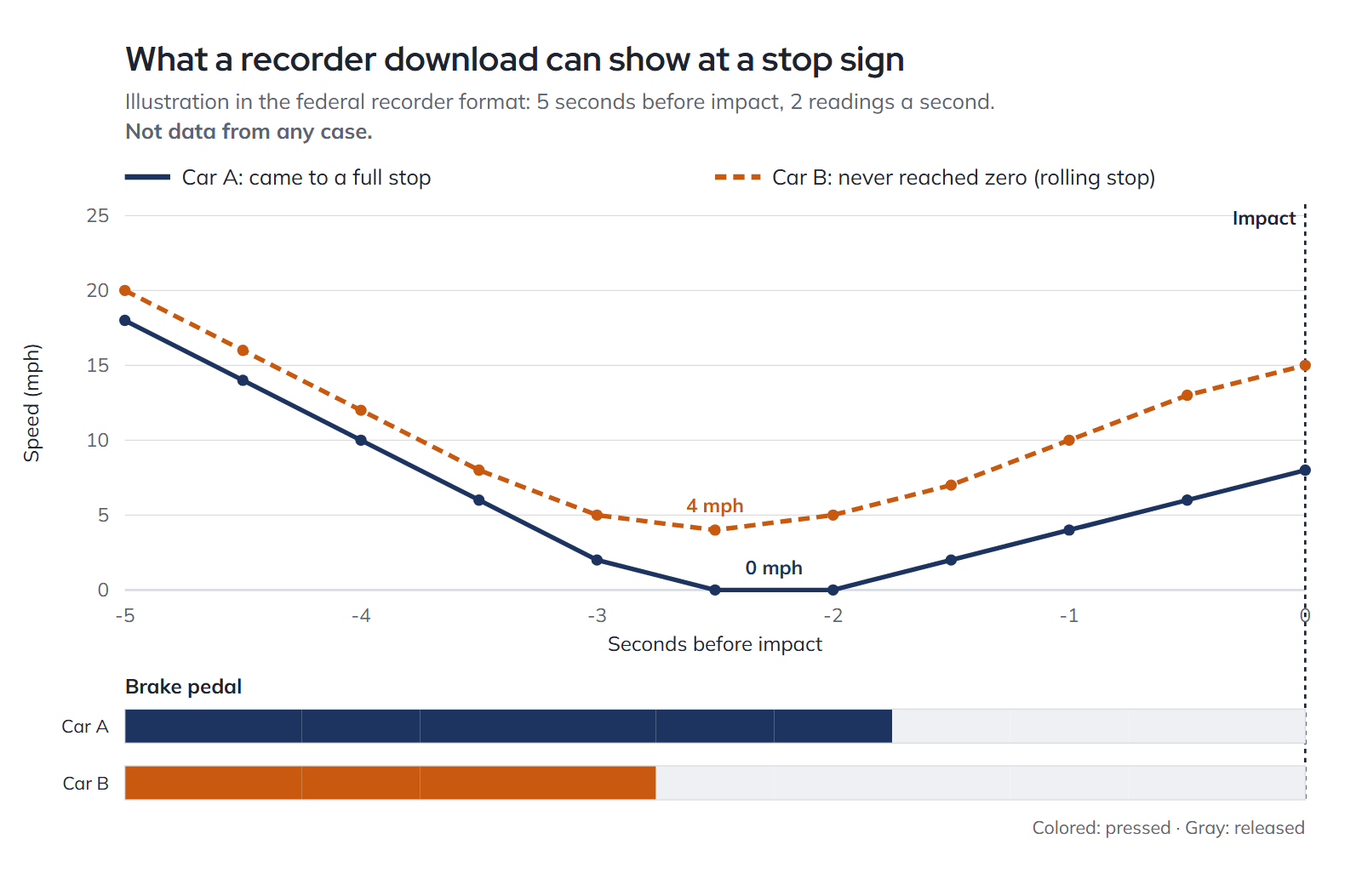
What the recorder cannot show is just as important. It does not see the color of the light, the stop sign, the other car or what either driver could see. It records only its own car, so it cannot directly tell you what the other car was doing. That is why I pair it with camera footage, the scene and every account of the crash.
What should you do after a crash to keep the data?
- Do not authorize repairs, salvage or disposal of your car until your attorney confirms the data has been preserved or is not needed.
- Tell your attorney where each car is: at home, at a tow yard, at a body shop or at the insurer’s salvage yard.
- Put the preservation request in writing. I put every preservation request in writing and send it right away, because a written request is the clearest way to put the other side on notice to keep the evidence. The letter goes to the other driver, the owner of the other car and their insurer.
- If your car is a total loss, deal with the data before the title passes to the insurer.
- Ask for camera footage quickly. Nearby businesses record over their footage on a cycle, and some systems keep it only for days.
- Keep a copy of the download report and the technician’s photos of the car.
What if the other driver’s data was not preserved?
Losing evidence that should have been kept is called spoliation, and in Florida it is handled inside your injury case, not as a separate lawsuit. In Martino v. Wal-Mart Stores (2005), the Florida Supreme Court held that you cannot bring a separate lawsuit for spoliation against the party you are already suing. Instead, the court can tell the jury it may infer that the missing evidence would have hurt the side that lost it. Where that side had a duty to keep the evidence and the loss keeps you from proving your case, the court can shift the burden of proof on that point to that side. The court can also impose sanctions. Whether you can sue someone outside the case, such as a salvage yard that destroyed the car, is a separate question the Florida Supreme Court left open.
Those remedies are a fallback, not a substitute for the data. A jury instruction about missing evidence is weaker than the evidence itself, which is why the written preservation request and a quick download matter more than anything a court can do later.
Frequently asked questions
Does every car have a black box?
Nearly every newer one does. The federal agency estimates about 99.5 percent of model year 2021 cars and light trucks have an event data recorder. Federal law does not require one, but if your car was built after September 2012 and has one, the owner’s manual must say so.
How long does the data stay in the car?
There is no set expiration date. A record from a crash that fired an airbag is locked and stays in the module until the module is destroyed. A record from a smaller crash can be overwritten by a later event. Either way, the car, or at least the module, has to be kept.
Can the police download my car’s data?
Only with the owner’s consent or legal authorization such as a court order, unless it is part of a federal crash investigation. The same rule applies to insurance companies and the other driver.
Can the data be used against me?
Yes. The recorder shows what your car was doing, whether it helps you or not. That is why I review my own client’s data before taking a position on fault.
Can I download my own car’s data?
The data is yours, but reading it takes the retrieval tool and a trained technician, and a download done carelessly can be challenged later. In a case where the data matters, it should be done by a professional and documented.
Does the black box record video or my location?
The event data recorder does not. Some cars’ collision-avoidance cameras save still frames, and infotainment and telematics systems can hold location and phone-connection history; those are separate downloads.
If your crash comes down to your word against the other driver’s, I will look at whether the cars’ data can settle it, and I will tell you what it shows. You can reach me through my attorney page or the form on this page.
Reviewed by Prosper Shaked, Florida personal injury attorney, who represents injured people in car, truck and motorcycle accident, premises liability, medical malpractice and wrongful death cases.
Law cited: 49 C.F.R. Part 563, Event Data Recorders; Driver Privacy Act of 2015, Pub. L. 114-94, div. B, title XXIV, §§ 24301-24302; Martino v. Wal-Mart Stores, Inc., 908 So. 2d 342 (Fla. 2005). Recording-period rules and the 99.5 percent estimate: NHTSA final rules, 89 Fed. Reg. 102810 (Dec. 18, 2024) and 91 Fed. Reg. 28432 (May 18, 2026). Download prices: published rate sheets of three Florida data-recovery firms. Checked October 28, 2026.