

By Prosper Shaked, Florida personal injury attorney. Published: November 12, 2026.
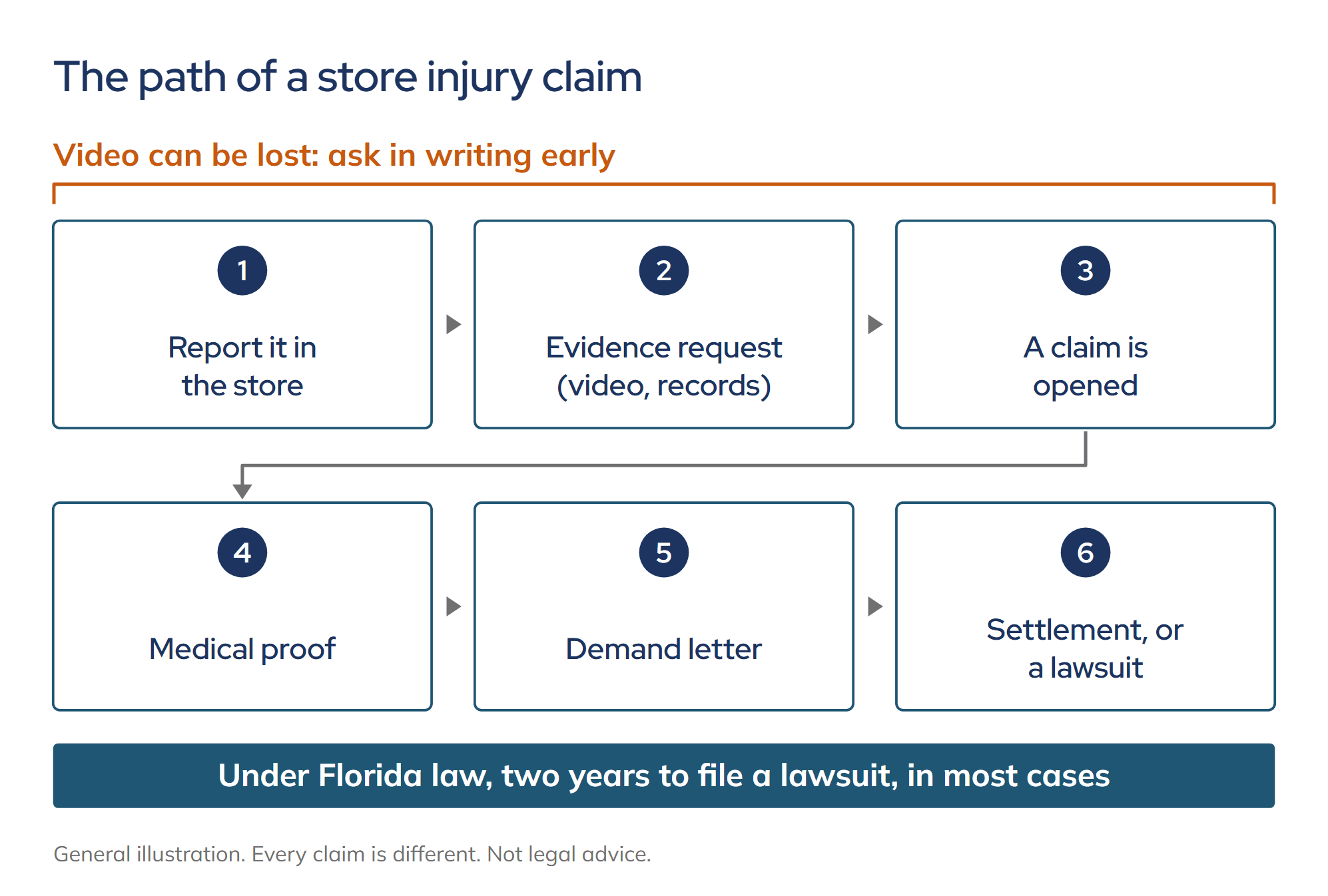
Target’s help and contact pages do not list an injury claim form or a claims address. The first steps are a report to the store manager, your own private notes and a written request to keep the video, which is better sent by a lawyer. None of them means Target has opened a claim. The adjuster who calls may work for Target or for a company that handles claims for Target. Under Florida law, for a slip and fall on a spill, you must prove the store knew or should have known of it and should have acted to fix it. Under Florida law, you have two years from the date of the injury, in most cases, to file a negligence lawsuit. When I take a store injury case, I write to every company tied to the store in the first days, asking it to keep the video and the records, and from then on the calls from the store’s side come to me.
Key terms
The six terms this article uses
Incident report. The store’s own written record of what happened, made by its employees. Florida courts have treated a store’s incident report as material prepared for a possible claim, so the store generally does not have to hand it over.
Adjuster. The person who investigates and handles a claim for the store’s side. An adjuster may work for the company itself or for a company it uses to handle claims, and does not work for you.
Premises liability. The law of injuries caused by an unsafe condition on property that someone else owns or controls, such as a wet floor, a falling box or a broken parking lot surface.
Constructive knowledge. What a business should have known about a hazard, because it was there long enough that a careful business would have found it, or because it happened regularly and was foreseeable.
Preservation request. A written request asking a business to keep its video and records about an injury before they are erased or thrown away in the ordinary course of business.
Statute of limitations. The deadline to file a lawsuit. Under Florida law, you have two years from the date of the injury, in most cases, to file a negligence lawsuit.
What should you do if you are hurt at a Target?

If someone is badly hurt, or you were attacked in the store or the parking lot, call 911 first. Medical care comes before anything else on this list.
- Get medical care, and say where it happened. Go to urgent care or an emergency room the same day if you can, and tell the doctor you were hurt in a store and how. Keep every record and bill.
- Tell a manager before you leave the store. Ask the manager on duty to make a written record of what happened, and ask for a copy or a report number, if there is one. The store may refuse to give you a copy; write down the manager’s name either way. If you write or sign a statement, ask for a copy of it before you leave.
- Photograph the spot, the floor and what hurt you. Take pictures of the spill, the shelf, the cart or the parking lot surface, close up and from across the aisle, and of any warning sign or the lack of one. Photograph your injuries too.
- Write your own account the same day. Write down the time, the aisle, what you saw on the floor or the shelf, what you felt, and what each employee said to you. Date it and keep it private, with your photographs.
- Get names of witnesses and employees you spoke to. Ask anyone who saw you fall, or saw the floor before you fell, for a name and a phone number. Write down the name of every employee who came over or talked to you.
- Keep your receipt, your shoes and your clothing. A receipt shows when you were in the store, so keep any you have, and put the shoes and clothes you wore in a bag without washing them. I always ask a client whether their clothes got wet in the fall, because wet clothing is evidence of what was on the floor.
- Ask in writing for the video to be kept. This request is better sent by a lawyer. If you do not plan to hire one, or want time to decide, send it yourself to lower the risk that the video is lost meanwhile. Write to the store manager with only your name, the date, the time and the place. Ask the store to keep the recording itself, not a still image, of that place and the entrance, from before you were hurt until you left. Send it by a service that confirms the day it arrived, and keep a copy.
- Do not give a recorded statement before you get advice. If an adjuster calls, write down the caller’s name, company and claim number, and say you will call back. Do not sign a release or a medical authorization until you understand what it covers.
How do you report the injury, and who handles the claim?
You report the injury to the manager on duty before you leave the store, and you ask for a written record and a report number, if there is one. Target’s help and contact pages do not list an injury claim form or a claims address. Their contact topics cover Target.com orders, the store experience, product safety and other subjects, and none of them is injuries or claims.
Target’s annual report says it retains a substantial portion of the risk for certain general liability claims, and that it carries stop-loss coverage to limit its exposure to certain risks. The report does not say who handles the claims. The adjuster who calls may work for Target or for a company that handles claims for Target. Ask the caller who they work for, and get the name, the company and the claim number in writing, in an email or a letter. Get advice before you talk about the injury.
If you left the store without reporting the injury, call the store, or call 1-800-440-0680. That number is Target’s guest-service line, not a claims office. After the call, write down for your own records who you spoke to and when.
An incident report is not a claim and not a lawsuit. Reporting the injury or talking to an adjuster does not, by itself, stop the clock on the deadline to file. Target’s help and contact pages do not describe how a report becomes a claim. Do not wait for the store’s side to call before the request to keep the video goes out.
What evidence does the store have, and how long does it last?
The store may hold video, its own incident report, its inspection and cleaning records and the names of the employees on duty. Target’s privacy policy says it uses cameras in and around its stores and gives no retention period for store video, so there is no number of days you can count on.
Two Florida appeals courts have held that a store that knows of an injury must keep video that may show it if a written request to keep that video arrives before the recording is erased. One of them said it would not be fair to require a business to keep video that no one had asked it in writing to keep.
Keeping the video and getting a copy are two different things. A preservation request asks the store to keep the recording; a copy is a separate request, and the store may decline it. A request that gets no answer does not mean the video was kept, so follow up in writing.
Florida courts have held that a store’s incident report, and what its employees gather to defend against a possible claim, are generally protected from being handed over. So do not count on getting the store’s own report. A statement you give is different. If the store takes a written statement from you about the injury, Florida law says it must give you a true and complete copy at the time. Anyone who has that statement later, such as an adjuster, must give you a copy if you ask (section 92.33).
What the store’s records cannot show matters just as much. A camera may not cover the aisle, or may catch the fall but miss the minutes before it, when the hazard was already on the floor. An incident report holds only what an employee wrote down. That is why my letter asks for the logs, the employees on duty and earlier complaints along with the video: when the video is gone or shows nothing, those can still show what the store knew.
What do you have to prove?
Under Florida law, if you slip and fall on a spill or other transitory foreign substance in a business, you must prove the business knew or should have known of it and should have acted to fix it (section 768.0755). You can show it should have known by proof that the substance was there long enough that a careful business would have found it, or that it happened regularly and was foreseeable.
Florida courts have held that a store owes its customers two duties: to keep the premises reasonably safe, and to warn of hidden dangers it knows or should know about. The spill statute leaves those duties in place. Florida courts have also held that a hazard you could plainly see may end the store’s duty to warn you about it, but not its duty to keep the store reasonably safe. So seeing a hazard does not by itself end the claim, though it can raise the question of your own share of the fault. You must also prove the hazard caused your injury and your losses.
Proving what the store knew is at the center of slip and fall claims on a spill, from the inspection logs to how long the spill had been on the floor.
What else besides a spill can cause an injury at a Target?
Falling merchandise, carts and stocking equipment, displays, doors, escalators and the parking lot can all cause an injury. Florida’s special statute for spills is written for a slip and fall on a substance. Injuries from other unsafe conditions come under the store’s ordinary duties: to keep the premises reasonably safe and to warn of hidden dangers it knows or should know about.
- Falling or poorly stacked merchandise. In falling-merchandise cases, Florida appeals courts have asked whether the store knew or should have known the display was unsafe, or created the danger by how it stacked or displayed the item. A falling item does not by itself prove the claim.
- Carts and stocking equipment. A cart or other stocking equipment that an employee left in an aisle can be a dangerous condition the store created. For an injury from equipment, a lawyer’s evidence request also asks for the name of the person operating it and the list of employees on duty.
- Displays, doors and escalators. These come under the same ordinary duties. If you were hurt on an escalator or elevator, a lawyer’s evidence request also asks who maintained it.
- The parking lot. A Florida appeals court has held that a hazard in a store’s parking lot, such as a raised cover in the pavement, can support a claim. In a shopping center, the owner or manager of the property may control the lot instead of the store. Who owns, controls and maintains the lot, and what the lease says, bear on who is responsible.
- A robbery or assault in the lot. That is a negligent security question, separate from a claim about the condition of the floor or the pavement.
What can the claim include?
A claim can cover the medical bills you have and the care you will need, the pay you lost, and harms that carry no price tag, such as pain and the activities the injury took from you. Lawyers call these compensatory damages, because they make up for the loss. No chart or formula sets what a claim is worth; the injury, the treatment and the proof decide it.
How long do you have to file?
Under Florida law, you have two years from the date of the injury, in most cases, to file a negligence lawsuit (section 95.11(5)(a)). The clock runs from when the claim accrues under section 95.031, which in most cases is the date of the injury, not your first doctor’s visit or the adjuster’s first call. Reporting the injury or talking to an adjuster does not, by itself, stop the clock. If the injury causes a death, the estate’s personal representative brings a wrongful death case, with its own two-year deadline, generally counted from the date of death (section 95.11(5)(e)). A child does not automatically get more time, so do not wait because the injured person is a minor. If your injury happened more than two years ago, have the date checked before you decide you are out of time.
What if you were partly at fault?
Under Florida law, in a negligence case, if you are found more than 50 percent at fault for your own injury, there is no recovery; at 50 percent or less, the recovery is reduced by your share (section 768.81(2) and (6)). Lawyers call this rule modified comparative negligence. If the store’s side says the fall was your fault, that is its position, not a finding of fault.
What can a lawyer do that you cannot do alone?
You can report the injury, keep your records and, if you have no lawyer yet, ask the store in writing to keep the video, giving only your name, the date, the time and the place. What is harder alone is what comes next. That means finding out who handles the claim and who controls the lot, getting the request to every company tied to the store, following up on each request, and putting the medical proof together.
When I take a store injury case, the first thing I do is find every company tied to the store: the retailer and, in a shopping center, the owner and the manager of the property. Each one gets a letter from me in the first days, sent by Federal Express with a signature on delivery, so there is proof of the day it arrived. The letter asks them to keep the video for a time window matched to the injury, the incident report, the inspection and cleaning logs, the names of the employees on duty and any earlier complaints about the same spot. I do not wait for a copy of the store’s incident report, because most businesses do not give one to the injured customer, and once my letter arrives the store is on notice of the claim. From that point the calls from the store’s side come to me, so my client is not answering an adjuster’s questions alone.
Frequently asked questions
Does Target have to give me a copy of the incident report?
Do not expect Target to give you a copy of its incident report. Florida courts have held that a store’s incident report, prepared for a possible claim, is generally protected from being handed over. Target’s help and contact pages say nothing about giving a guest a copy. Ask anyway for a copy or a report number, if there is one, and write your own account the same day. If the store took a written statement from you, Florida law says it must give you a true and complete copy of that statement when you make it, and a copy later if you ask.
Who will call me about my claim, Target or an insurance company?
Target’s help and contact pages and its annual report do not say who handles guest injury claims. The annual report says Target retains a substantial portion of the risk for certain general liability claims and carries stop-loss coverage to limit its exposure to certain risks. The adjuster who calls may work for Target or for a company that handles claims for Target. Ask the caller who they work for, and get the name, the company and the claim number in writing.
Will Target pay my medical bills right away?
Do not count on Target paying your medical bills as they come in. Its annual report, Terms and Conditions and help pages do not describe paying a guest’s medical bills that way. Get the care you need now, using your own health insurance if you have it, and keep every bill, record and receipt, because they become the proof of what the injury cost you.
What if I left the store without reporting the injury?
Report it now, by phone: call the store or Target’s guest-service line, and write down who you spoke to and when. Do not wait on the request to keep the video, because each day that passes is a day the recording may be erased. It is better sent by a lawyer. If you send it yourself, give only your name, the date, the time and the place.
What if I was hurt at a Target outside Florida?
The practical steps in this article still make sense, but the law that governs your claim may be that state’s, not Florida’s. The deadline, the fault rule and the proof rules described here are Florida’s, and another state’s can be different, so check them before you rely on them. My cases are in Florida. If you were hurt at a Target in another state, you can still call me, and I can usually refer you to a lawyer there.
Does Target have an injury policy or a claim form I can use?
Target’s help and contact pages do not list an injury claim form or a claims address, and nothing on those pages describes an injury policy for guests. Its Terms and Conditions say individual claims for personal bodily injury or death are not subject to arbitration. In place of a form, the first steps are a report to the store, your own private notes and a written request to keep the video, which is better sent by a lawyer.
If you were hurt at a Target, I start with the evidence the store holds, before it is gone, and I talk to you myself. You can reach me through my attorney page or the form on this page.
Reviewed by Prosper Shaked, Florida personal injury attorney, who represents injured people in car, truck and motorcycle accident, premises liability, medical malpractice and wrongful death cases.
Statutes cited: section 92.33, section 95.11, section 95.031, section 768.0755 and section 768.81, Florida Statutes (2026). Target sources: its Terms and Conditions (last updated September 10, 2026), its Privacy Policy, its corporate Contact and Help page, its Contact Us help page and its Form 10-K for the fiscal year ended January 31, 2026, read November 11, 2026. Checked against the 2026 Florida Statutes on November 12, 2026. Prosper Injury Attorneys is not affiliated with Target Corporation.