When medical malpractice occurs at a Florida hospital, one of the first questions that affects your legal options is whether that hospital has sovereign immunity. Government-owned hospitals in Florida operate under damage caps that limit recovery to $200,000 per person or $300,000 per incident—regardless of how severe your injuries may be.
Understanding which hospitals qualify for this protection is essential before pursuing a claim. The answer determines not only how much compensation you can recover but also what procedural requirements you must follow to bring a case at all.
What Is Sovereign Immunity and How Does It Apply to Florida Hospitals?
The Legal Basis for Sovereign Immunity in Florida
Sovereign immunity is a legal doctrine that historically prevented citizens from suing the government without its consent. The principle traces back to English common law and the idea that “the king can do no wrong.” In the United States, both federal and state governments have traditionally enjoyed this protection.
Florida, like most states, has modified this doctrine over time. The Florida Constitution and Legislature have created a framework that allows certain lawsuits against government entities while still limiting the government’s exposure to liability.
How Florida Waived Immunity for Medical Malpractice Claims
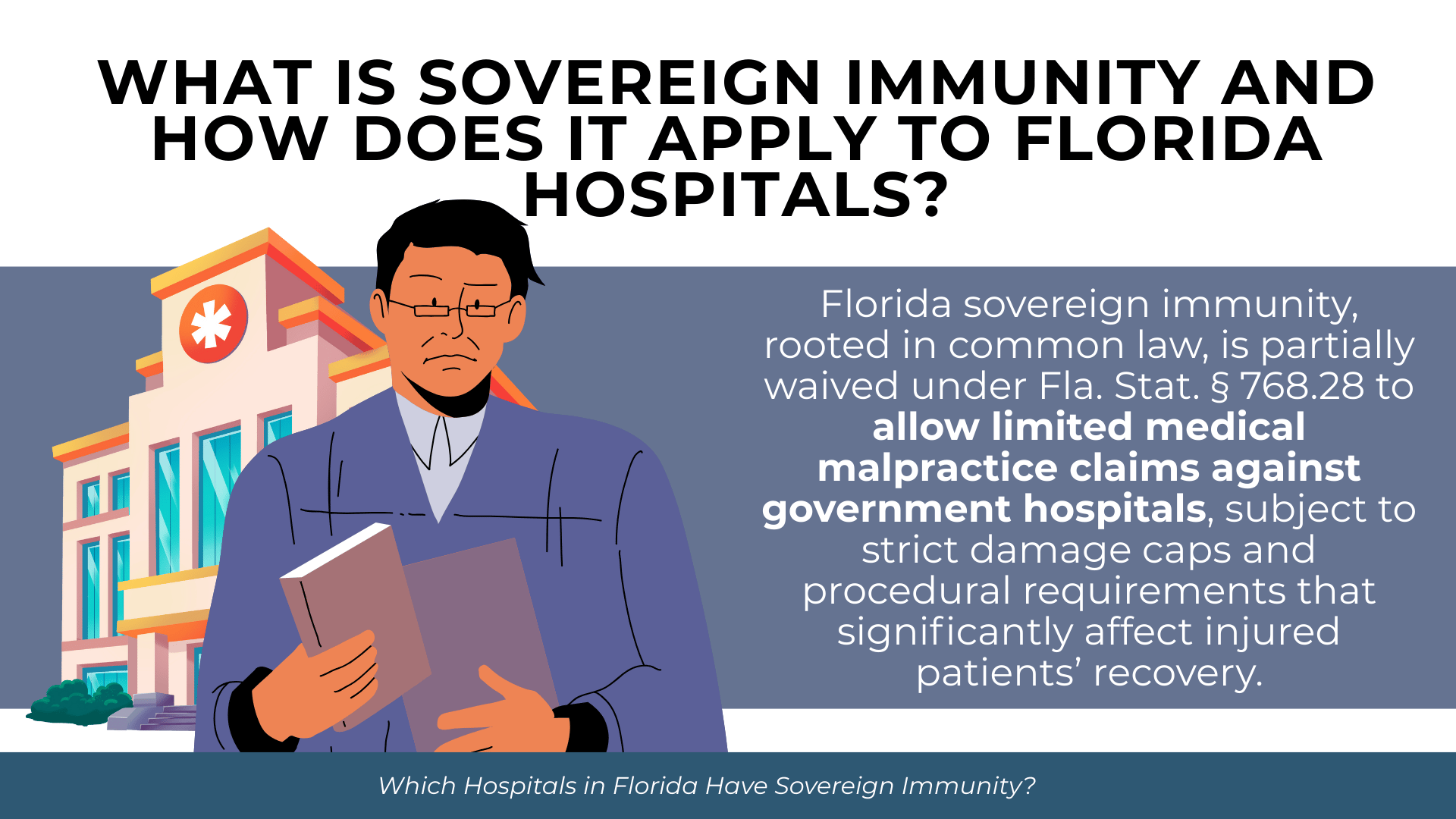
Florida has partially waived sovereign immunity through Fla. Stat. § 768.28. This statute permits tort claims, including medical malpractice claims, against state agencies, counties, municipalities, and other governmental entities. However, this waiver comes with significant limitations.
The waiver applies only to the extent specified in the statute. Government hospitals can be sued for the negligent acts of their employees acting within the scope of employment. But the statute caps the amount plaintiffs can recover and imposes strict procedural requirements before any lawsuit can be filed.
What Sovereign Immunity Means for Injured Patients
For patients injured at a government hospital, sovereign immunity creates a fundamentally different legal landscape than injuries at private facilities. The damage caps mean that even catastrophic injuries resulting in millions of dollars in medical bills and lost income are subject to strict recovery limits.
This does not mean claims against government hospitals are impossible or not worth pursuing. It does mean that patients and their attorneys must evaluate these cases with the caps in mind and follow precise procedural steps that do not apply to claims against private hospitals.
Which Florida Hospitals Have Sovereign Immunity Protection?

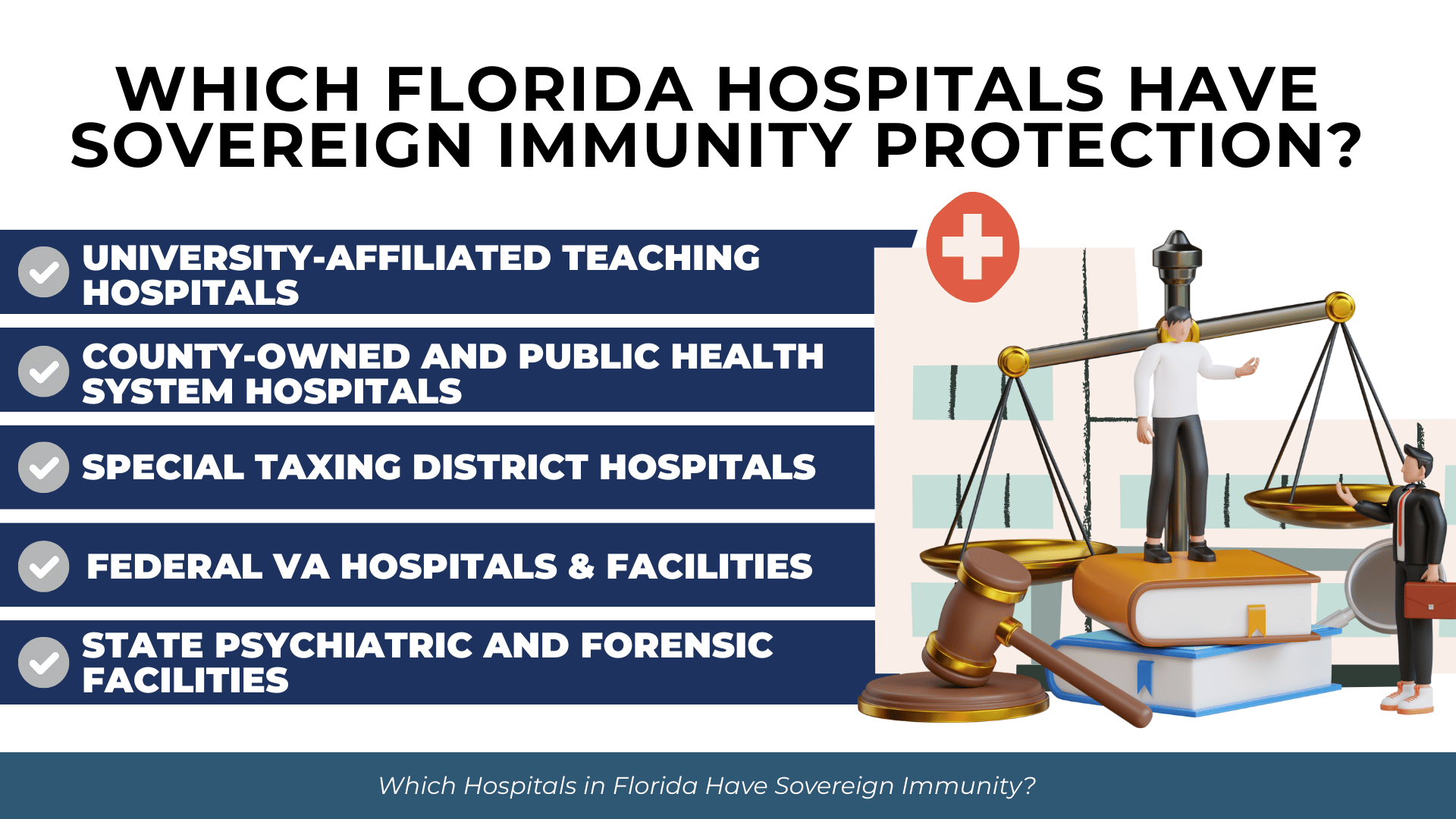
Determining whether a hospital qualifies for sovereign immunity requires identifying its ownership structure. Government hospitals in Florida generally fall into four categories: university-affiliated teaching hospitals, county-owned public health systems, special taxing district hospitals, and federal VA facilities.
University-Affiliated Teaching Hospitals
Florida’s public university health systems operate hospitals that qualify for state sovereign immunity protection. These include:
- UF Health Shands Hospital (Gainesville)
- UF Health Jacksonville (formerly Shands Jacksonville Medical Center)
- UF Health hospitals throughout the state affiliated with the University of Florida
- USF Health facilities affiliated with the University of South Florida
- University of Miami Hospital (operated in partnership with public entities)
These teaching hospitals are connected to state university systems and therefore fall under the umbrella of state sovereign immunity. The connection to public universities—rather than the quality of care or teaching mission—is what triggers the immunity protection.
County-Owned and Public Health System Hospitals
Many of Florida’s largest hospital systems are owned and operated by county governments or public health authorities. These include:
- Jackson Health System (Miami-Dade County), including Jackson Memorial Hospital
- Broward Health hospitals throughout Broward County
- Lee Health (Lee County), including Lee Memorial Hospital
- Memorial Healthcare System (Broward and Palm Beach Counties)
- Sarasota Memorial Hospital (Sarasota County)
- Halifax Health (Volusia County)
These facilities are operated by public hospital districts or county health departments. Their status as government entities—not their names or locations—determines their sovereign immunity protection.
Special Taxing District Hospitals
Some Florida hospitals operate as special taxing districts, which are independent governmental units created by the Florida Legislature. These districts have the authority to levy taxes to support hospital operations. Because they are governmental entities, they qualify for sovereign immunity protection.
Examples include hospitals operated by hospital districts in various Florida counties. Patients may not immediately recognize these facilities as government hospitals because they often operate under names that do not include “county” or “public” in their titles.
Federal VA Hospitals and Facilities
Veterans Affairs hospitals and clinics throughout Florida are protected by federal sovereign immunity under the Federal Tort Claims Act (FTCA), not Florida’s Fla. Stat. § 768.28. The distinction matters because federal claims follow different procedures and are subject to different caps.
Florida VA facilities include hospitals in Miami, Tampa, Gainesville, Orlando, and numerous outpatient clinics statewide. Claims against VA facilities must be filed with the federal government and follow FTCA requirements, including a mandatory administrative claim before any lawsuit can be filed in federal court.
State Psychiatric and Forensic Facilities
Florida also operates state psychiatric and forensic treatment facilities that qualify for sovereign immunity, including:
- South Florida State Hospital
- Treasure Coast Forensic Treatment Center
- Other facilities operated by the Florida Department of Children and Families
These facilities treat patients who may be particularly vulnerable, and injuries at these institutions are subject to the same damage caps as other government healthcare facilities.
How Do Damage Caps Affect Claims Against Florida Government Hospitals?
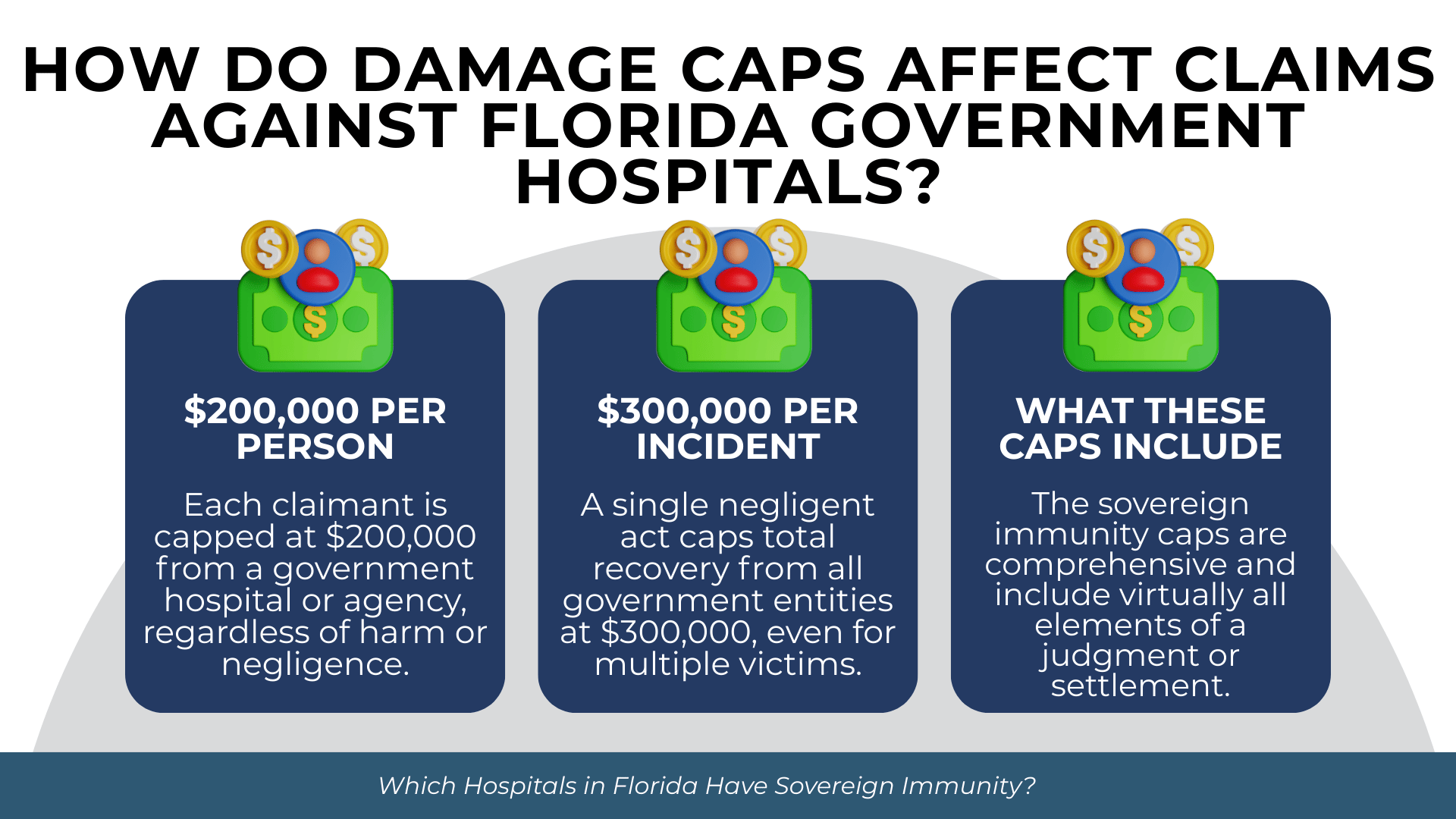
The most significant practical effect of sovereign immunity is the limitation on recoverable damages. Under Fla. Stat. § 768.28(5), plaintiffs are limited to recovering $200,000 from any one state agency or subdivision, with a total cap of $300,000 for all government entities involved in a single incident.
The $200,000 Per Person Cap
Each injured claimant can recover a maximum of $200,000 from a government hospital or agency. This cap applies regardless of the severity of injuries, the amount of medical bills incurred, or the degree of negligence involved.
For context, a patient who suffers permanent brain damage due to a government hospital’s negligence faces the same $200,000 cap as a patient with far less severe injuries. The cap does not adjust based on the actual harm suffered.
The $300,000 Per Incident Cap
When a single negligent act injures multiple people, the total recovery from all government entities involved cannot exceed $300,000. If a negligent act at a county hospital injures three family members, for example, the combined recovery for all three cannot exceed $300,000—even if each individual’s damages far exceed $100,000.
What These Caps Include
The sovereign immunity caps are comprehensive and include virtually all elements of a judgment or settlement:
- Compensatory damages for medical expenses
- Lost wages and lost earning capacity
- Pain and suffering
- Loss of consortium claims by family members
- Attorney’s fees and costs
This means that after paying attorney’s fees and litigation costs out of the capped amount, the injured patient’s actual recovery is reduced further. There is no separate allowance for fees on top of the caps.
How Caps Differ from Private Hospital Claims
Claims against private hospitals in Florida are not subject to these statutory caps. Following the Florida Supreme Court’s decisions in Estate of McCall v. United States, 134 So. 3d 894 (Fla. 2014), and North Broward Hospital District v. Kalitan, 219 So. 3d 49 (Fla. 2017), statutory caps on non-economic damages in medical malpractice cases were struck down as unconstitutional.
However, these decisions specifically addressed Fla. Stat. § 766.118, which applied to private healthcare providers. The sovereign immunity caps in Fla. Stat. § 768.28 remain fully enforceable because they represent the terms under which the state has consented to be sued—not an unconstitutional limitation on damages.
What Notice Requirements Apply to Government Hospital Claims?
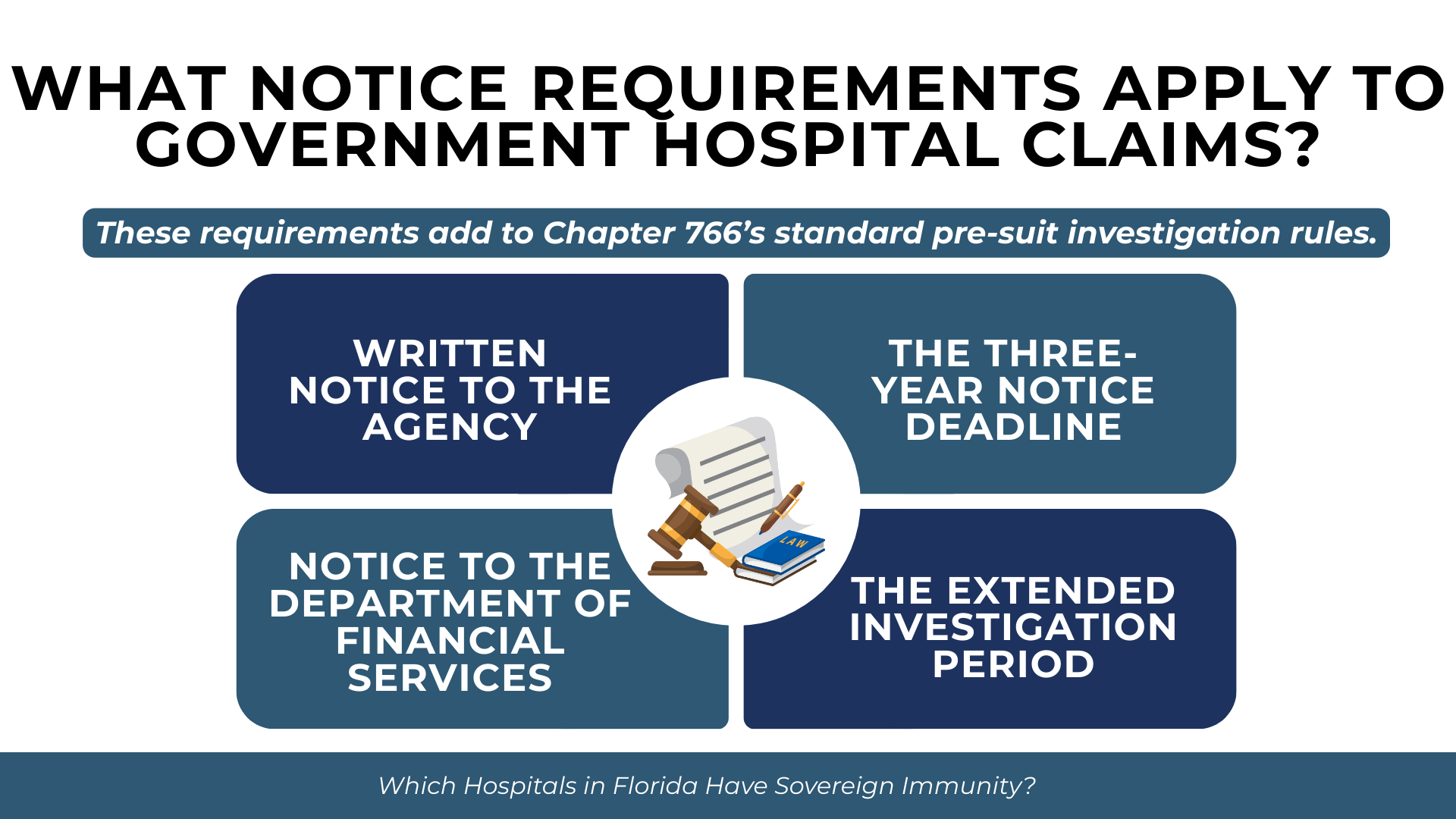
Before filing a lawsuit against a government hospital, Florida law requires strict compliance with pre-suit notice requirements. These requirements are in addition to the standard Chapter 766 pre-suit investigation requirements that apply to all medical malpractice claims.
Written Notice to the Agency
Under Fla. Stat. § 768.28(6)(a), a claimant must provide written notice of the claim to the government agency or hospital. This notice must describe the circumstances of the injury and the damages claimed. Unlike the Chapter 766 Notice of Intent, this notice goes directly to the government entity.
The notice must be actually received by the agency—not merely mailed. As the Florida Supreme Court held in Levine v. Dade County School Board, 442 So. 2d 210 (Fla. 1983), the notice requirement is a mandatory condition precedent to filing suit, and courts strictly construe sovereign immunity waivers.
Notice to the Department of Financial Services
In addition to notifying the agency, claimants must also send written notice to the Florida Department of Financial Services (formerly the Department of Insurance). As established in Menendez v. North Broward Hospital District, 537 So. 2d 89 (Fla. 1988), this dual-notice requirement is an essential element of the cause of action—not merely a procedural formality.
Failure to properly notify both the agency and the Department of Financial Services can result in dismissal of the claim, even if the claimant otherwise has a valid case.
The Three-Year Notice Deadline
Written notice must be received by both entities within three years of the date the claim accrues. This three-year period runs from when the patient knew or should have known of the injury and its connection to the government’s negligence.
This timeline differs from the two-year statute of limitations for standard medical malpractice claims under Fla. Stat. § 95.11(4)(b). However, failing to provide timely notice can bar the claim entirely, so patients should not wait until the third year to begin the process.
The Extended Investigation Period
After receiving notice, the government has six months to investigate the claim before the claimant can file suit. For medical malpractice claims, this period is reduced to 90 days, aligning with the Chapter 766 pre-suit screening period.
During this time, the claimant cannot file a lawsuit. Filing before the investigation period expires can result in dismissal.
Can You Recover More Than the Cap Through a Claims Bill?
When damages exceed the sovereign immunity caps, Florida law provides a mechanism for seeking additional recovery through the Legislature. This process, known as a claims bill, allows injured parties to petition lawmakers for compensation beyond the statutory limits.
What Is a Claims Bill?
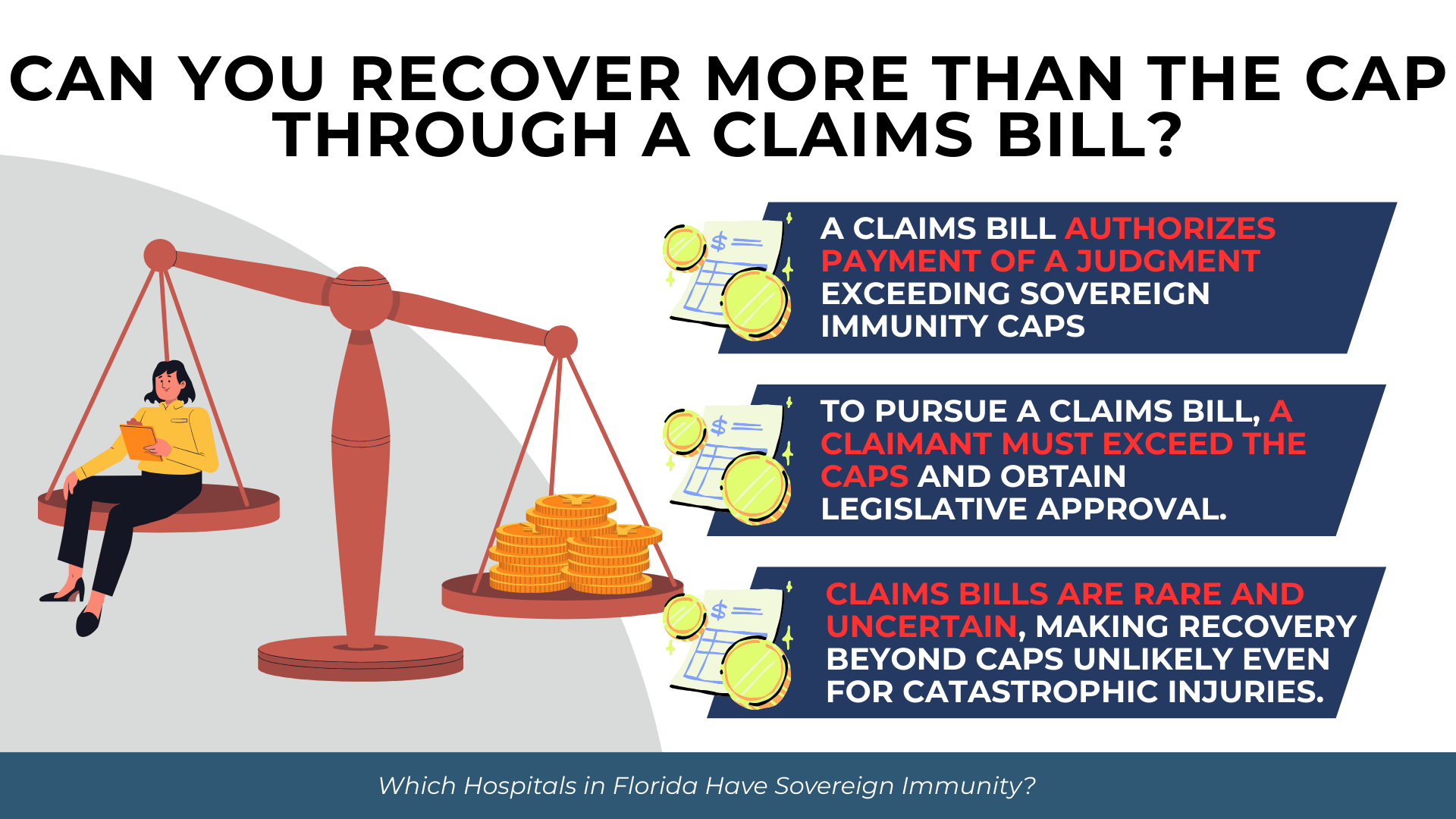
A claims bill is a proposed law that authorizes the state or a local government to pay a judgment that exceeds the sovereign immunity caps. Unlike ordinary legislation, claims bills apply to specific individuals and specific injuries rather than creating general policy.
The Legislature considers claims bills that would authorize payment from either the state treasury or local government funds, depending on which entity caused the injury.
The Legislative Approval Process
To pursue a claims bill, a claimant typically must first obtain a judgment or settlement exceeding the caps. A member of the Florida Legislature must then sponsor a bill authorizing the excess payment.
The bill must pass through committee hearings, floor votes in both the House and Senate, and ultimately be signed by the Governor. At each stage, the government entity that would pay the claim can oppose the bill.
Success Rates and Practical Considerations
Claims bills are difficult to obtain. The Legislature is not required to pass any claims bill, and many are never enacted. Political considerations, the state’s fiscal situation, and the specific facts of the case all affect whether a claims bill will succeed.
For patients with catastrophic injuries, the claims bill process may be the only path to adequate compensation from a government hospital. But the uncertainty and length of the process—often taking years after the initial judgment—means that recovery beyond the caps is far from guaranteed.
Does Sovereign Immunity Protect Hospital Employees?
Sovereign immunity extends not only to government hospitals as institutions but also to their employees under certain circumstances. Understanding these protections is important for developing an effective claim strategy.
Personal Immunity for Government Employees
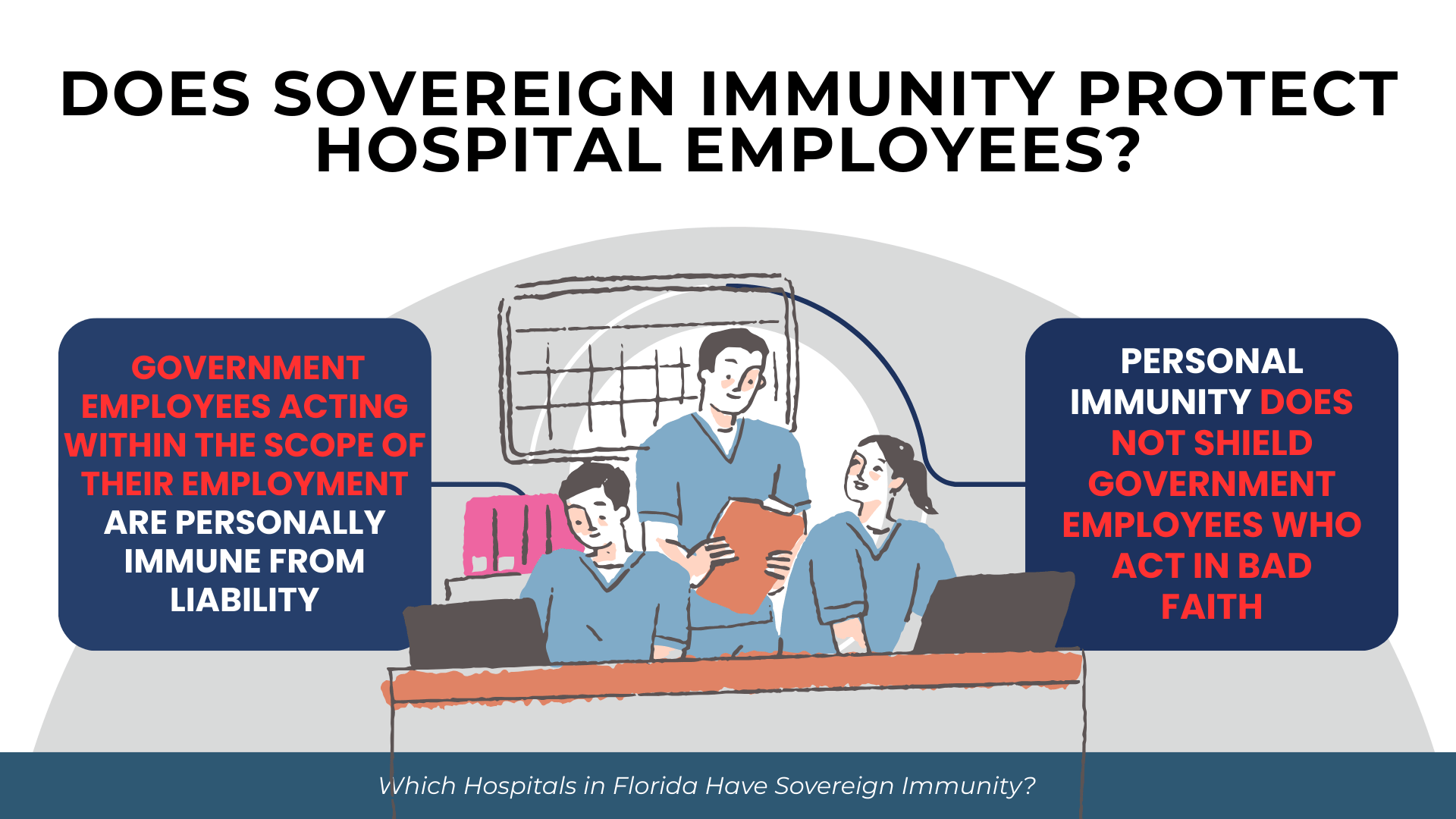
Under Fla. Stat. § 768.28(9)(a), government employees acting within the scope of their employment are personally immune from liability. This means that a nurse, doctor, or technician at a government hospital generally cannot be sued individually for negligent acts performed as part of their job duties.
Instead, the government hospital itself is the proper defendant. The hospital can be held vicariously liable for its employees’ negligence under respondeat superior, but the individual employees are protected from personal lawsuits.
Exceptions for Bad Faith or Willful Conduct
Personal immunity does not protect government employees who act “in bad faith or with malicious purpose or in a manner exhibiting wanton and willful disregard of human rights, safety, or property.” Fla. Stat. § 768.28(9)(a).
This exception is narrow. Ordinary negligence—even gross negligence—typically does not rise to the level of bad faith or willful misconduct. The conduct must be so extreme that it essentially demonstrates an intentional disregard for the patient’s wellbeing.
How This Affects Your Claim Strategy
Because individual employees are usually immune, medical malpractice claims against government hospitals focus on the institution’s liability. This can affect how claims are investigated and presented, as the emphasis is on systemic failures and institutional negligence rather than individual wrongdoing.
The practical effect is that even if a specific doctor or nurse caused the injury, the claim proceeds against the hospital, and the sovereign immunity caps apply to the recovery.
Frequently Asked Questions About Suing Government Hospitals in Florida
Can I sue a government hospital for medical malpractice in Florida?
Yes. Florida has waived sovereign immunity for medical malpractice claims against government hospitals under Fla. Stat. § 768.28. However, the waiver comes with damage caps and procedural requirements that do not apply to claims against private hospitals.
What is the maximum I can recover from a sovereign immune hospital?
The maximum recovery from a single government entity is $200,000 per person, with a total cap of $300,000 per incident if multiple claimants are involved. These caps include all damages, attorney’s fees, and costs.
How long do I have to file a claim against a government hospital?
Written notice must be received by the hospital and the Department of Financial Services within three years of when the claim accrues. The government then has 90 days (for medical malpractice) to investigate before you can file suit.
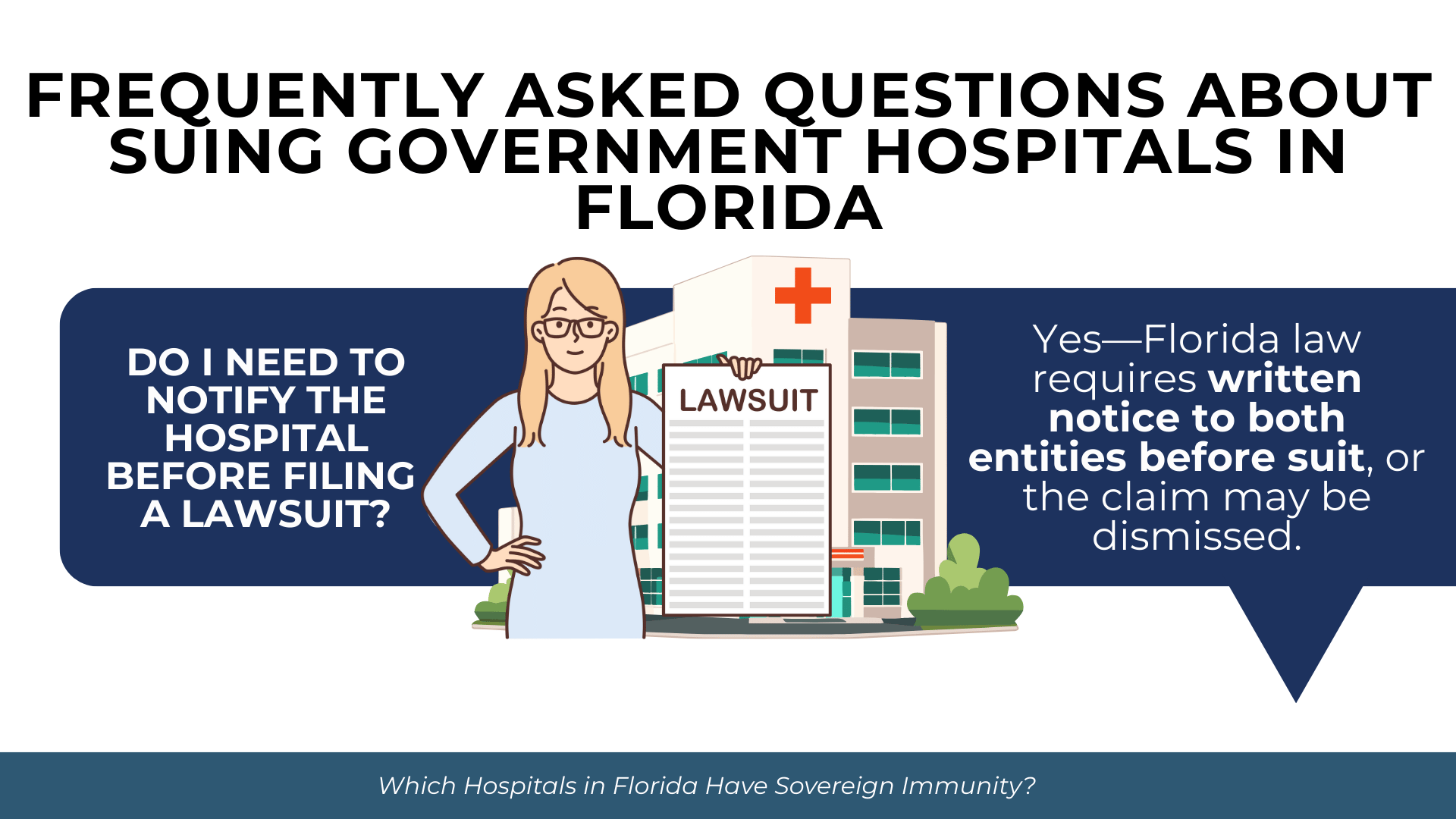
Do I need to notify the hospital before filing a lawsuit?
Yes. Florida law requires written notice to both the government hospital and the Department of Financial Services before filing a lawsuit. Failure to provide proper notice can result in dismissal of your claim.
What happens if my damages exceed the sovereign immunity cap?
You may petition the Florida Legislature for a claims bill authorizing payment beyond the statutory caps. This process is uncertain and can take years, but it represents the only path to additional recovery from a government hospital.
Are all hospital employees protected by sovereign immunity?
Government hospital employees acting within the scope of their employment are personally immune from suit under Fla. Stat. § 768.28(9)(a). The hospital itself is liable for their negligence. However, employees who act with bad faith or willful misconduct may be personally liable.
Understanding Your Options After a Government Hospital Injury
Determining whether a hospital has sovereign immunity is one of the first and most important steps in evaluating a potential medical malpractice claim. The answer shapes everything from the maximum possible recovery to the procedural requirements that must be followed.
Government hospital claims are not impossible, but they require early identification of the hospital’s status, strict compliance with notice requirements, and realistic assessment of case value given the damage caps. For patients with serious injuries, the claims bill process offers a potential path beyond the caps, though success is never guaranteed.
If you have questions about whether a Florida hospital has sovereign immunity or how the caps might affect your situation, contact Prosper Injury Attorneys to discuss your circumstances.