If you’ve been injured on a cruise ship, one of the first questions you probably have is simple: what is my case worth? It’s a reasonable question, and you might expect a straightforward answer—something like an average settlement range to give you a sense of what to expect. The reality is more complicated. Cruise ship injury claims vary so dramatically in value that any “average” figure would be meaningless at best and misleading at worst.
What actually matters is understanding the specific factors that drive settlement value in maritime injury cases. These include the severity of your injury, how clearly the cruise line’s negligence can be established, the evidence available to support your claim, and several maritime-specific legal rules that affect what you can recover. This article explains each of these factors so you can better understand what shapes the value of a cruise ship injury claim.
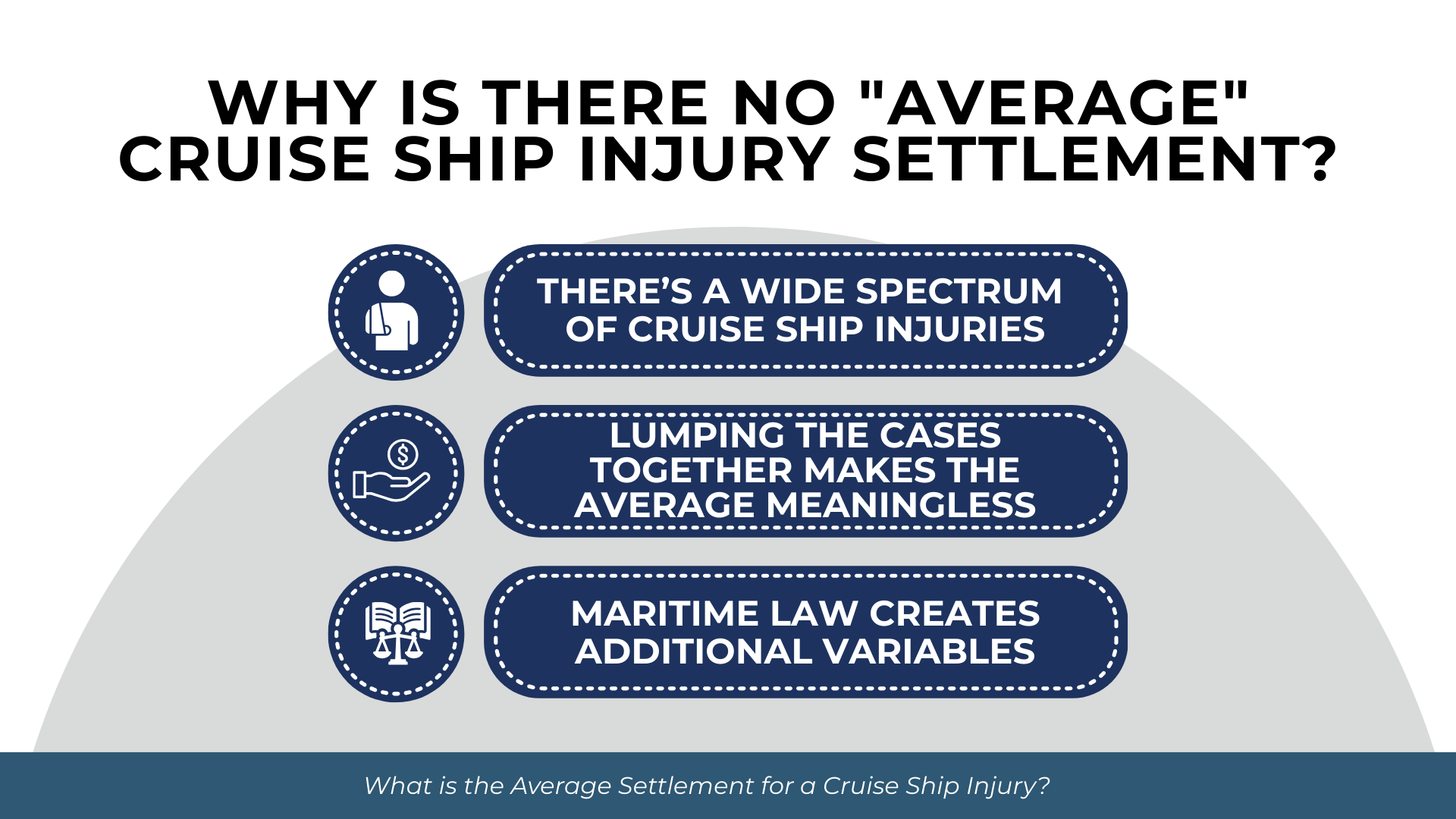
Why Is There No “Average” Cruise Ship Injury Settlement?
The wide spectrum of cruise ship injuries
Cruise ships are complex environments where injuries range from minor inconveniences to life-altering catastrophes. On any given voyage, passengers might sustain bruises from a stumble in a crowded buffet line or suffer traumatic brain injuries from a hard fall on a wet pool deck. Some injuries require a single visit to the ship’s medical center. Others result in emergency evacuations, multiple surgeries, and permanent disability.
Roughly 45% of cruise injuries involve slips, trips, and falls, according to available hospitality industry data. But within that category alone, outcomes vary enormously. A slip that causes a sprained wrist has little in common with one that fractures a hip or causes a head injury requiring ongoing care.
Why lumping cases together distorts the picture
When you combine minor injuries settled for modest amounts with catastrophic cases resolved for substantial sums, the resulting “average” tells you almost nothing useful. The high-value cases pull the number up, while the many smaller claims pull it down. Neither extreme reflects what any particular case might be worth.
More importantly, settlement value isn’t determined by injury category alone. Two passengers with seemingly similar injuries can end up with very different outcomes depending on the strength of the evidence, how clearly negligence can be proven, and the specific legal rules that apply.
Maritime law creates additional variables
Cruise ship injury claims fall under federal maritime law, which operates differently from ordinary personal injury law. Maritime rules governing negligence, damages, and time limits add complexity that doesn’t exist in typical premises liability cases. For instance, maritime law uses pure comparative negligence, meaning your recovery is reduced by your percentage of fault rather than eliminated. Whether your injury occurred in territorial waters or on the high seas can determine what types of damages you can recover. These legal variables mean that case value depends heavily on the specific facts and applicable doctrines—not on what other passengers received.
What Factors Determine How Much a Cruise Ship Injury Claim Is Worth?

While no formula produces a precise settlement figure, certain factors consistently influence claim value. Understanding these factors helps explain why individual case evaluation is essential.
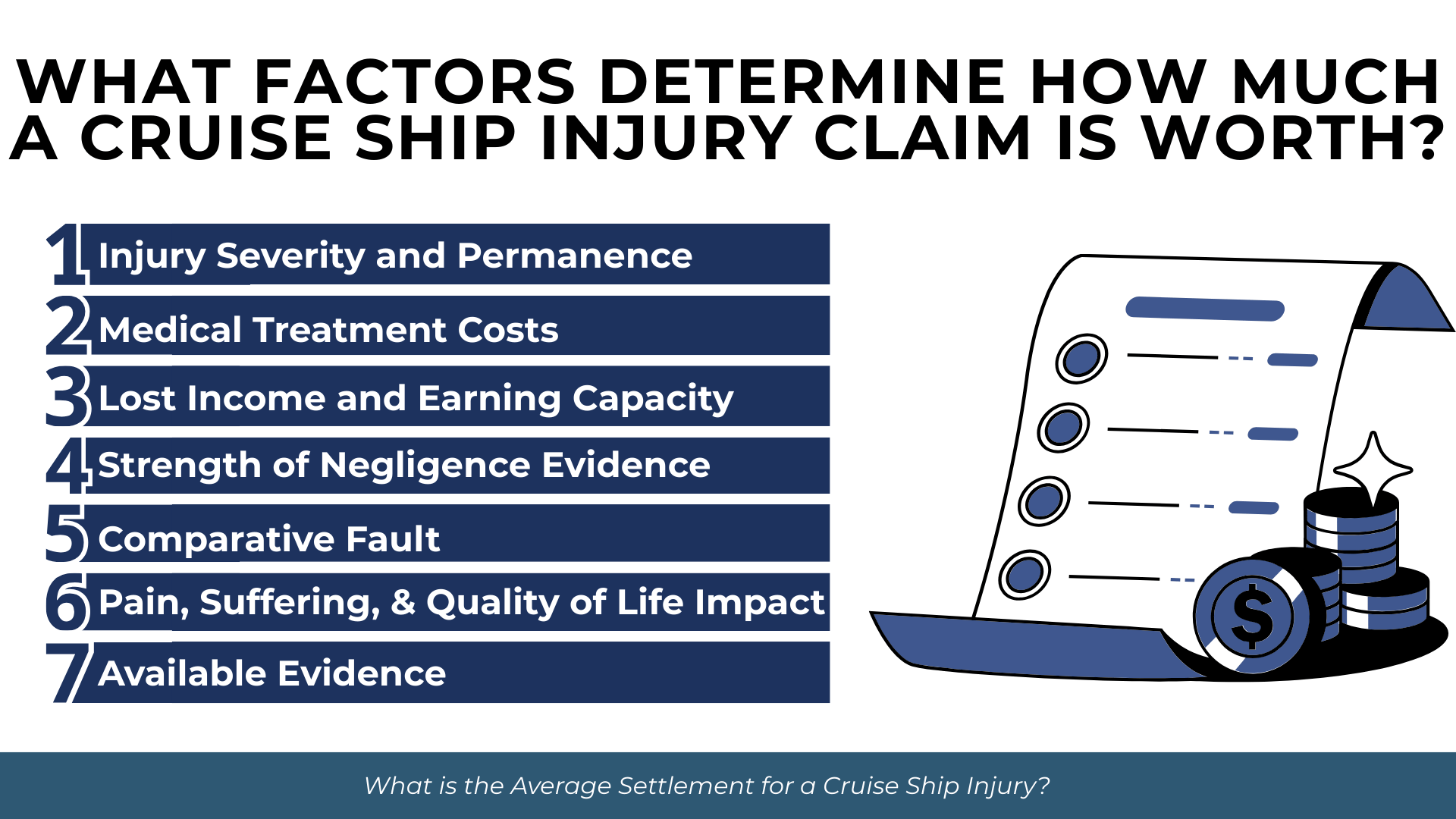
The following elements typically have the greatest impact on what a cruise ship injury claim is worth:
- Injury severity and permanence. A broken bone that heals fully is worth less than one requiring hardware, ongoing physical therapy, or resulting in chronic pain. Injuries causing permanent disability, disfigurement, or reduced life expectancy substantially increase claim value.
- Medical treatment costs. The total cost of medical care—past and future—forms a significant part of economic damages. This includes emergency treatment, surgeries, rehabilitation, and any long-term care needs.
- Lost income and earning capacity. If your injury caused you to miss work or diminished your ability to earn income in the future, those losses contribute directly to claim value.
- Strength of negligence evidence. Claims with clear evidence that the cruise line knew about a dangerous condition and failed to address it are worth more than cases where negligence is harder to prove.
- Comparative fault. If your own actions contributed to the accident—such as ignoring a wet floor sign—your recovery will be reduced proportionally. High comparative fault significantly lowers claim value.
- Pain, suffering, and quality of life impact. Maritime law allows recovery for physical pain, emotional distress, and loss of enjoyment of life. These non-economic damages often represent a substantial portion of total compensation.
- Available evidence. Strong evidence—including surveillance footage, witness statements, and ship incident reports—strengthens your negotiating position and increases settlement value.
Severity and long-term impact of the injury
Not all injuries affect claim value equally. A temporary soft-tissue injury that resolves within weeks carries far less value than a herniated disc requiring surgery or a traumatic brain injury with lasting cognitive effects. When evaluating claim worth, the key questions involve permanence, required treatment, and how the injury affects your ability to work and live your daily life.
Injuries requiring ongoing medical care—such as chronic pain management, physical therapy, or future surgeries—increase both the economic and non-economic value of a claim. The projected cost of future treatment, supported by medical expert opinions, can add significantly to total damages. Taking the right steps immediately after your injury helps document these damages from the start.
Strength of negligence evidence
Maritime negligence claims require proving the cruise line breached its duty of reasonable care. But proving a breach often hinges on whether the cruise line had notice of the dangerous condition. Strong notice evidence—particularly surveillance footage showing a spill going uncleaned for an extended period or internal records documenting prior similar incidents—dramatically strengthens a claim.
Cases where evidence clearly establishes that the cruise line created the hazard, knew about it, or should have discovered it through reasonable inspection are worth more than those relying on circumstantial evidence alone.
How comparative fault affects your recovery
Maritime law follows pure comparative negligence, meaning your damages are reduced by your percentage of fault but never entirely barred. If a jury determines you were 30% responsible for your accident—perhaps because you were looking at your phone rather than where you were walking—your total compensation would be reduced by 30%.
This rule, established in United States v. Reliable Transfer Co., 421 U.S. 397 (1975), applies to all maritime personal injury claims. Understanding how your own conduct might affect the calculation is essential when evaluating potential settlement value.
How Does Proving Cruise Line Negligence Affect Settlement Value?
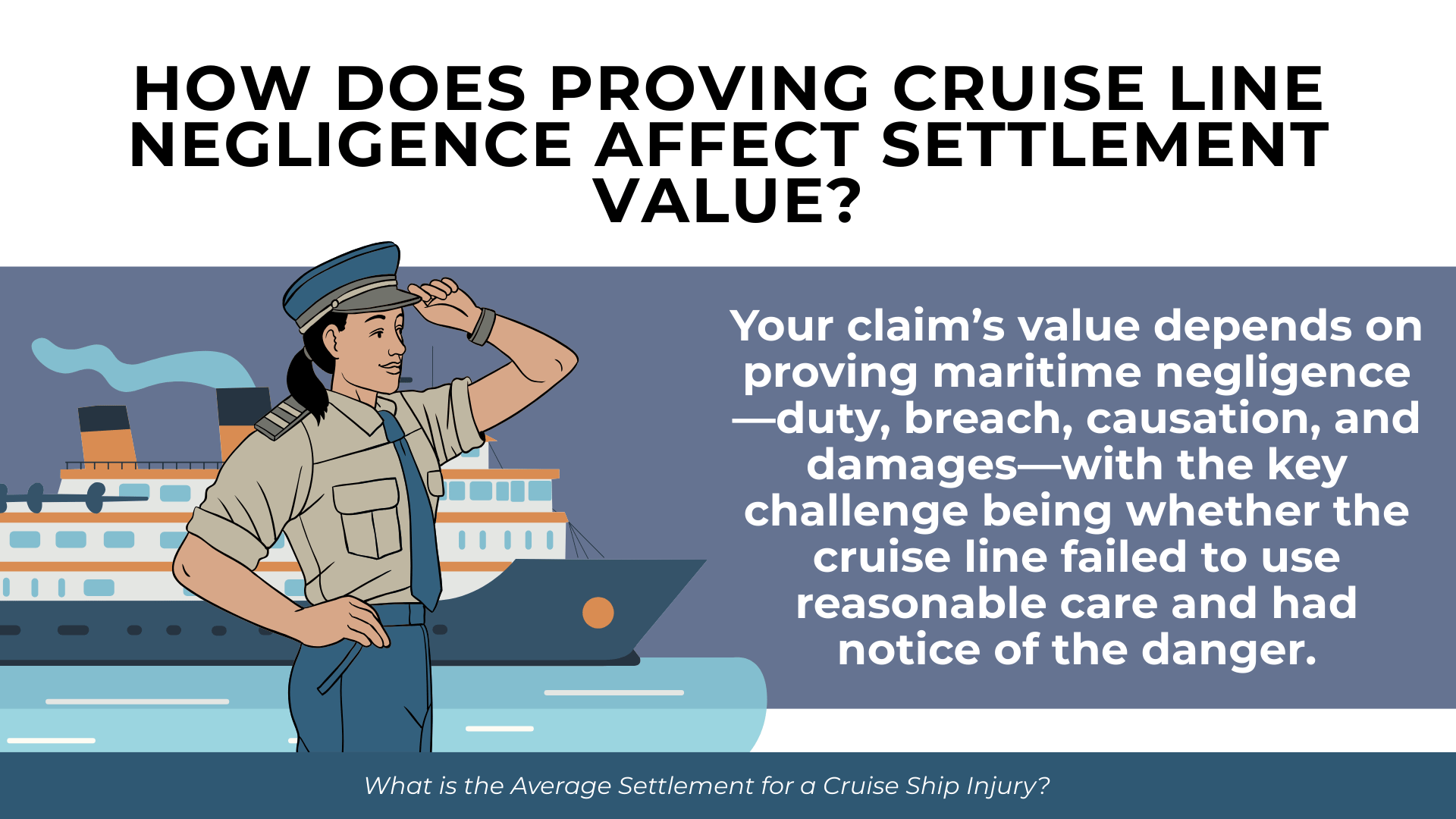
The strength of your negligence case directly impacts what your claim is worth. Maritime negligence requires proving four elements: duty, breach, causation, and damages. The cruise line owes passengers a duty of reasonable care under the circumstances—not an absolute guarantee of safety, but an obligation to act as a reasonable vessel operator would. The challenge often lies in proving breach and establishing that the cruise line had notice of the dangerous condition.
The notice requirement and why it matters
Under established maritime law, a cruise line is liable only if it had actual or constructive notice of the hazardous condition. The Eleventh Circuit’s decision in Keefe v. Bahama Cruise Line, 867 F.2d 1318 (11th Cir. 1989) established this framework, which has been consistently applied in cruise injury cases since.
This notice requirement is one of the most litigated issues in cruise ship injury cases. It can mean the difference between a claim with substantial value and one that struggles to survive summary judgment.
Actual versus constructive notice
Actual notice exists when the cruise line directly created the hazard or had documented knowledge of it. Constructive notice applies when the dangerous condition existed long enough that the cruise line should have discovered it through reasonable inspection procedures—or when prior similar incidents put the company on notice of a recurring risk.
For example, if surveillance footage shows a puddle on a deck for more than 20 minutes without being addressed, that can provide strong evidence of constructive notice. Similarly, internal records showing previous falls in the same location establish that the cruise line was aware of an ongoing hazard.
Evidence that strengthens your position
Cases with strong notice evidence settle for more. The most valuable evidence typically includes contemporaneous footage showing how long a hazard existed, incident reports documenting the condition, and records of prior similar accidents. When this evidence is preserved and available, it significantly increases settlement leverage.
What Types of Damages Can You Recover in a Cruise Injury Case?
Maritime law allows injured passengers to recover both economic and non-economic damages, though specific rules affect what’s recoverable depending on where the injury occurred and whether it resulted in death.
Economic damages
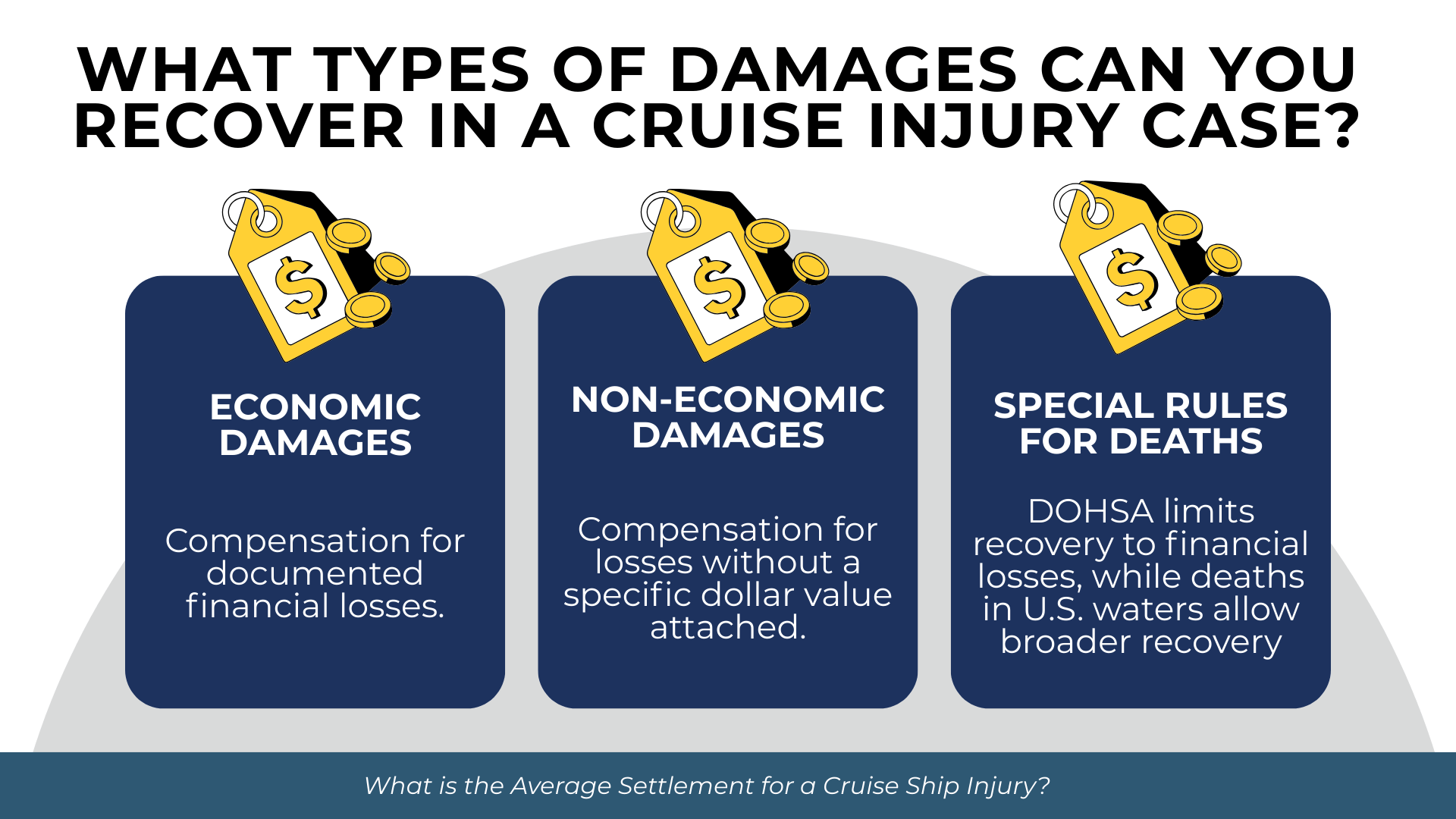
Economic damages compensate for financial losses with documented value. In cruise injury cases, these typically include:
- Medical expenses. All reasonable costs of treatment, from emergency care to long-term rehabilitation and future medical needs.
- Lost wages. Income lost during recovery, including sick days, missed bonuses, and reduced hours.
- Lost earning capacity. If the injury permanently limits your ability to work or earn at your previous level, that diminished earning capacity is compensable.
- Travel and transportation costs. Expenses related to reaching medical appointments or traveling for treatment.
- Home modification costs. If the injury requires accessibility modifications to your home, those costs may be recoverable.
- Domestic services. If you can no longer perform household tasks you previously handled, the cost of hiring help can be included.
Non-economic damages
Non-economic damages compensate for losses without a specific dollar value attached. These include physical pain, emotional distress, mental anguish, and loss of enjoyment of life. In serious injury cases, non-economic damages often represent a substantial portion of total compensation.
Because cruise lines owe passengers a duty of reasonable care under the standard set by Kermarec v. Compagnie Générale Transatlantique, 358 U.S. 625 (1959), injuries resulting from breached duties can give rise to significant non-economic damage claims.
Special rules for deaths at sea
When a cruise ship death occurs more than three nautical miles offshore, the Death on the High Seas Act (DOHSA) governs what survivors can recover. DOHSA limits recovery to pecuniary (financial) losses only. Under this statute, families cannot recover for loss of companionship, grief, or the decedent’s pre-death pain and suffering. Recoverable damages are restricted to lost financial support, lost services, and funeral expenses.
For deaths occurring in U.S. territorial waters (within three nautical miles), general maritime law allows broader recovery, potentially including loss of society for non-seamen. The location of death can dramatically affect what a wrongful death claim is worth.
Additionally, maritime law generally awards pre-judgment interest as a default, which adds to total recovery and increases settlement pressure on cruise lines.
How Do Deadlines and Contract Terms Affect Your Claim’s Value?
Time limits in cruise injury cases are significantly shorter than in typical personal injury claims, and missing them can eliminate your ability to recover anything—regardless of how strong your case otherwise is.
Shortened time limits in cruise contracts
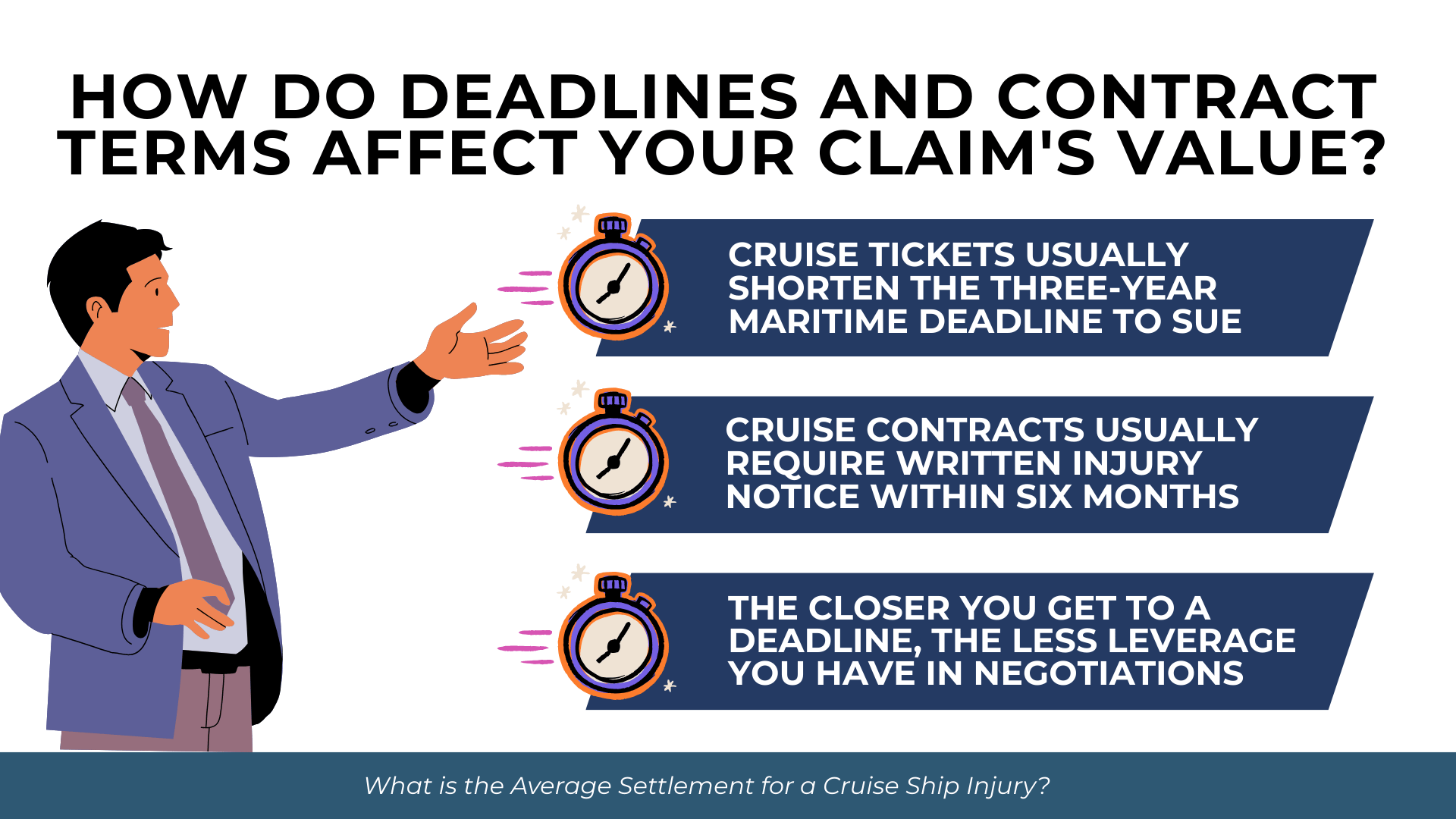
While federal maritime law allows three years to file a lawsuit, cruise line ticket contracts almost universally shorten this period. Under 46 U.S.C. § 30508, these contractual modifications are enforceable. Most major cruise lines require lawsuits to be filed within one year of the injury.
Courts consistently enforce these provisions. A strong claim filed after the contractual deadline expires is worth nothing because it cannot proceed.
Notice requirements that can bar your claim
Beyond the shortened lawsuit deadline, cruise contracts typically require passengers to provide written notice of their injury within six months. Failing to comply with this notice requirement—even if you file suit within the one-year window—can bar your claim entirely.
These notice provisions require specific information, and defective notice may be treated the same as no notice at all. Reviewing your cruise ticket contract immediately after an injury is essential.
Why timing affects settlement leverage
Tight deadlines don’t just create procedural traps—they affect settlement dynamics. The closer you get to a deadline, the less leverage you have in negotiations. Cruise lines know that passengers approaching a statute of limitations may feel pressure to accept lower offers rather than risk losing the right to sue altogether.
Acting quickly preserves options and strengthens negotiating positions.
What Evidence Helps Maximize a Cruise Ship Injury Settlement?
The value of a cruise injury claim depends heavily on what evidence is available to prove negligence and damages. Preserving critical evidence often requires immediate action.
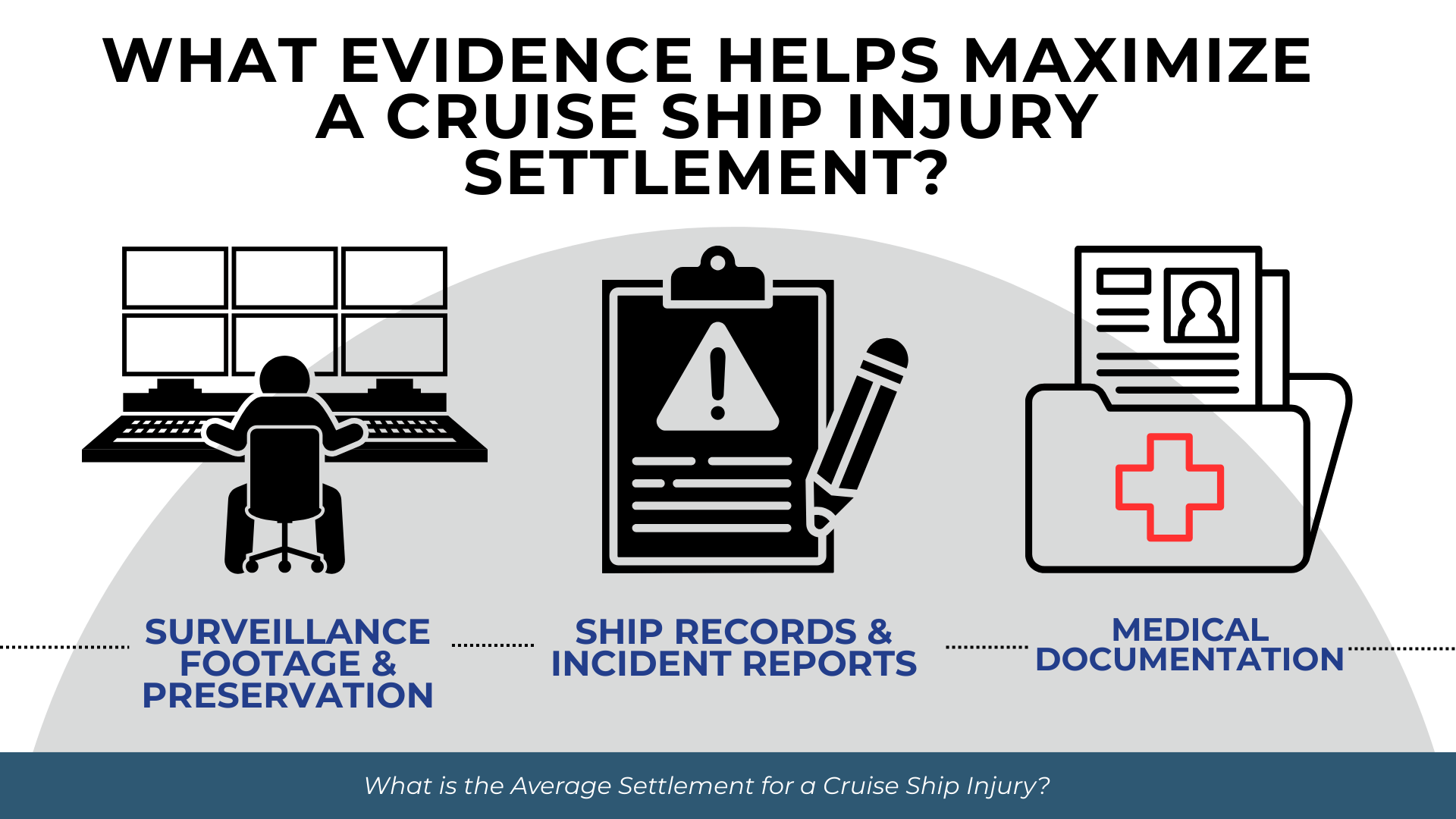
Surveillance footage and preservation
Modern cruise ships have extensive camera systems covering public areas, and this footage can be decisive in proving negligence. However, cruise lines typically overwrite surveillance recordings on short cycles—often within 7 to 30 days—unless formally notified to preserve them.
A litigation hold letter sent promptly after an accident can require the cruise line to preserve relevant footage. If the cruise line destroys footage after receiving notice of a claim, courts may issue adverse inference instructions, allowing juries to presume the missing evidence would have been unfavorable to the cruise line’s defense.
Ship records and incident reports
When an accident occurs, crew members typically respond by documenting the incident, noting conditions, gathering witness information, and filing internal reports. These records can establish what the cruise line knew and when they knew it.
Obtaining these documents through discovery often reveals valuable evidence about prior similar incidents, maintenance schedules, and inspection practices—all of which can strengthen a negligence claim.
Medical documentation
Comprehensive medical records documenting your injuries, treatment, and prognosis are essential for proving damages. Seek medical attention immediately after an injury, both on the ship and upon returning home. Gaps in treatment or delays in seeking care can be used to argue that your injuries weren’t serious.
The following types of evidence are typically most valuable in cruise injury claims:
- Surveillance footage from cameras covering the accident location and surrounding areas.
- Written incident reports prepared by crew members at the scene.
- Witness contact information from other passengers who saw what happened.
- Photographs of the hazardous condition, your injuries, and the surrounding environment.
- Medical records from the ship’s medical center and all subsequent treatment.
- Your cruise ticket contract specifying applicable deadlines and requirements.
- Prior incident records showing similar accidents in the same location.
An experienced maritime attorney can help secure and preserve this evidence before it’s lost or destroyed.
Frequently Asked Questions
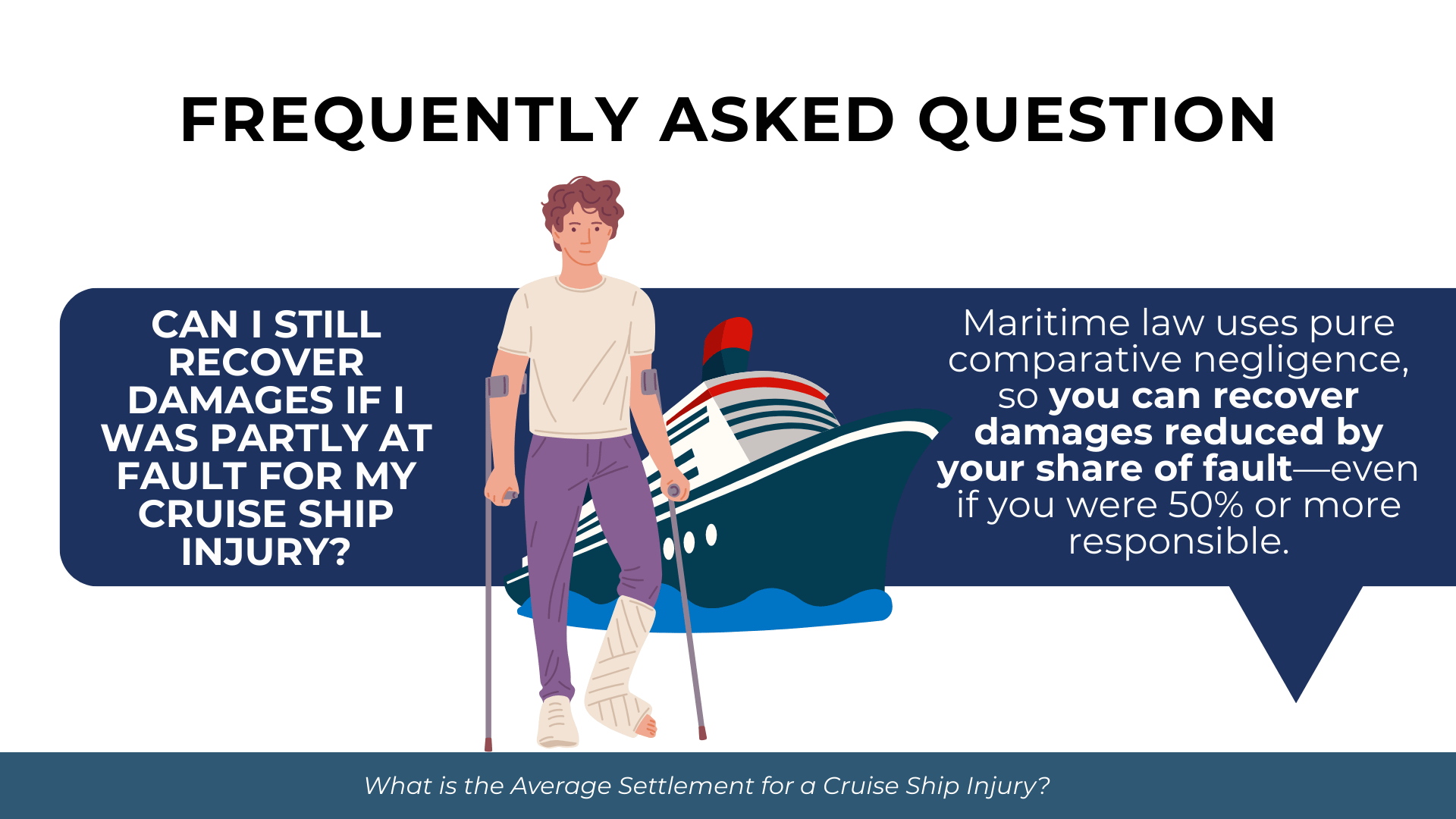
Can I still recover damages if I was partly at fault for my cruise ship injury?
Yes. Maritime law applies pure comparative negligence, meaning your damages are reduced by your percentage of fault but not eliminated. Even if you were 50% or more responsible, you can still recover a proportional share of your damages. This differs from some state laws that bar recovery entirely if you’re more than half at fault.
Does the location where my injury occurred affect how much I can recover?
It can, particularly in wrongful death cases. Deaths occurring more than three nautical miles offshore fall under the Death on the High Seas Act, which limits recovery to financial losses and excludes compensation for grief, loss of companionship, and pre-death pain and suffering. Deaths in territorial waters may allow broader recovery.
How long do I have to file a cruise ship injury claim?
Most cruise line contracts shorten the standard three-year maritime limitation period to just one year. Additionally, contracts typically require written notice within six months of the injury. Missing either deadline can bar your claim regardless of its merits. Check your ticket contract immediately. For a step-by-step guide, see how to file a cruise ship injury claim.
What happens if the cruise line deleted the security footage of my accident?
If a cruise line destroys footage after being notified of a potential claim, courts may impose an adverse inference instruction. This allows a jury to presume the missing evidence would have been unfavorable to the cruise line’s defense—effectively strengthening your case.
Will my health insurance payments reduce my settlement?
Generally no. Maritime law applies the collateral source rule, which prevents defendants from reducing damages based on payments you received from independent sources like your own health insurance. The cruise line typically cannot take credit for benefits paid by your insurer.
Protecting Your Right to Fair Compensation
There’s no shortcut to understanding what a cruise ship injury claim is worth. Averages don’t account for the specific factors—injury severity, strength of evidence, applicable maritime doctrines, and contractual deadlines—that actually determine value. Each case requires individual evaluation based on its unique facts and circumstances.
What matters most is acting quickly to preserve evidence, comply with notice requirements, and understand how maritime law applies to your situation. Surveillance footage disappears, deadlines approach faster than expected, and the strength of your case often depends on steps taken in the first weeks after an injury.
If you’ve been injured on a cruise ship and want to understand what your claim might be worth, contact Prosper Injury Attorneys to discuss your cruise ship injury case. A fact-specific evaluation with a Miami cruise ship injury lawyer is the best way to get a meaningful answer to that question.