The deck suddenly lurches beneath you, and before you can grab the railing, you’re on the ground with a sharp pain shooting through your knee. Whether you’ve slipped on a wet pool deck, fallen on a gangway, or been injured during a shore excursion, a cruise ship injury can transform your dream vacation into a nightmare of pain, medical bills, and legal confusion. Understanding what to do immediately after a cruise ship injury can make the difference between recovering full compensation and losing your right to pursue a claim. It’s normal to feel overwhelmed after an accident at sea. The combination of physical pain, unfamiliar surroundings, and complex maritime laws creates unique challenges that land-based accidents don’t present. This guide walks you through the critical steps to protect your health and legal rights after a cruise ship injury.
What Should I Do Immediately After a Cruise Ship Injury?
The first 24 hours after your injury are crucial for both your medical recovery and legal claim. Your immediate priority is documenting everything while evidence remains fresh and accessible. Most importantly, you need to act quickly because cruise lines often delete critical evidence within days.
Evidence to Gather
Report your injury to ship personnel immediately and insist on obtaining a written incident report. Don’t accept verbal assurances that your injury has been noted. Request a copy of the report before leaving the ship. Take photographs of the hazardous condition that caused your injury. Whether it’s a wet deck, defective equipment, or poorly lit stairway, document the scene from multiple angles. Include wide shots showing the surrounding area and close-ups of the specific hazard. Collect contact information from any witnesses. Fellow passengers often disembark at different ports, making them nearly impossible to locate later. Get their names, cabin numbers, phone numbers, and email addresses.
Key Deadline: CCTV Preservation Request
Send a formal preservation request for CCTV footage immediately. Cruise lines typically auto-delete surveillance footage within 7 to 30 days. Submit your request in writing to the ship’s security office and guest services, explicitly demanding preservation of all footage from the incident area for the entire day of your accident. Request preservation of maintenance logs and prior incident reports for the area where you were injured. These documents can prove the cruise line knew about the dangerous condition.
Documentation Requirements
Seek medical attention in the ship’s infirmary even if your injuries seem minor. Adrenaline can mask serious injuries, and delaying treatment creates gaps in your medical record that insurance companies exploit. Obtain copies of all medical records before disembarking. Keep every receipt related to your injury. This includes medical expenses, medications, mobility aids, and any shore excursions or shipboard activities you couldn’t attend due to your injury. 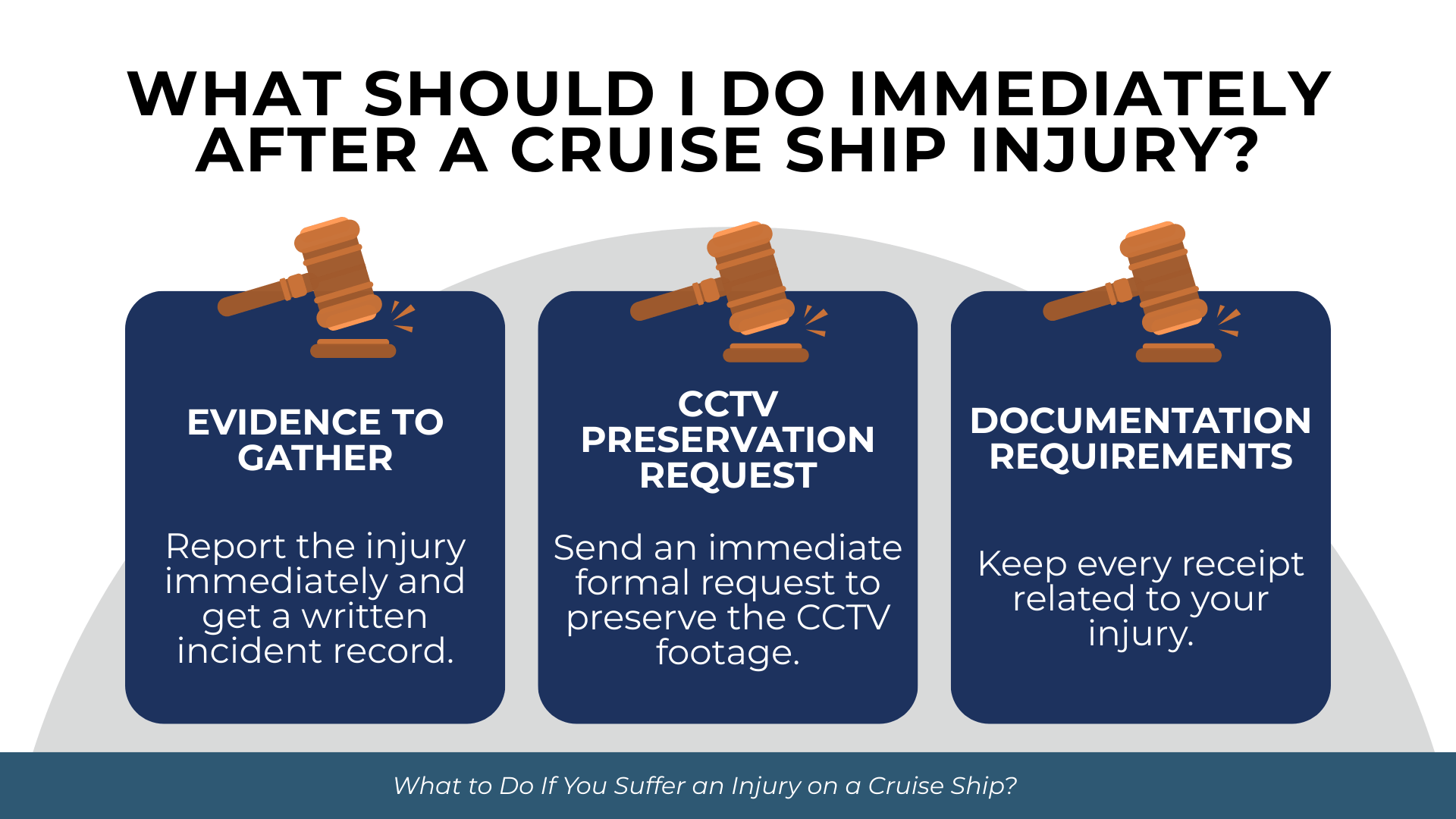
Does Federal Maritime Law Apply to My Cruise Ship Injury?
Call us today at (305) 694-2676 or
contact us online for a free case evaluation.
Hablamos español.


Federal maritime law, not state law, governs cruise ship injuries regardless of where you file your lawsuit. This specialized body of law applies because cruise ship injuries satisfy both required tests for admiralty jurisdiction under 28 U.S.C. § 1333.
Admiralty Jurisdiction Rule
Your injury falls under maritime law when it meets the location test and connection test established in Grubart v. Great Lakes Dredge & Dock Co., 513 U.S. 527 (1995). The location test requires that your injury occurred on navigable waters or was caused by a vessel on navigable waters. The connection test requires that the incident could potentially disrupt maritime commerce and bears a substantial relationship to traditional maritime activity.
Key Legal Standard
Cruise lines owe passengers reasonable care under the circumstances according to Kermarec v. Compagnie Générale Transatlantique, 358 U.S. 625 (1959). This isn’t a heightened “common carrier” duty or strict liability. The cruise line must act as a reasonable vessel operator would under similar circumstances.
Court Options Available
Under the saving-to-suitors clause (28 U.S.C. § 1333(1)), you can file your lawsuit in federal court under admiralty jurisdiction or in state court. However, federal maritime law governs the substance of your case regardless of which court you choose. State tort doctrines that conflict with maritime law don’t apply.
International Exception
An important exception applies to certain international itineraries that never touch U.S. waters. Some cruise lines include contractual provisions requiring passengers on foreign-departing voyages to litigate personal injury claims exclusively in foreign courts under foreign law. Celebrity Cruises, for example, specifies in Paragraph 10.a.(i) of its Guest Terms that disputes on qualifying international sailings—such as cruises departing Sydney, Australia—”must be litigated…in and before the Courts of England and Wales” under English law (10.a.(ii)). If your cruise departed from a foreign port and never entered U.S. jurisdiction, review your ticket contract carefully because U.S. federal maritime law may not apply to your claim at all. 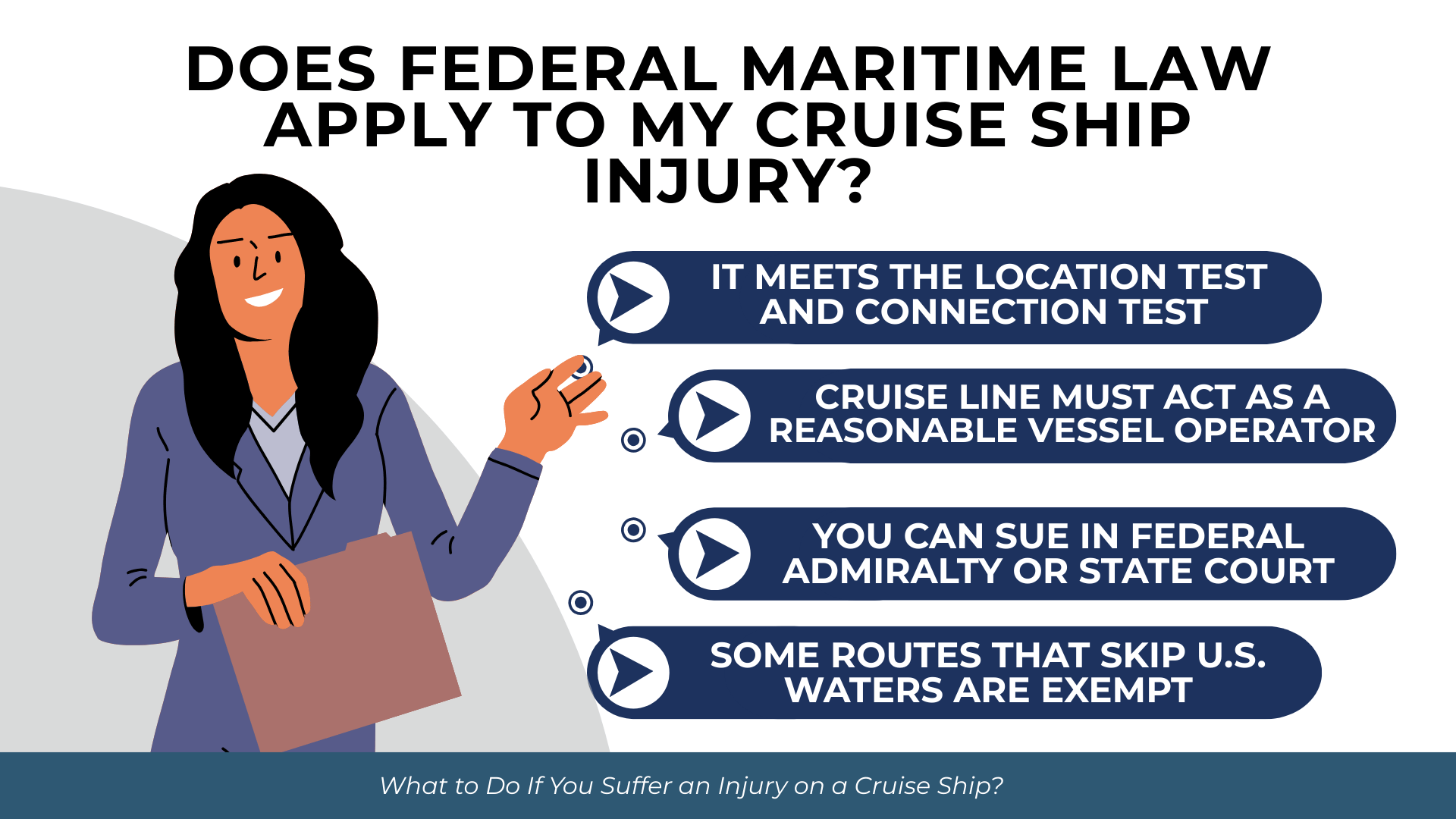
What Compensation Can I Recover for My Cruise Ship Injury?
Your compensation depends on the severity of your injuries and how they impact your life. Each case value is unique, determined by specific factors including medical expenses, lost income, and the extent of your pain and suffering.
Economic Damages
Medical expenses form the foundation of your economic damages. This includes emergency treatment on the ship, hospital care at ports or after returning home, surgeries, physical therapy, medications, and medical equipment. Future medical expenses for ongoing treatment are also recoverable. Lost wages cover both time missed from work and reduced earning capacity if your injuries prevent you from returning to your previous occupation. Self-employed individuals can claim lost business income with proper documentation.
Non-Economic Damages
Pain and suffering compensates you for physical discomfort, emotional distress, and diminished quality of life. These damages vary significantly based on injury severity and individual circumstances. Loss of enjoyment encompasses activities you can no longer participate in due to your injuries.
Comparative Fault Impact
Maritime law follows pure comparative negligence under United States v. Reliable Transfer Co., 421 U.S. 397 (1975). Your damages are reduced by your percentage of fault but never completely barred. If you’re found 30% at fault for not watching where you were walking, you’ll recover 70% of your total damages. The court can award pre-judgment interest from the date of injury under City of Milwaukee v. Cement Div., Nat’l Gypsum, 515 U.S. 189 (1995). This increases the pressure on cruise lines to settle fairly rather than delay. 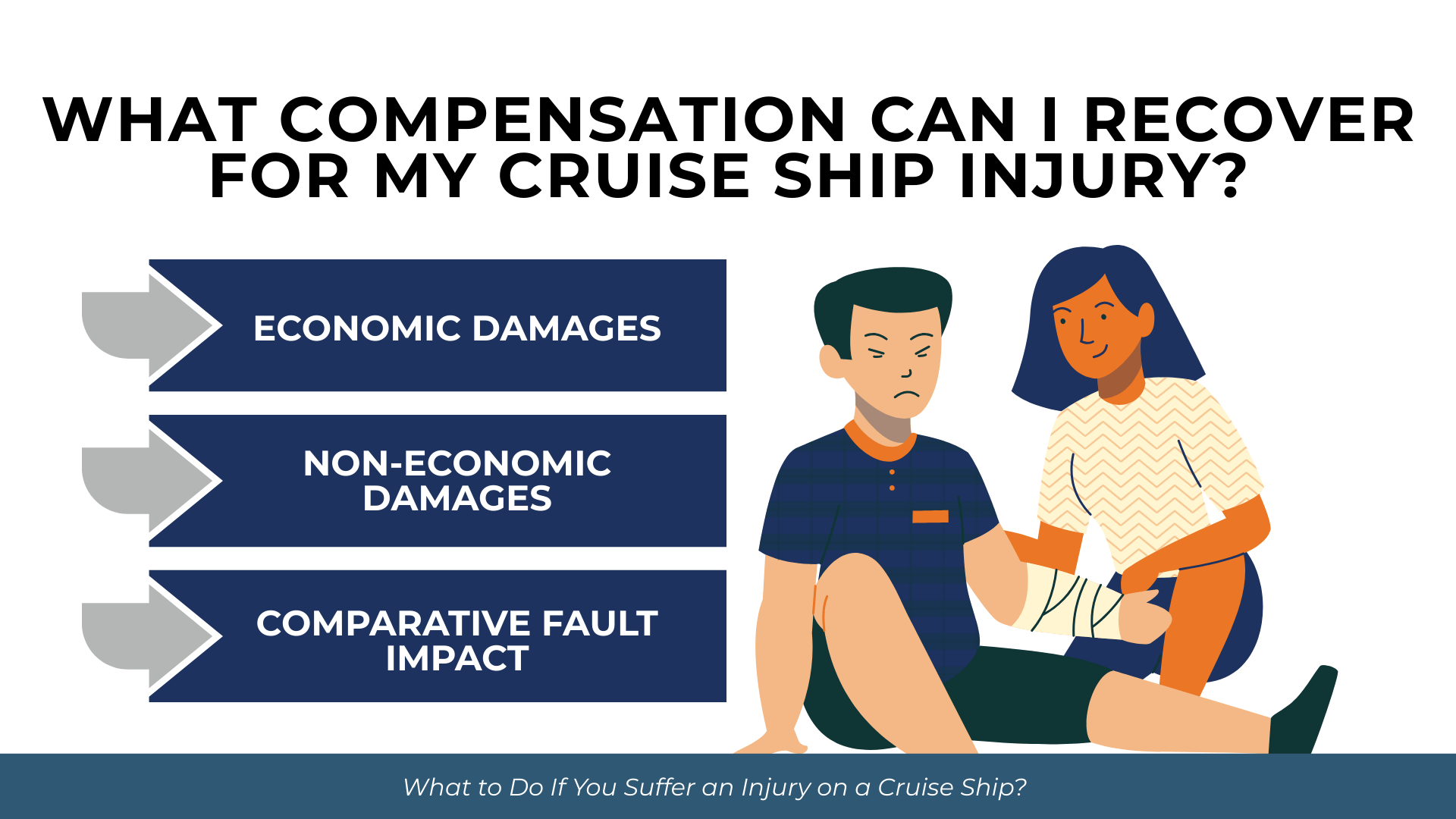
What Are the Time Limits for Filing a Cruise Ship Injury Claim?
Missing a deadline can permanently bar your claim regardless of how serious your injuries are. Cruise lines deliberately shorten the standard three-year maritime statute of limitations through contract provisions.
Critical Notice Deadline
Most cruise ticket contracts require written notice of your injury within six months. This notice must be sent to the address specified in your ticket contract, typically the cruise line’s headquarters. Failure to provide timely notice can completely bar your claim even if you file suit within the one-year deadline.
Filing Deadline
Under 46 U.S.C. § 30508, cruise lines can contractually reduce the standard three-year statute under 46 U.S.C. § 30106 to just one year. Nearly all major cruise lines enforce this shortened deadline. The clock starts running from the date of your injury, not when you discover the full extent of your damages.
| Deadline Type | Time Frame | Legal Basis |
| Written Notice | 6 months | Ticket contract |
| Filing Lawsuit | 1 year | 46 U.S.C. § 30508 |
| Federal Maritime Default | 3 years | 46 U.S.C. § 30106 |
Required Filing Location
Your ticket contract likely contains a forum selection clause requiring you to file suit in the U.S. District Court for the Southern District of Florida (Miami Division). The Supreme Court upheld these clauses in Carnival Cruise Lines, Inc. v. Shute, 499 U.S. 585 (1991). Courts rarely invalidate these requirements even when filing in Miami is expensive or inconvenient. 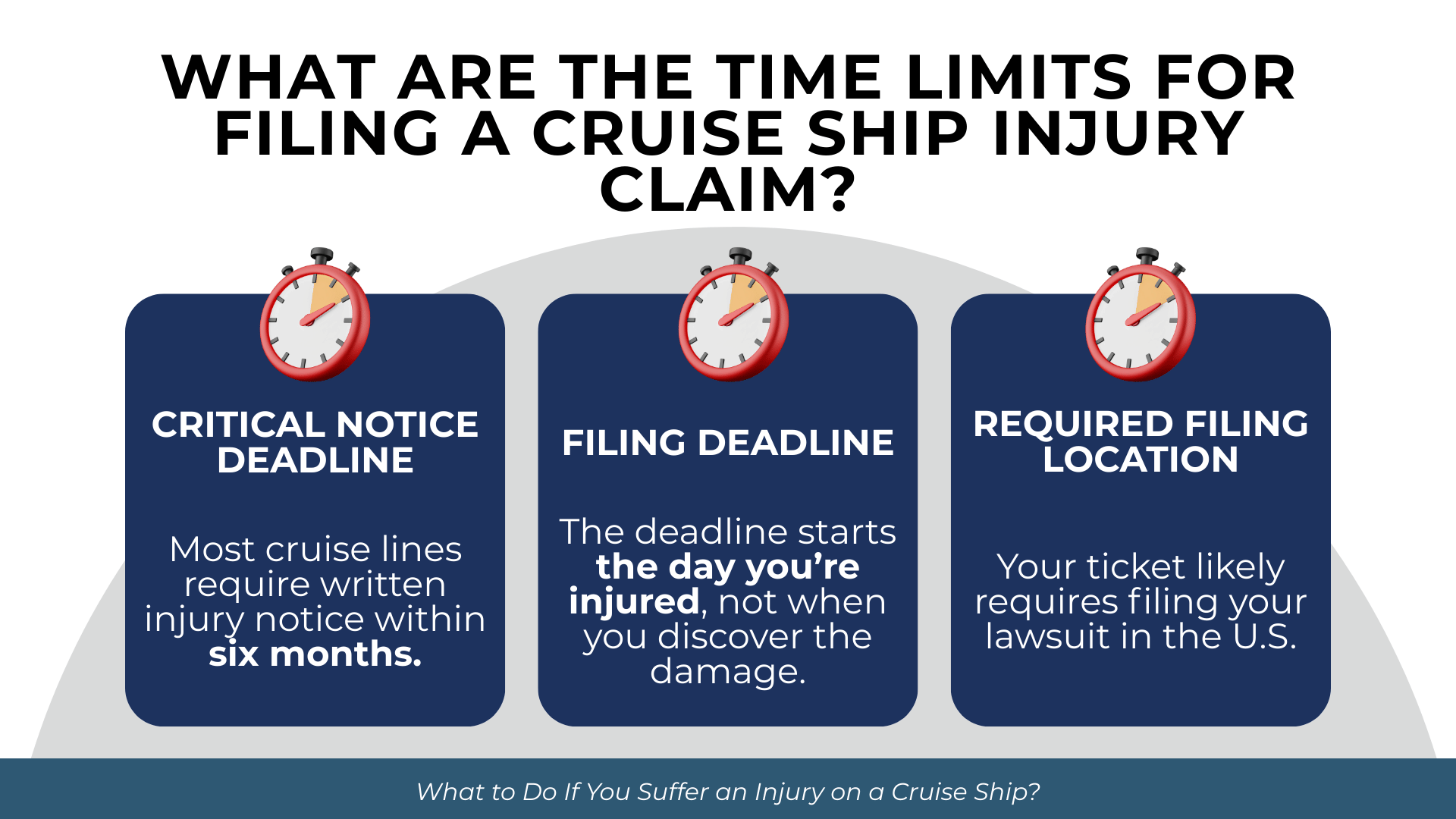
How Do I Prove the Cruise Line Was Negligent?
Get started with your complimentary case evaluation today;
call us at (305) 694-2676 or reach us online using our
secure contact form.
Proving negligence requires showing the cruise line had actual or constructive notice of the dangerous condition that caused your injury. This notice requirement, established in Keefe v. Bahama Cruise Line, 867 F.2d 1318 (11th Cir. 1989), is one of the most litigated issues in maritime law.
Notice Requirement Rule
Actual notice exists when the cruise line created the hazard or knew about it. Constructive notice applies when prior similar incidents occurred or the hazard existed long enough that reasonable inspection would have discovered it. Prior incidents can establish constructive notice according to Everett v. Carnival Cruise Lines, 912 F.2d 1355 (11th Cir. 1990). However, the cruise line must have had enough time or warning to address the danger.
Types of Evidence Needed
CCTV footage provides the strongest evidence of how long a hazard existed and whether crew members observed it. Inspection logs show whether the cruise line followed its own safety protocols. Prior incident reports prove the cruise line knew certain areas or conditions posed risks. Witness testimony can establish timeline and conditions. Crew members’ admissions about known problems or maintenance issues strengthen your case significantly.
Common Defenses to Expect
Cruise lines often invoke the open-and-obvious doctrine, arguing they had no duty to warn about visible hazards. However, this defense doesn’t eliminate liability if the cruise line created the hazard or had noticed that the condition posed an unreasonable risk despite being visible. Comparative fault arguments attempt to shift blame to you. The cruise line will scrutinize your footwear, alcohol consumption, and attention level. Remember that even significant fault on your part only reduces, not eliminates, recovery under maritime law’s pure comparative negligence standard. 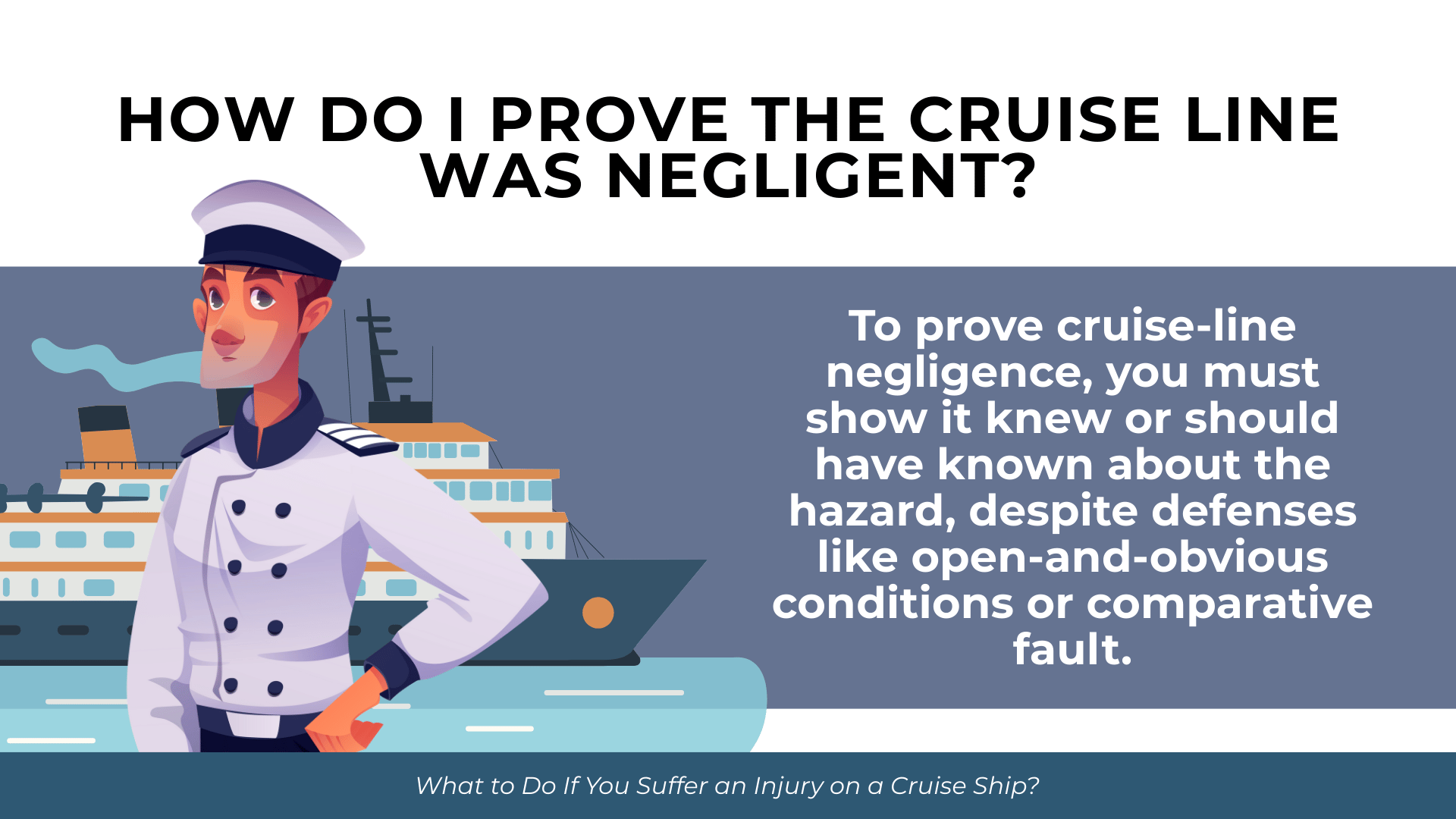
What If I Was Injured During a Shore Excursion?
Shore excursion injuries involve different liability standards than shipboard accidents. Cruise lines typically aren’t responsible for injuries caused by independent tour operators but can face liability for their own negligence in selecting or monitoring vendors.
Liability Standard
Under Smolnikar v. Royal Caribbean Cruises Ltd., 787 F. Supp. 2d 1308 (S.D. Fla. 2011), ticket disclaimers prevent vicarious liability for independent contractors’ negligence. However, cruise lines remain liable for direct negligence such as negligently selecting vendors or failing to warn about known dangers.
Required Proof Elements
You must prove the cruise line knew or should have known about prior similar incidents with the vendor. Evidence includes past accident reports, safety violations, or customer complaints the cruise line received or could have discovered through reasonable investigation. Failure to provide adequate warnings about known risks creates liability. If the cruise line knew about specific dangers but didn’t inform passengers, they bear responsibility for resulting injuries.
Vendor vs. Cruise Line Responsibility
The tour operator remains the primary defendant for direct negligence causing your injury. Contract disclaimers explicitly identify vendors as independent contractors to limit cruise line liability. The cruise line’s liability depends on its actual or constructive knowledge of safety issues. Marketing materials presenting excursions as cruise line operations rather than independent vendors can create apparent agency liability. 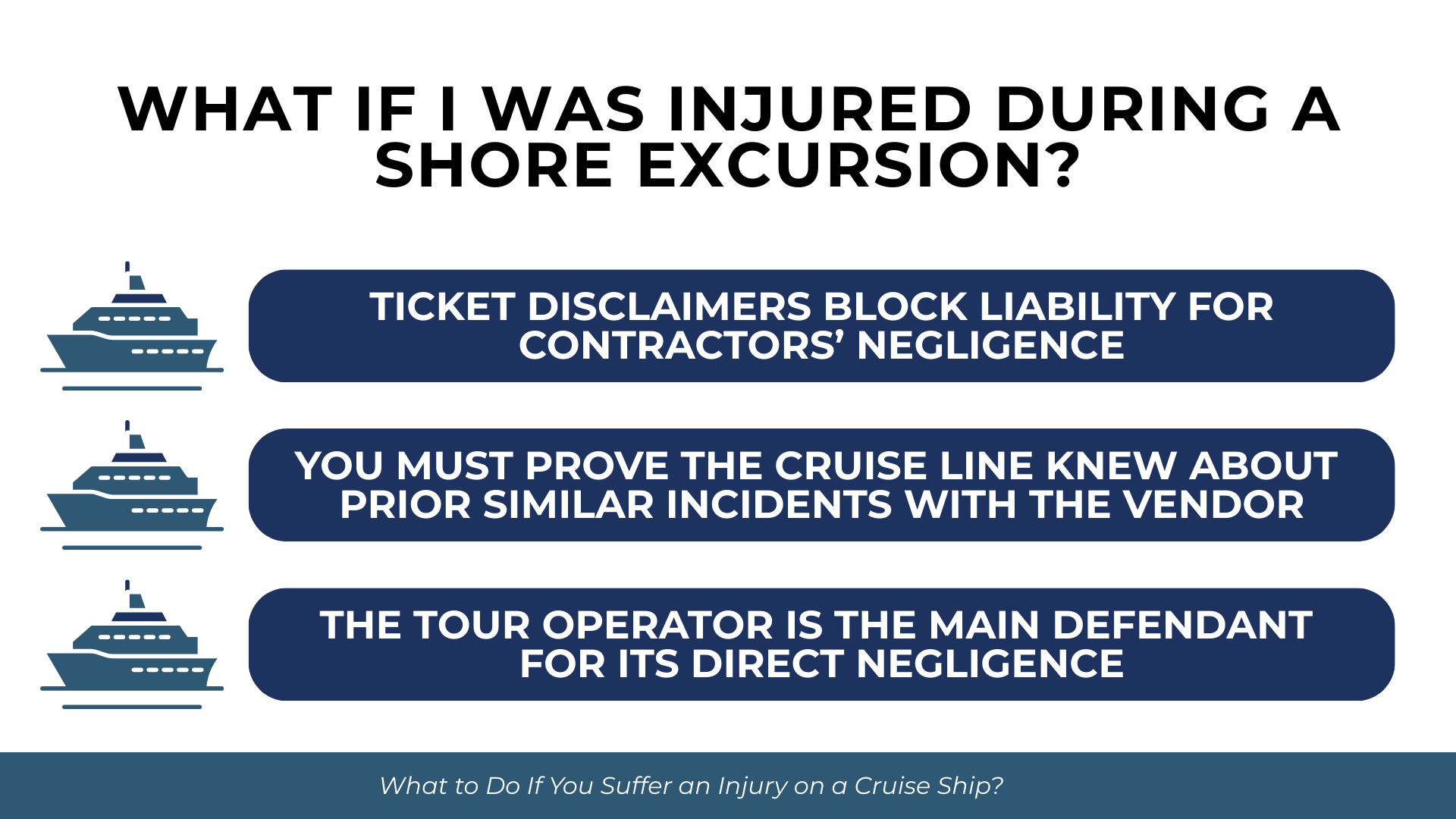
When Should I Contact a Maritime Injury Attorney?
The complex intersection of contractual deadlines, federal maritime law, and multi-jurisdictional issues makes immediate legal consultation essential. Waiting even a few weeks can result in lost evidence and missed deadlines.
Evidence Preservation Urgency
CCTV footage deletion within 7-30 days means you need formal preservation letters sent immediately. An attorney can draft and send comprehensive preservation demands that cruise lines can’t ignore. Key witnesses scatter to different countries after disembarkation, making early contact crucial.
Legal Complexity Factors
Maritime law differs significantly from state personal injury law. The notice requirement, forum selection clauses, and pure comparative negligence create unique challenges. Federal court procedures in the Southern District of Florida have specific requirements that trip up even experienced attorneys unfamiliar with admiralty practice.
Free Consultation Benefits
Experienced maritime attorneys can evaluate your case’s strengths and weaknesses immediately. They understand which evidence disappears quickly and how to preserve it. Most importantly, they can ensure you meet all contractual notice requirements while you focus on healing. If you’ve been injured on a cruise ship, an experienced maritime injury attorney can protect your rights and guide you through the complex legal process. 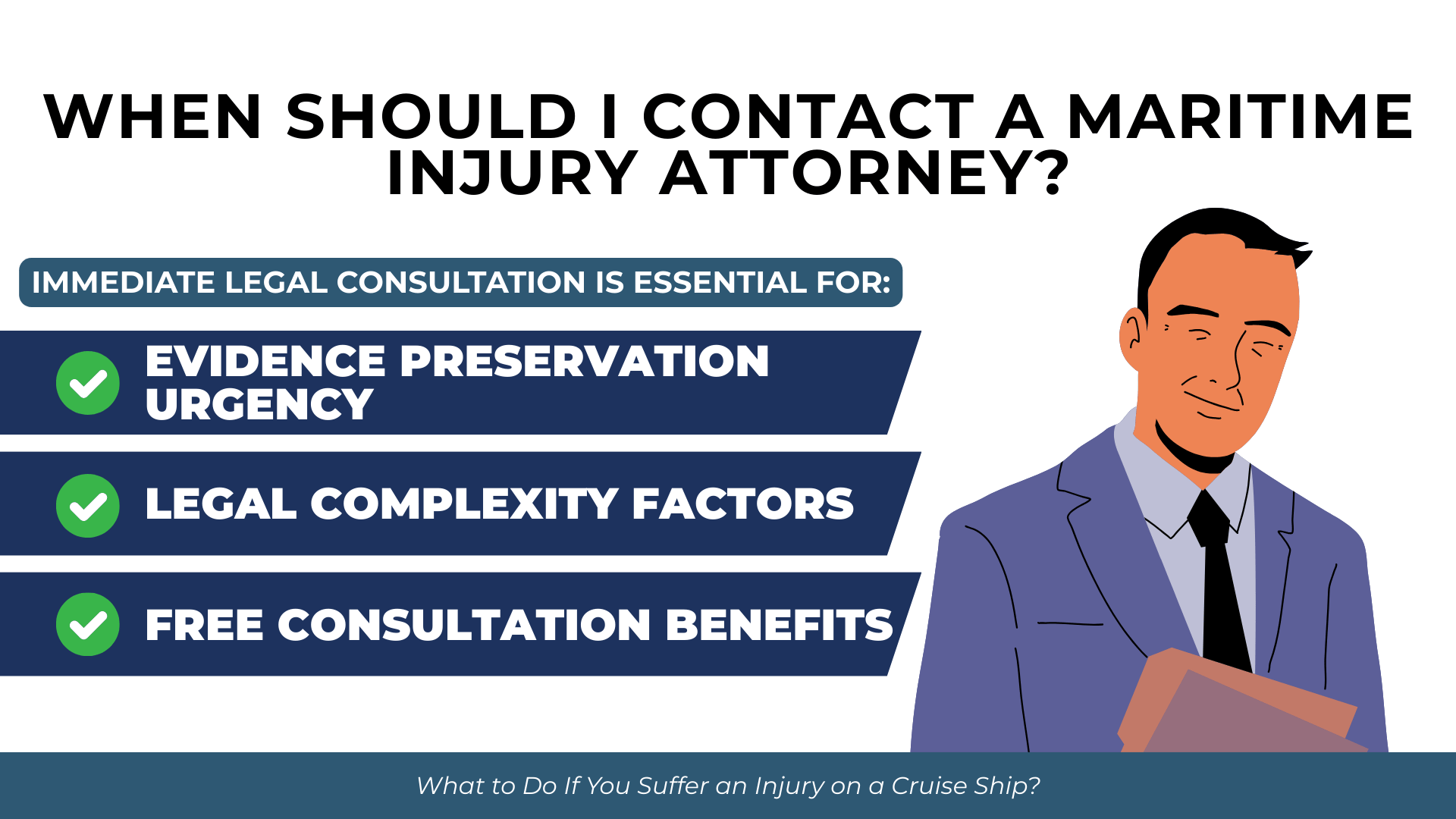
Frequently Asked Questions
Q: What is the notice requirement for cruise ship injury claims?
A: Cruise lines can be held liable only if they had actual or constructive notice of the dangerous condition, as established in Keefe v. Bahama Cruise Line, 867 F.2d 1318 (11th Cir. 1989). Actual notice means the cruise line created the hazard or knew about it, while constructive notice applies when prior similar incidents occurred or the hazard existed long enough for discovery through reasonable inspection.
Q: Where must cruise ship injury lawsuits be filed?
A: Forum selection clauses in cruise contracts typically require filing suit in the U.S. District Court for the Southern District of Florida (Miami Division). These clauses are generally enforceable under Carnival Cruise Lines, Inc. v. Shute, 499 U.S. 585 (1991), even when filing in Miami is inconvenient or expensive for passengers from other states.
Q: How long do I have to file a cruise ship injury lawsuit?
A: While maritime law provides three years under 46 U.S.C. § 30106, cruise lines commonly shorten this to one year through ticket contracts as permitted by 46 U.S.C. § 30508. Additionally, most contracts require written notice within six months of injury. Missing either deadline can permanently bar your claim.
Q: What if the hazard was open and obvious?
A: Under maritime doctrine, cruise lines have no duty to warn of open and obvious hazards. However, this doesn’t bar your claim entirely. Comparative fault still applies, reducing but not eliminating damages. You can pursue other theories of liability, such as the cruise line creating the hazard or having notice that the condition posed an unreasonable risk despite being visible.
Q: Can the cruise line be liable for shore excursion injuries?
A: Yes, cruise lines can face liability for their own direct negligence in selecting vendors or failing to warn of known dangers, as established in Smolnikar v. Royal Caribbean Cruises Ltd., 787 F. Supp. 2d 1308 (S.D. Fla. 2011). While ticket disclaimers prevent vicarious liability for independent operators’ negligence, cruise lines remain responsible when they knew or should have known about safety issues with excursion vendors. 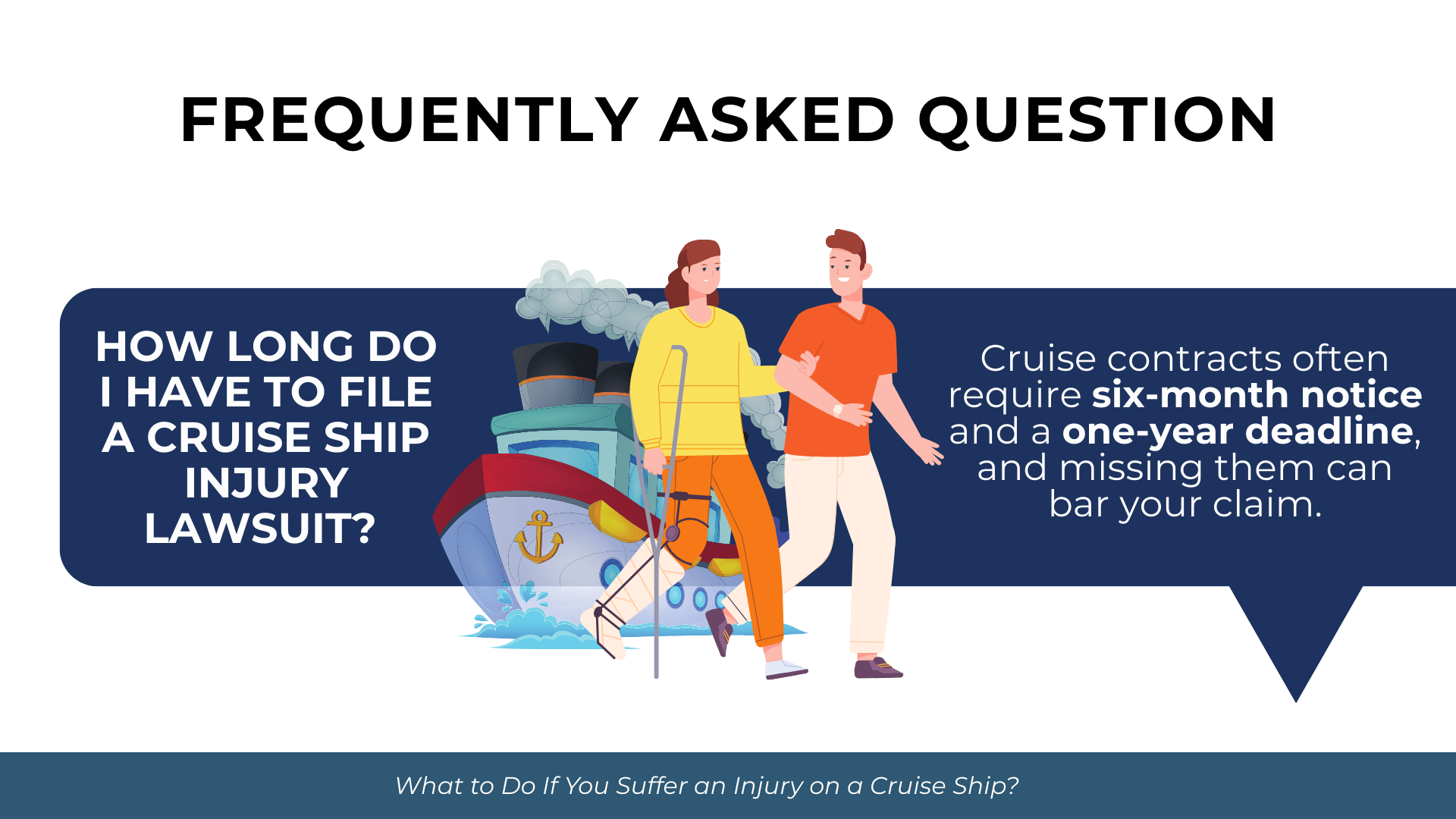
Conclusion
After a cruise ship injury, your immediate actions significantly impact your ability to recover compensation. Document everything, seek medical attention, formally request evidence preservation, and understand the strict deadlines that govern maritime claims. The complexity of federal maritime law and the cruise line’s aggressive defense tactics make experienced legal representation essential. Contact Prosper Injury Attorneys to discuss your cruise ship injury case and understand your options.