Rental boat injuries in Miami happen with alarming regularity. The combination of inexperienced operators, crowded waterways, and equipment that may not be properly maintained creates conditions where serious accidents occur every year. If you rented a boat in Miami and suffered an injury, understanding what types of accidents are most common can help you recognize whether negligence played a role in what happened to you.
Miami sits at the center of Florida’s recreational boating industry—the state with the highest volume of boating activity in the nation. The warm weather, accessible waterways, and tourist-driven demand mean rental boats are constantly in use. But the same factors that make Miami attractive for boating also create elevated risks. National data from 2024 shows 3,887 total boating incidents, 556 fatalities, and 2,170 injuries, with rental vessels showing higher accident rates per operating hour than owner-operated boats.
This guide explains the most frequent injury types on rental boats, why they happen, and when the rental company may bear legal responsibility.
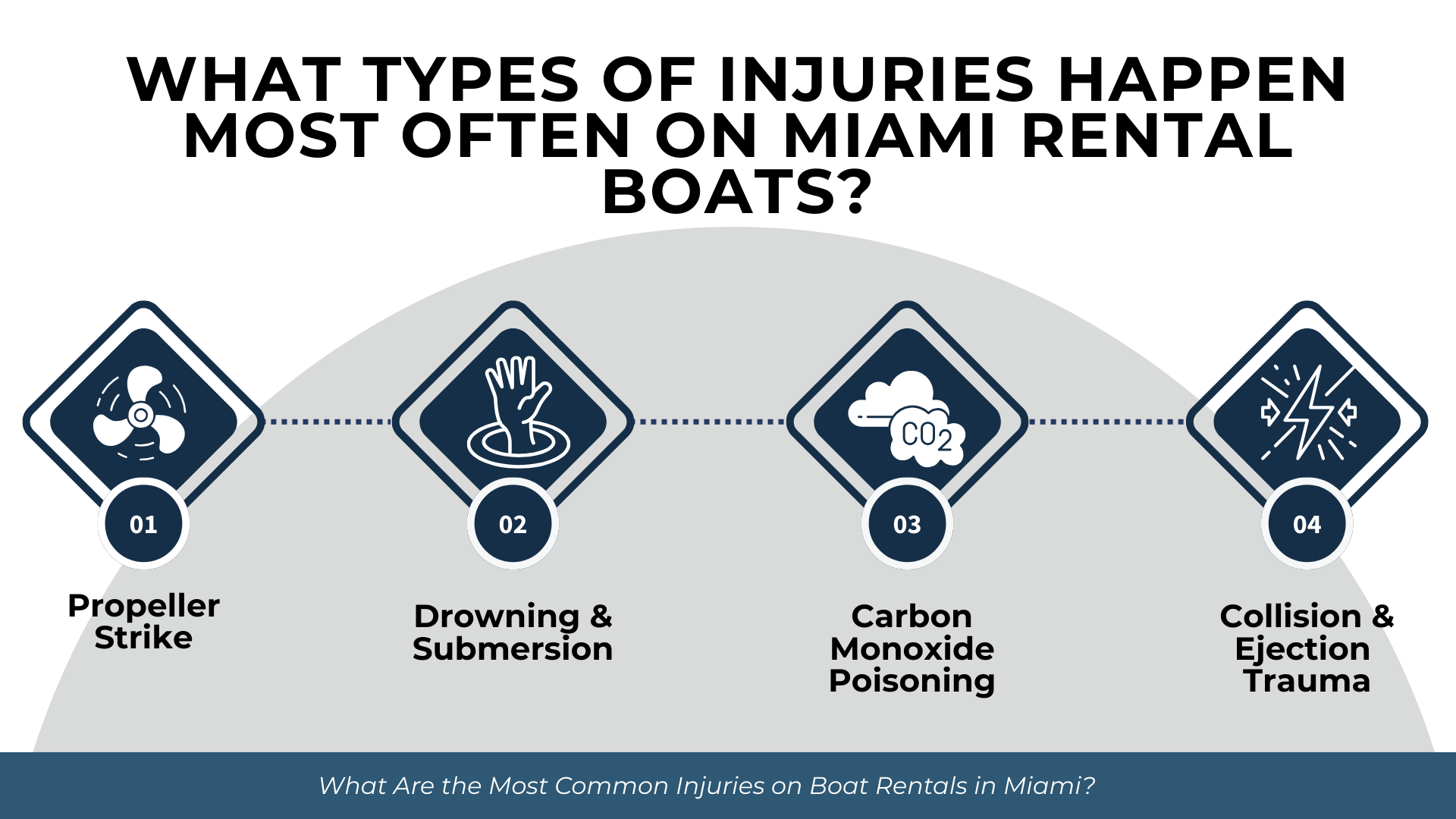
What Types of Injuries Happen Most Often on Miami Rental Boats?
Rental boat injuries fall into several distinct categories, each with its own mechanism and severity profile. Understanding these patterns helps injured passengers recognize whether their experience reflects a preventable accident.
Propeller strike injuries
Propeller strikes represent some of the most devastating injuries on rental boats. These accidents occur when passengers fall overboard or enter the water near the stern while the engine remains running. An untrained operator may inadvertently put the boat in reverse while someone is in the water, or fail to kill the engine before picking up a swimmer. The spinning propeller causes severe lacerations, limb amputations, and fatalities. The USCG reports approximately 170-180 propeller strikes annually nationwide, though studies suggest significant underreporting because many incidents never receive formal documentation.
Drowning and submersion incidents
Drowning remains the primary cause of fatality in rental boat accidents. These incidents often follow other accident types—a passenger ejected during a collision, someone thrown overboard when the boat capsizes, or a victim who falls unconscious from carbon monoxide exposure and slips into the water. Unlike pools with lifeguards and controlled conditions, rental boat passengers face open water, currents, and distance from shore that make rescue difficult.
Carbon monoxide poisoning
Carbon monoxide poisoning on boats follows a specific pattern. The practice known as “teak surfing”—where passengers hold onto the swim platform while the boat moves—exposes them to exhaust fumes concentrated at the stern. Similarly, swimming near the swim platform while the generator or engine runs creates the “station wagon effect,” where CO accumulates in the breathing zone. Victims may lose consciousness without warning and drown before anyone recognizes what happened.
Collision and ejection trauma
Collisions with other vessels, docks, and fixed objects cause blunt trauma injuries including fractures, head injuries, and internal damage. Inexperienced operators unfamiliar with navigation markers may run aground on shoals, causing sudden stops that eject passengers. Standing passengers are particularly vulnerable when the boat turns sharply or strikes an obstacle.
The most common injury types on Miami rental boats include:
- Propeller lacerations and amputations. Contact with spinning propellers causes catastrophic tissue damage and limb loss.
- Drowning. Submersion following ejection, capsizing, or loss of consciousness from other causes.
- Carbon monoxide poisoning. Exhaust exposure leading to unconsciousness and secondary drowning.
- Blunt force trauma. Impact injuries from collisions with vessels, docks, or fixed structures.
- Fractures from ejection. Broken bones sustained when passengers are thrown from the boat during sudden stops or impacts.
- Capsizing injuries. Trauma and drowning resulting from boats overturning, particularly double-decker pontoons.
Why Are Rental Boat Accidents So Common in Miami?
Call us today at (305) 694-2676 or
contact us online for a free case evaluation.
Hablamos español.


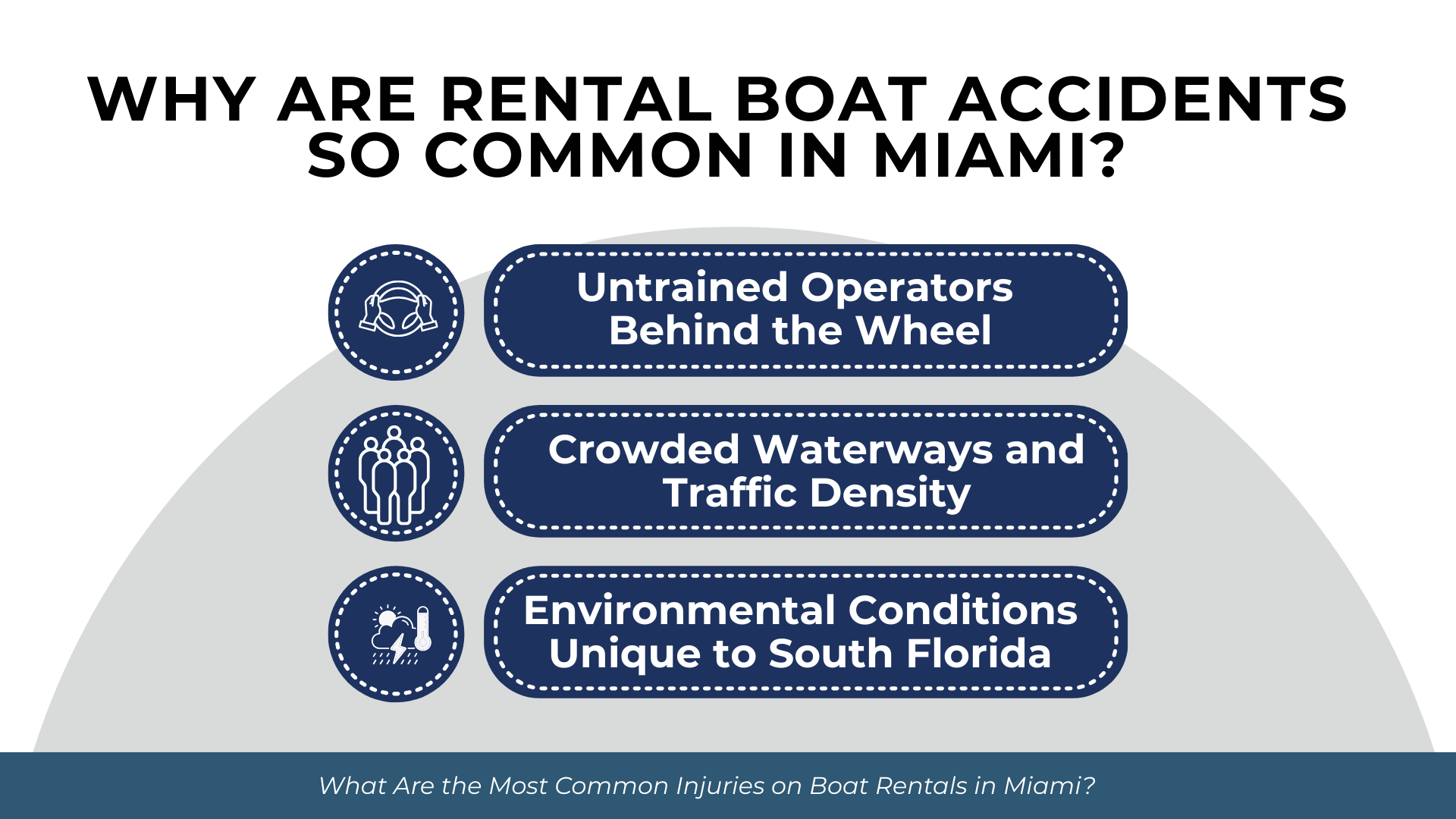
Several factors converge to make Miami’s rental boat environment particularly hazardous. The combination of operator inexperience, waterway congestion, and environmental conditions creates a setting where accidents occur at rates higher than in owner-operated boating.
Untrained operators behind the wheel
The single most significant factor in rental boat accidents is operator inexperience. Nationwide, 74% of boating deaths occur on vessels where the operator had no formal boating safety instruction. Many jurisdictions historically required no training whatsoever to rent a boat—just a driver’s license and a credit card. First-time operators face an unfamiliar vessel in unfamiliar waters with only a brief safety talk as preparation. The same dynamic applies to jet ski rentals, where inexperienced tourists face similar risks compounded by the unique handling characteristics of personal watercraft.
Renters often underestimate how different boat handling is from driving a car. There are no brakes. Steering responds differently at various speeds. Navigation markers have meanings that untrained operators don’t understand. The learning curve is steep, and mistakes happen quickly.
Crowded waterways and traffic density
Miami’s waterways experience heavy traffic, particularly during summer months and holiday weekends. Passages like Haulover Inlet concentrate these risks in narrow channels with challenging wave conditions. Accidents spike on Memorial Day, July 4th, and Labor Day when recreational boaters flood the water in large numbers. Congested conditions mean multiple vessels operating in close proximity, often piloted by people with varying experience levels. A single mistake by one operator can trigger chain-reaction incidents.
The demographic profile of those at highest risk reinforces this pattern: inexperienced tourists aged 20-40, vacationing in a rental context, operating boats for the first time.
Environmental conditions unique to South Florida
Miami’s environment presents challenges that catch visitors off guard. Strong currents can push boats into hazards before inexperienced operators can compensate. Sudden weather changes bring wind and waves that make smaller vessels difficult to control. Evening hours raise collision risk as visibility drops and fatigue sets in. Navigating unfamiliar waters in reduced light compounds every other risk factor.
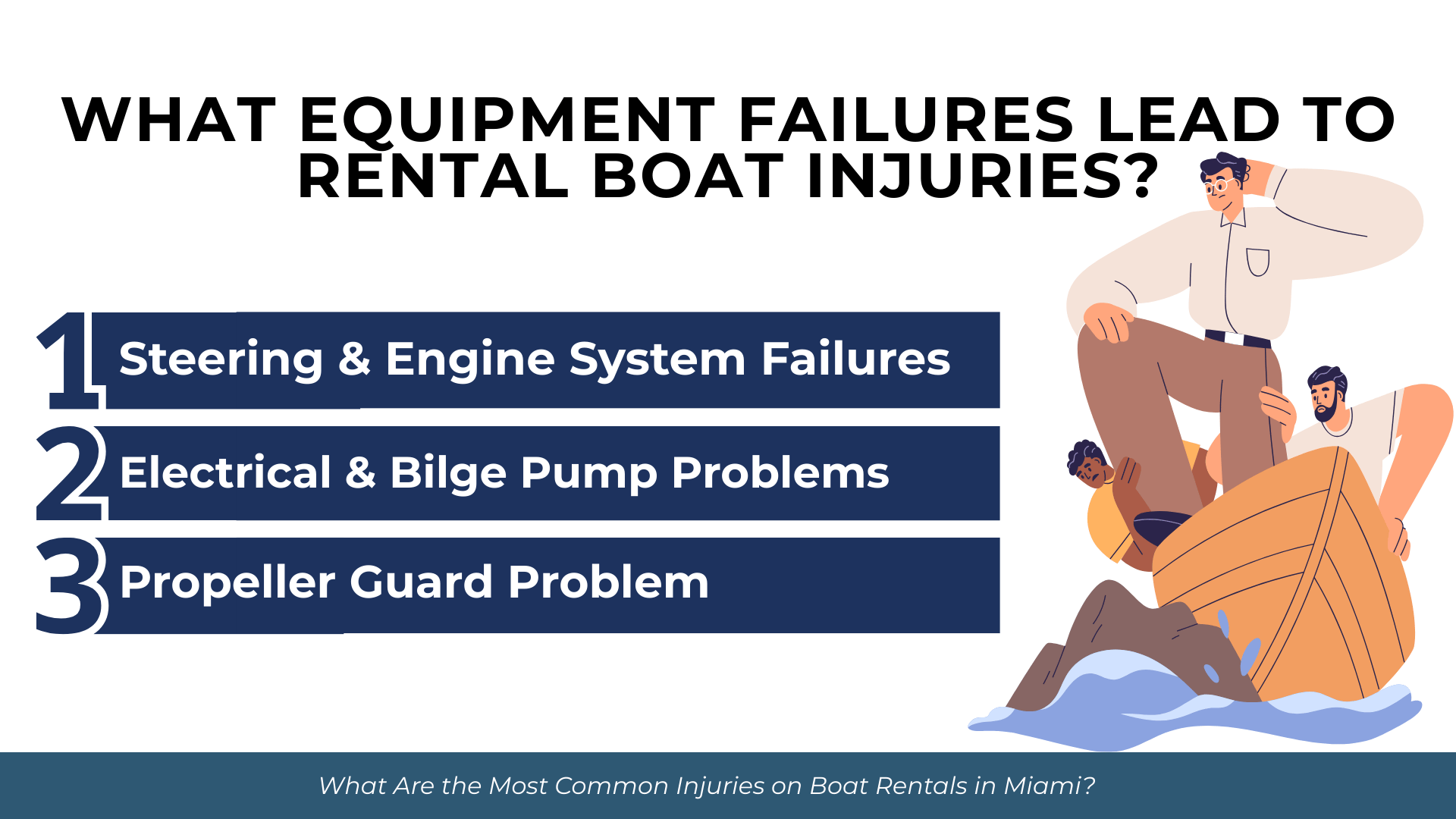
What Equipment Failures Lead to Rental Boat Injuries?
Equipment failures in rental fleets contribute to accidents that injure passengers who had no way to anticipate the mechanical problem. Deferred maintenance and cost-cutting create conditions where critical systems fail at dangerous moments.
Steering and engine system failures
Mechanical failures in rental boats often involve the systems most essential to safe operation:
- Steering cable corrosion. Salt exposure causes cables to corrode, leading to “frozen” steering that won’t respond or snapped cables that eliminate directional control entirely.
- Hydraulic steering failures. Loss of hydraulic pressure renders steering ineffective without warning.
- Engine stalling. Fuel system issues and clogged filters cause power loss, leaving operators unable to maneuver away from hazards.
- Fuel leaks. Deteriorating fuel systems create fire hazards in addition to engine problems.
- Throttle malfunctions. Corroded throttle mechanisms may stick or fail to respond.
These mechanical failures often trace back to the same causes of boat accidents seen across Miami’s waterways—deferred maintenance and profit-driven shortcuts.
Electrical and bilge pump problems
Electrical system failures create multiple hazards. Poor DIY wiring in older rental fleets—identifiable by corroded connections showing green or white crust—causes shorts that stall engines at critical moments. Bilge pump electrical failures are particularly dangerous because the pump is a critical safety system. If the hull takes on water and the bilge pump doesn’t function, the boat may swamp or sink.
The propeller guard problem
The boat rental industry has generally resisted installing propeller guards despite their potential to prevent amputations and severe lacerations. Operators cite “performance issues” as justification, but the absence of guards means spinning propellers remain directly accessible to anyone in the water near the stern. This industry-wide reluctance creates ongoing risk that proper equipment could mitigate.
Rental fleets commonly exhibit deferred maintenance patterns: older boats kept in service past safe operating life, inspection intervals extended beyond manufacturer recommendations, and repairs done cheaply rather than properly.
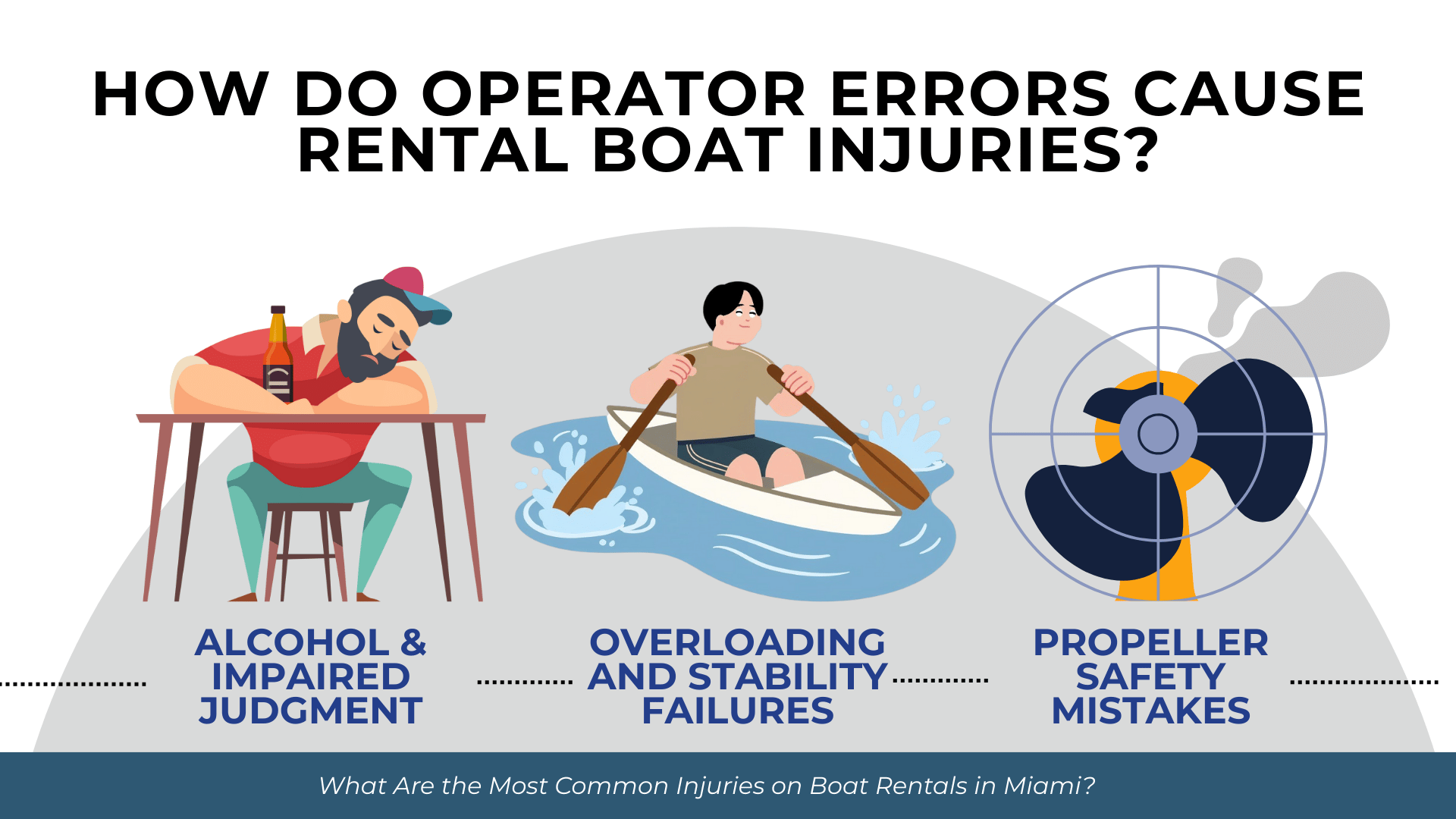
How Do Operator Errors Cause Rental Boat Injuries?
Even when equipment functions properly, operator mistakes cause the majority of rental boat injuries. The patterns are predictable and often preventable with adequate training and supervision.
Alcohol and impaired judgment
Alcohol use is the leading known contributing factor in fatal boating accidents. Impairment affects judgment, reaction time, and balance—all critical for safe boat operation. The effects compound on the water, where sun exposure, dehydration, and motion amplify alcohol’s impact. Passengers and operators alike underestimate how quickly conditions become dangerous when alcohol enters the equation.
Overloading and stability failures
Renters frequently exceed weight limits, especially on pontoon boats where extra passengers seem harmless. Overloading compromises stability and freeboard—the distance between the waterline and the deck edge. When weight exceeds design limits, boats become top-heavy and capsizing risk increases dramatically. This problem worsens because weight standards historically assumed 140 pounds per person, far below modern actual passenger weights.
Double-decker pontoons face particular vulnerability. When passengers congregate on the upper deck, the high center of gravity creates instability that high winds can exploit. Multiple incidents involving double-decker rental pontoons flipping have demonstrated this dangerous pattern.
Propeller safety mistakes
Operator errors around propeller safety follow a consistent pattern: failing to kill the engine when someone is in the water, putting the boat in gear while swimmers are nearby, and not designating a spotter to watch for people in the water. These mistakes turn routine situations—picking up a tuber, retrieving a dropped item, swimming off the stern—into catastrophic injury events.
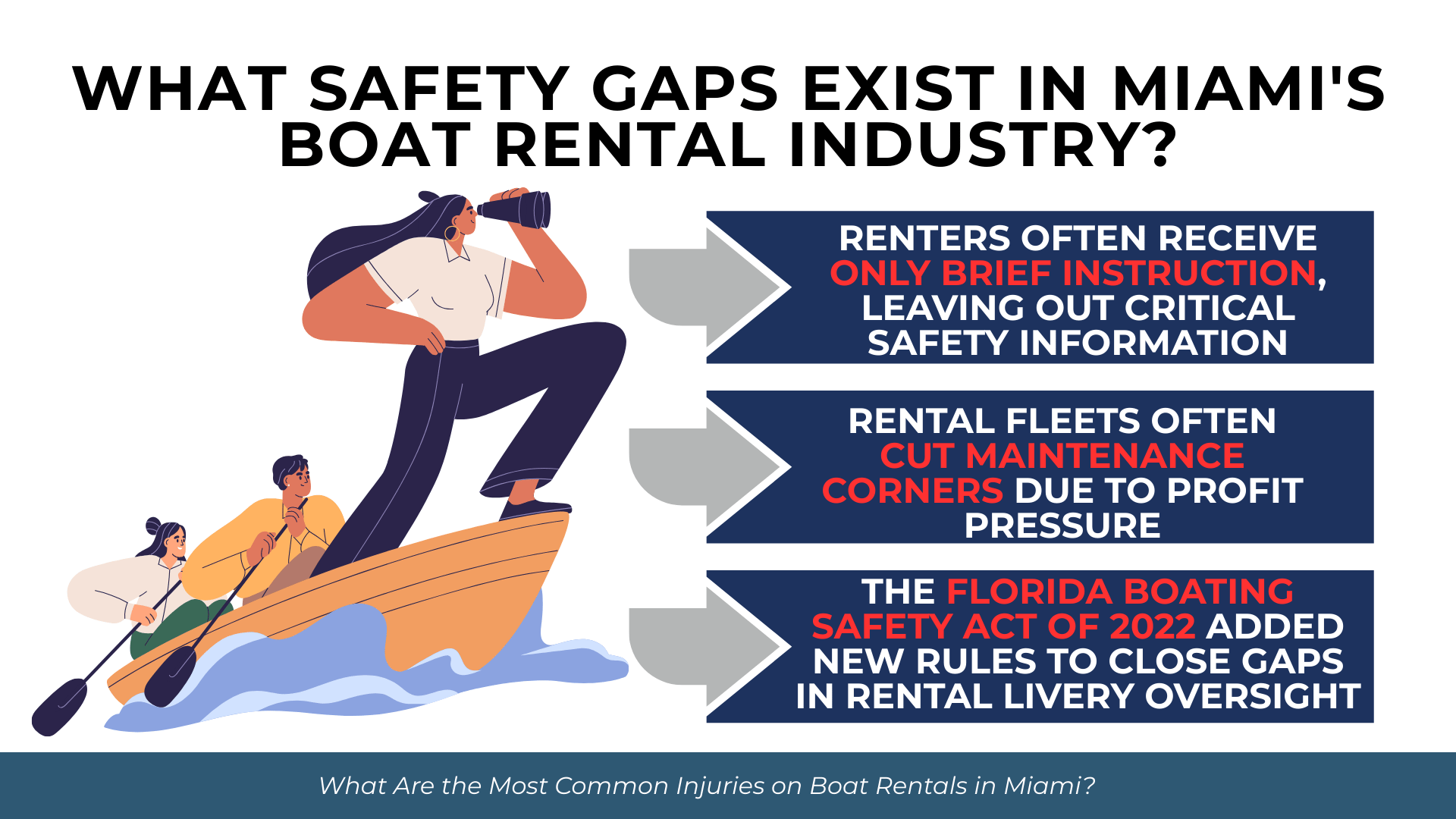
What Safety Gaps Exist in Miami’s Boat Rental Industry?
Get started with your complimentary case evaluation today;
call us at (305) 694-2676 or reach us online using our
secure contact form.
The rental boat industry operates with significant safety gaps that contribute to predictable injury patterns. Understanding these gaps reveals where negligence may have played a role in your accident.
Rushed briefings and inadequate instruction
Standard rental transactions include safety briefings lasting 10-20 minutes, covering throttle operation, steering basics, navigation fundamentals, and life jacket locations. These briefings are checklist-based and quality varies wildly between operators. Staff frequently rush through briefings to turn over rentals faster, prioritizing volume over passenger safety.
Critical information often receives inadequate attention or is omitted entirely: local hazards like unmarked shoals, traffic patterns in congested areas, reboarding techniques if someone falls overboard, and what to do in emergencies. Renters depart with superficial knowledge and false confidence.
Fleet maintenance shortcuts
Rental fleets commonly exhibit maintenance shortcuts driven by profit pressure. Older boats remain in rotation past safe operating life. Inspection intervals extend beyond manufacturer specifications. Repairs get done cheaply rather than properly—DIY fixes instead of professional service. These shortcuts accumulate until equipment fails at a critical moment, injuring passengers who trusted that the boat was safe.
What Florida law now requires
The Florida Boating Safety Act of 2022 imposed new requirements on rental liveries that address some historical gaps:
- Rental livery permits. Companies must now obtain specific permits to rent boats.
- Pre-rental safety instructions. Specific safety information must be provided before each rental.
- Documented safety briefings. Briefings must be formally documented, creating records of what renters were told.
- Consistent standards. The law establishes baseline requirements rather than leaving safety entirely to operator discretion.
Prior to 2022, Florida required nothing beyond a driver’s license to rent a boat. The new requirements represent improvement, but enforcement and compliance vary.
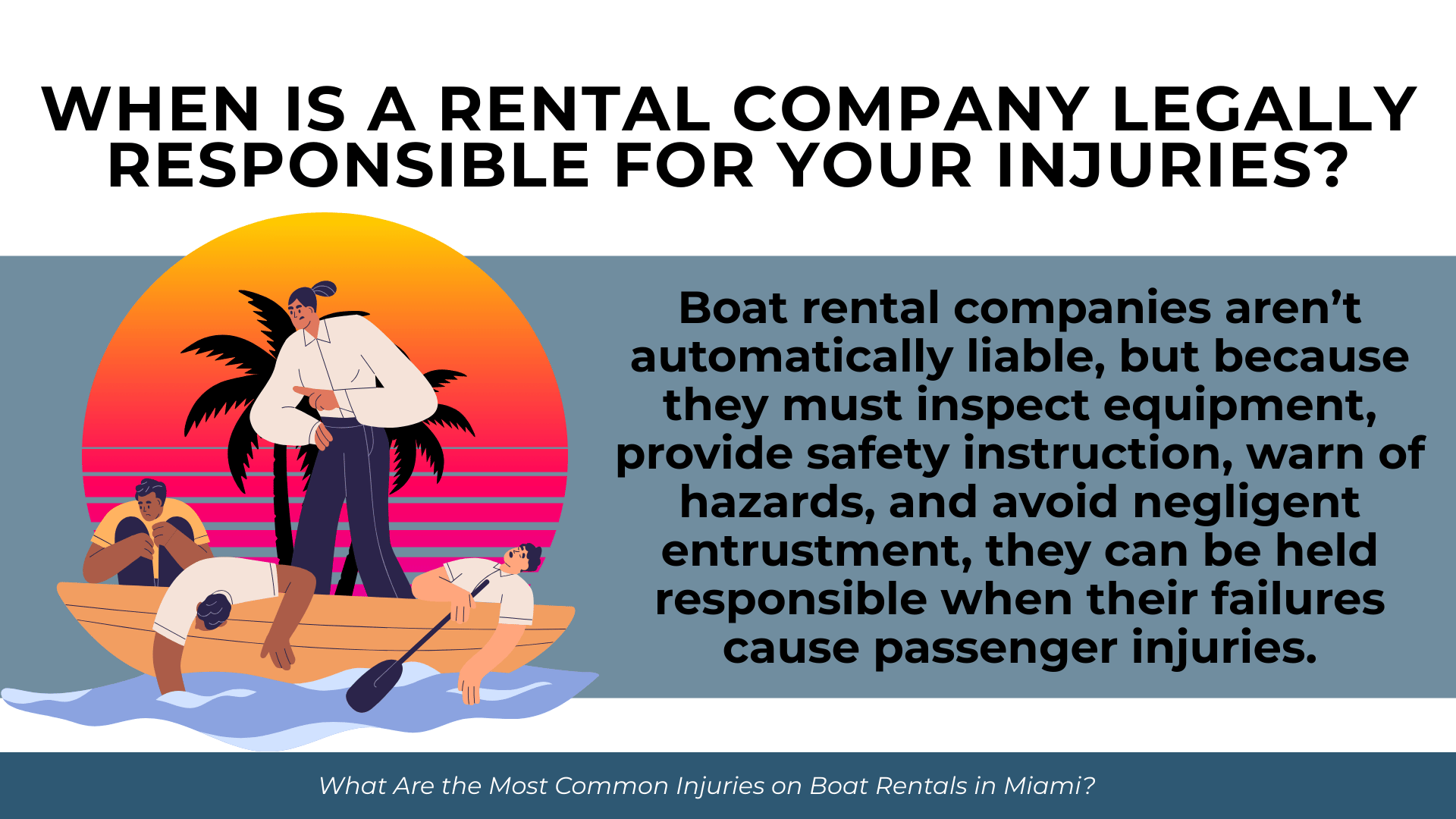
When Is a Rental Company Legally Responsible for Your Injuries?
Rental companies are not automatically liable for every injury that occurs on their boats. However, they have specific duties under maritime and Florida law, and breaching those duties can create legal responsibility for passenger injuries.
Duties rental companies owe you
Under general maritime law, boat rental companies owe passengers a duty of ordinary reasonable care under the circumstances. This translates into specific obligations. They must inspect equipment for hazards before each rental, checking steering cables, electrical systems, engines, and safety equipment. They must provide adequate instruction on safe operation, covering vessel-specific controls, local hazards, and emergency procedures. They must warn of known or reasonably discoverable risks including weather conditions, water currents, and traffic patterns in the rental area.
These duties exist because rental companies profit from putting inexperienced operators in vessels they control. The company benefits from the transaction and must take reasonable steps to prevent foreseeable harm.
The negligent entrustment theory
Rental companies can be sued under a theory of negligent entrustment when they rent boats to people who are unfit or untrained to operate them safely. This theory applies when a rental company provides a vessel to someone whose inexperience or condition makes an accident foreseeable. Rushing through safety briefings, failing to verify renter experience, or renting to obviously intoxicated individuals may establish negligent entrustment.
Why the “bareboat charter” defense usually fails
Rental companies sometimes argue that once they hand over the keys, they bear no responsibility for what happens. This argument invokes the bareboat charter doctrine, which shields vessel owners when they transfer complete possession and control to a charterer. However, most recreational rentals are not true bareboat charters.
Rental companies typically retain operational responsibilities: they conduct safety briefings, manage fuel, maintain the vessels, and impose geographic or operational restrictions. Because these elements of control remain with the rental company, liability typically stays with them rather than shifting entirely to the renter. An attorney experienced in maritime law can evaluate whether the rental company’s retained control creates a basis for your claim.
Does Maritime Law Apply to Boat Rental Injuries in Miami?
Understanding which legal framework governs your case matters because maritime law differs from ordinary Florida tort law in important ways.
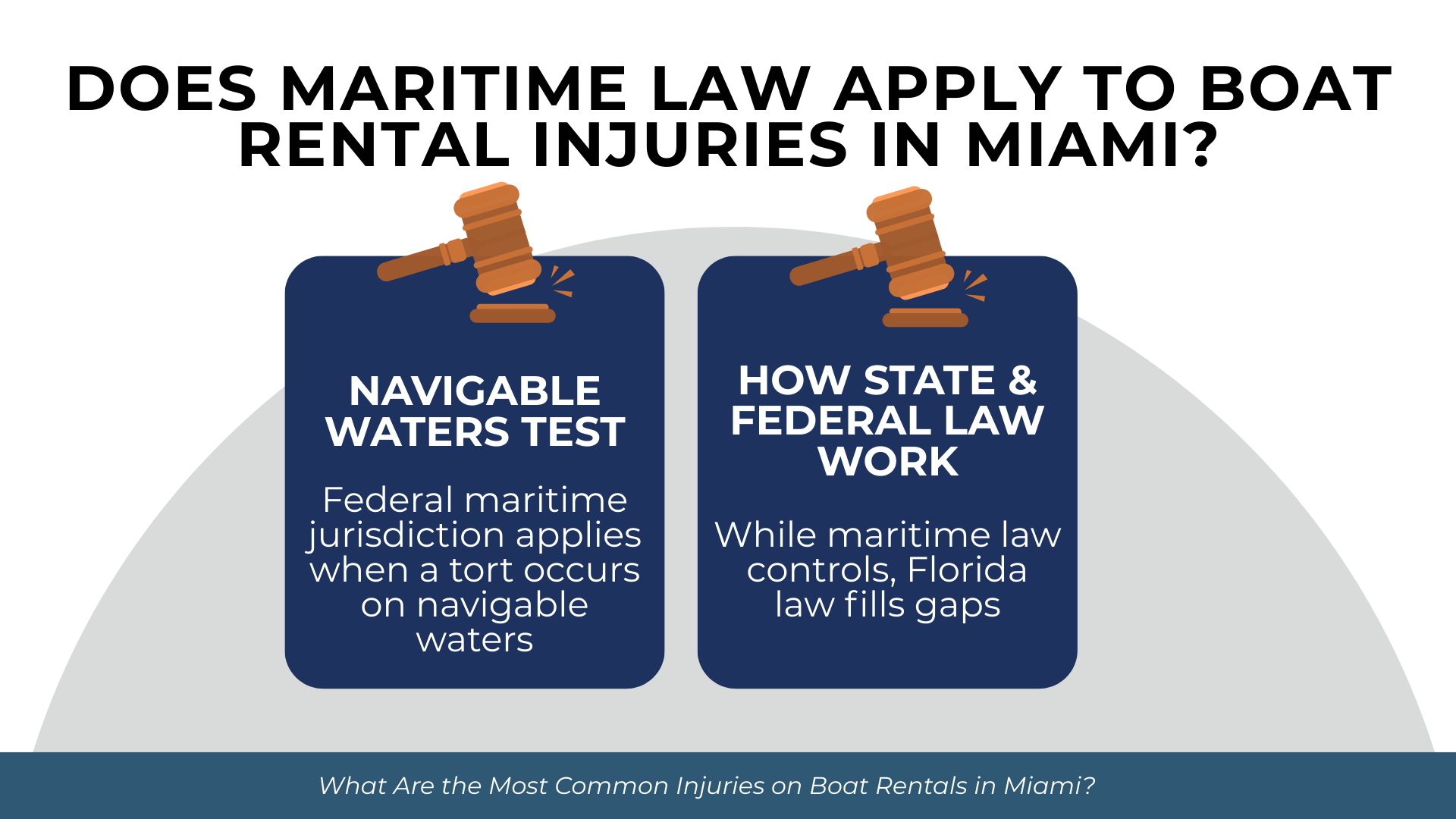
The navigable waters test
Federal maritime jurisdiction applies when a tort occurs on navigable waters and bears a substantial relationship to traditional maritime activity. Miami’s coastal waters, Biscayne Bay, and connected waterways qualify as navigable under 28 U.S.C. § 1333. Rental boat accidents in these areas fall under maritime jurisdiction, meaning maritime negligence standards apply.
How state and federal law work together
Maritime law is supreme, but state law fills gaps where maritime law provides no remedy. Florida wrongful death statutes apply to fatal boating accidents within three nautical miles of shore, allowing broader damages than would be available under federal maritime law alone. State licensing and inspection standards for rental fleets—including the Florida Boating Safety Act of 2022—apply alongside maritime rules unless federally preempted.
This dual framework means your claim may involve both federal maritime principles and Florida state law, depending on the specific circumstances and injuries involved.
Frequently Asked Questions
How often do propeller strikes happen on rental boats?
The USCG reports approximately 170-180 propeller strikes annually nationwide, though studies suggest significant underreporting. Many incidents are never formally documented, especially non-fatal injuries that receive treatment without official reports being filed.
Are rental boat operators required to have training in Florida?
Prior to 2022, Florida required no formal training for renters. The Florida Boating Safety Act of 2022 now requires rental liveries to obtain permits and provide documented safety briefings, though the quality of instruction still varies considerably between operators.
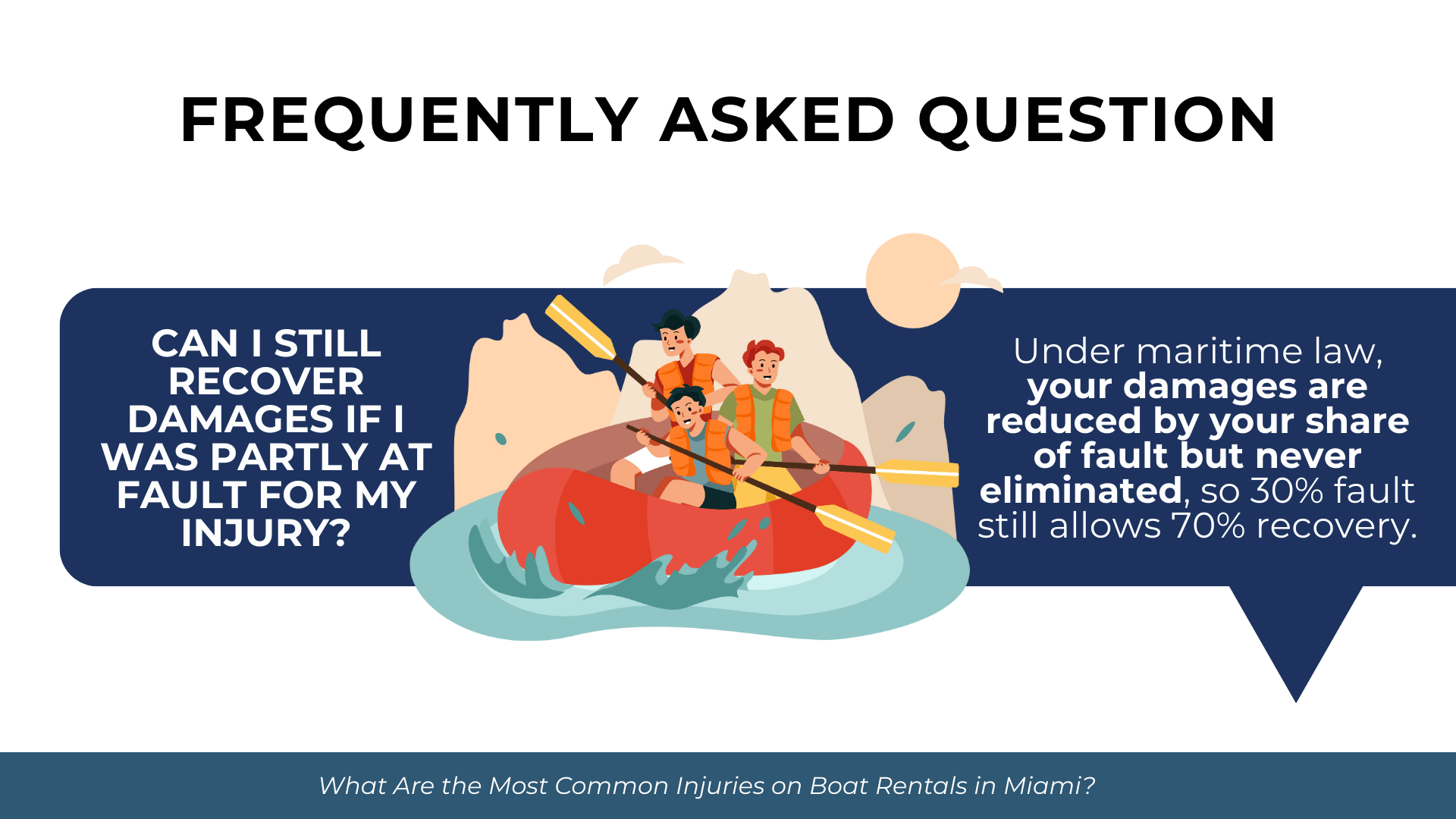
Can I still recover damages if I was partly at fault for my injury?
Maritime law uses pure comparative negligence. Your damages are reduced by your percentage of fault but are never completely barred, even if you share significant responsibility for the accident. A passenger who was 30% at fault would recover 70% of their total damages.
What makes pontoon boats particularly dangerous for capsizing?
Double-decker pontoon boats have high centers of gravity that make them vulnerable to capsizing, especially when passengers congregate on the upper deck. Combined with high winds and overloading beyond weight limits, these conditions create dangerous instability that has caused multiple fatal incidents.
How long do I have to file a claim for a boat rental injury in Miami?
Maritime torts generally must be filed within three years under 46 U.S.C. § 30106. However, acting quickly is essential to preserve evidence and document equipment conditions before the rental company makes repairs, disposes of the vessel, or overwrites relevant records.
Protecting Your Rights After a Rental Boat Injury
Boat rental injuries in Miami follow predictable patterns: propeller strikes, drowning, carbon monoxide poisoning, collisions, capsizing, and ejection trauma. These accidents often result from a combination of inexperienced operators, inadequate safety briefings, deferred equipment maintenance, and crowded waterways. When rental companies fail to meet their legal duties—inspecting equipment, providing adequate instruction, and warning of known hazards—they may be held responsible for the injuries that result.
If you or a family member suffered injuries on a rental boat in Miami, the circumstances matter. Evidence about equipment condition, safety briefings provided, and the rental company’s maintenance practices can deteriorate quickly. Contact Prosper Injury Attorneys to discuss your boat rental injury case and understand your options under maritime and Florida law.