
When you suspect that a healthcare provider’s negligence caused your injury, meeting with a medical malpractice lawyer is an important first step. How you prepare for that consultation directly affects the attorney’s ability to evaluate your potential claim. Arriving with organized documentation and a clear understanding of what to expect allows both you and the attorney to make the most of your time together.
Florida medical malpractice claims involve specific legal requirements that differ from other personal injury cases. Understanding these requirements before your consultation helps you provide the information the attorney needs to assess whether you have a viable case under Florida law.
Why Preparation Matters for Your Medical Malpractice Consultation
What Attorneys Evaluate During Initial Meetings
A medical malpractice attorney evaluates four essential elements during your consultation. Under Florida law, a successful claim requires proving that a healthcare provider violated the prevailing professional standard of care, that this violation caused your injury, and that you suffered compensable damages as a result.
The prevailing professional standard of care is defined under Fla. Stat. § 766.102(1) as “that level of care, skill, and treatment which, in light of all relevant surrounding circumstances, is recognized as acceptable and appropriate by reasonably prudent similar health care providers.” Your attorney needs to understand exactly what medical care you received to determine whether it fell below this standard.
Florida also requires proof of causation under a “more likely than not” standard—meaning greater than 50 percent probability. In Gooding v. University Hospital Building, Inc., 445 So. 2d 1015 (Fla. 1984), the Florida Supreme Court established this threshold and rejected claims based on lost chance of survival. Your attorney will assess whether the evidence supports this causation standard.
How Preparation Affects Case Assessment
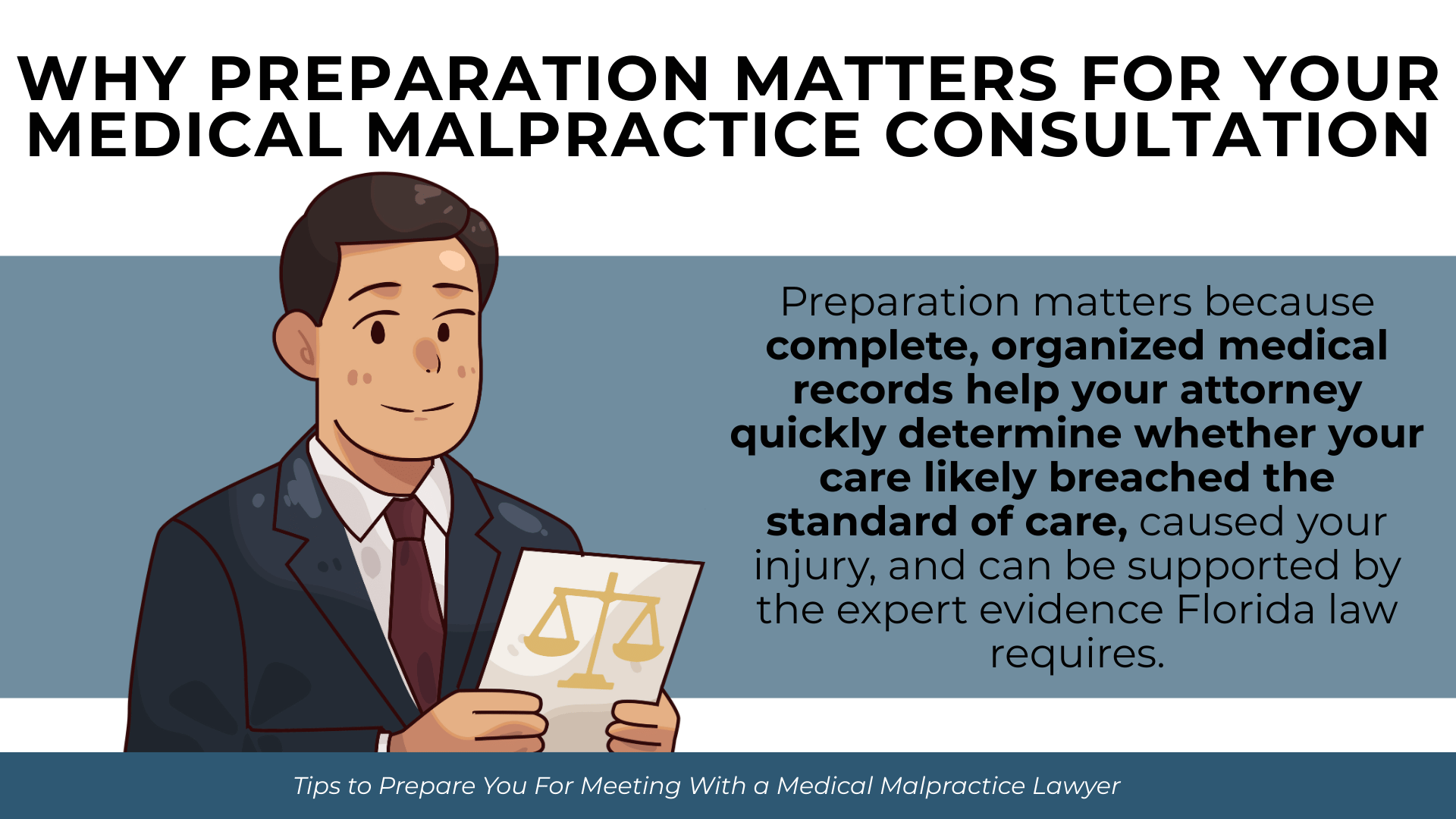
The documents and information you bring to your consultation form the foundation of the attorney’s case evaluation. Medical malpractice cases require expert medical testimony to establish the standard of care and breach. Under Fla. Stat. § 766.102(5)(a), that expert must specialize in the same specialty as the defendant physician and must have devoted professional time during the three years immediately preceding the incident to active clinical practice in that specialty.
Without complete medical records, an attorney cannot fully assess whether qualified expert support exists for your claim. The more organized your documentation, the more efficiently the attorney can identify the key issues and potential defendants in your case.
The Role of Documentation in Medical Malpractice Claims
Florida’s pre-suit requirements make documentation especially critical. Before filing a medical malpractice lawsuit, Fla. Stat. § 766.203 requires the claimant to obtain a verified written medical expert opinion corroborating reasonable grounds to support the claim. This expert opinion must be submitted with the Notice of Intent to Initiate Litigation.
The attorney evaluating your case needs to determine whether the available evidence would support obtaining this mandatory expert opinion. Complete medical records allow the attorney to identify what went wrong, when it occurred, and which healthcare providers were involved.
What Documents Should You Bring to a Malpractice Consultation?

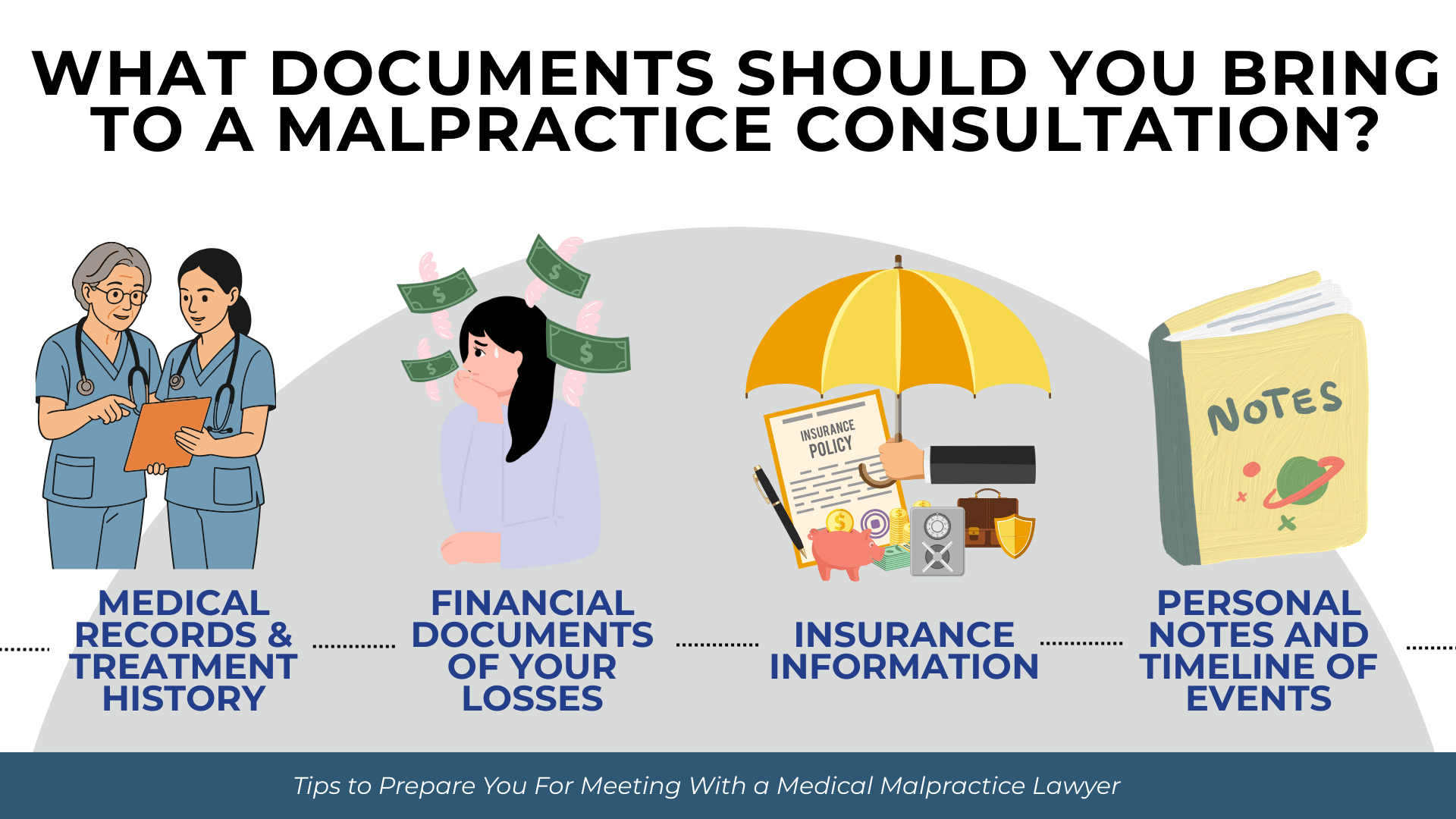
Medical Records and Treatment History
Medical records are the most important documents for your consultation. These records establish what care you received, when you received it, and from whom. They also document your condition before, during, and after the alleged negligence.
You should gather the following documentation before your meeting:
- Hospital admission and discharge records from any relevant hospitalizations
- Emergency room records if your injury required emergency treatment
- Operative reports detailing any surgical procedures performed
- Physician office visit notes from all providers involved in your care
- Laboratory and diagnostic test results, including imaging studies
- Nursing notes and medication administration records
- Consultation reports from specialists who evaluated your condition
- Ambulance or emergency medical services records if applicable
If you have not yet obtained your medical records, inform the attorney during scheduling. Under Florida law, healthcare providers must furnish copies of medical records within specific timeframes upon written request. Your attorney can advise you on how to obtain these records or may be able to assist with record retrieval.
Financial Documentation of Your Losses
Florida recognizes both economic and non-economic damages in medical malpractice cases. Economic damages include quantifiable financial losses such as medical expenses, lost wages, and lost earning capacity. Documenting these losses strengthens your case and helps the attorney assess its value.
Bring any documentation of medical bills you have received, including itemized statements showing charges for treatment related to the alleged malpractice. If you missed work due to your injury, bring pay stubs or employer documentation showing your lost income. If your injury affects your ability to work in the future, bring information about your occupation and earning history.
Insurance Information and Correspondence
Your health insurance information and any correspondence with insurance companies provide important context for your case. Bring your health insurance cards and any explanation of benefits statements related to your medical treatment. If you received correspondence from the healthcare provider’s malpractice insurer, bring those documents as well.
If you filed a complaint with a hospital, medical board, or other regulatory body, bring copies of that correspondence and any responses you received. These documents can contain admissions or information relevant to your claim.
Personal Notes and Timeline of Events
Your personal recollection of events provides crucial context that may not appear in medical records. Before your consultation, write down everything you remember about your medical care, including conversations with healthcare providers and concerns you raised.
Note the dates of all medical appointments, procedures, and hospitalizations. Record when you first noticed symptoms, when you sought treatment, and when you realized something had gone wrong. This timeline helps the attorney understand the sequence of events and identify when the statute of limitations began running.
How Should You Organize Your Medical History?
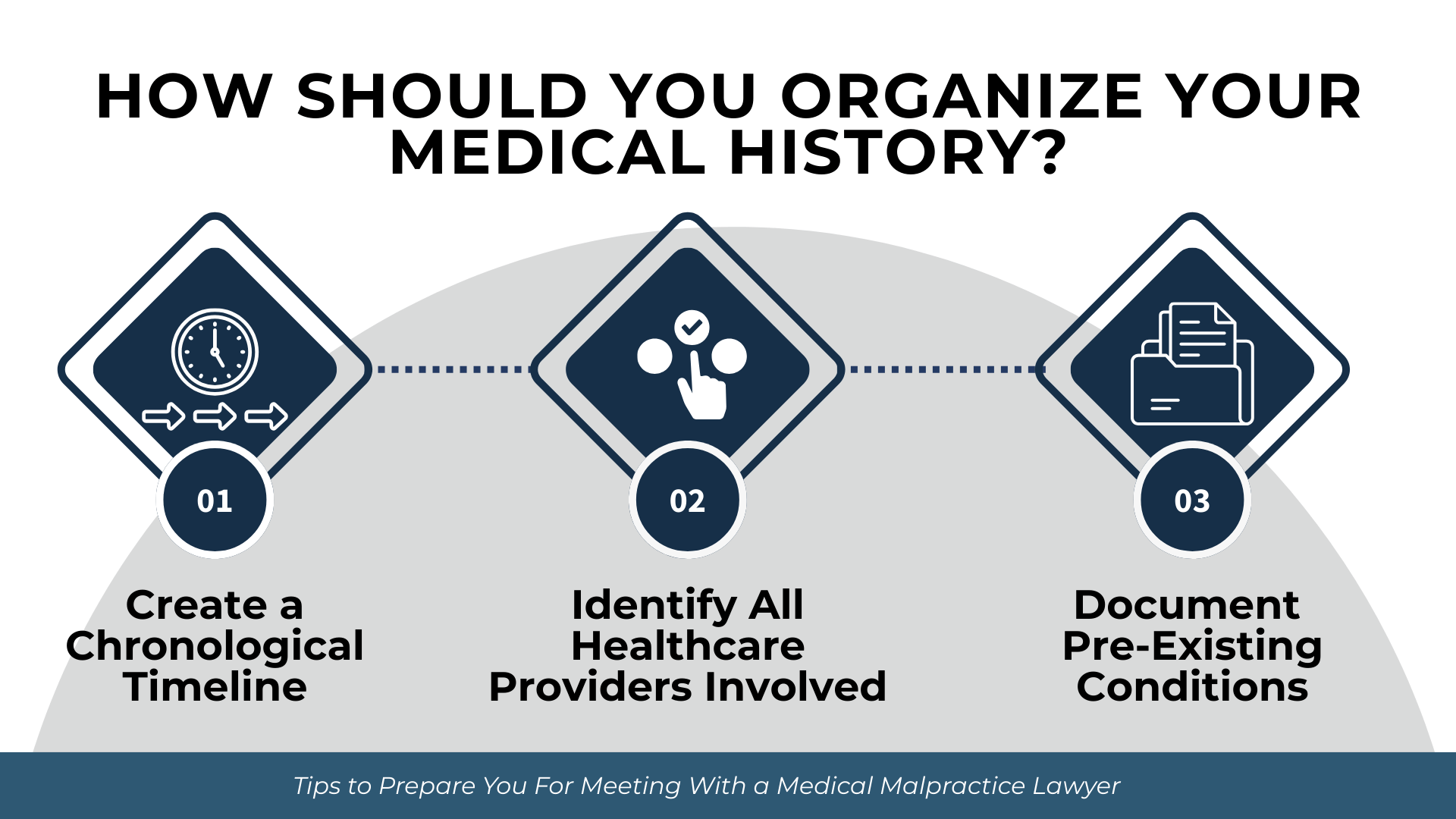
Creating a Chronological Timeline
A chronological timeline of your medical care helps the attorney quickly understand your case. Start with the earliest relevant medical event and proceed through the present day. For each entry, note the date, healthcare provider, facility, and what occurred.
Mark the specific incident or incidents you believe constituted malpractice. Note when you first became aware that something had gone wrong with your care. Under the standard established in Tanner v. Hartog, 618 So. 2d 177 (Fla. 1993), the statute of limitations begins when you have knowledge of both your injury and a “reasonable possibility that the injury was caused by medical malpractice.”
Identifying All Healthcare Providers Involved
List every healthcare provider involved in the care at issue, including physicians, nurses, hospitals, surgical centers, laboratories, and pharmacies. Include the provider’s name, specialty, and the facility where you received treatment.
Florida’s pre-suit notice requirements under Fla. Stat. § 766.106(2) require that the Notice of Intent include a list of all known healthcare providers seen for injuries subsequent to the alleged negligence and all known providers during the two years before the alleged act. Identifying these providers early helps the attorney understand who may be potential defendants and who may be witnesses.
Documenting Pre-Existing Conditions
Be prepared to discuss any pre-existing medical conditions, even if you do not believe they are related to your claim. Defense attorneys often argue that a plaintiff’s injuries resulted from pre-existing conditions rather than malpractice. Your attorney needs to understand your complete medical history to anticipate and address these arguments.
Honesty about pre-existing conditions strengthens rather than weakens your case. Your attorney can work with medical experts to distinguish between symptoms caused by pre-existing conditions and injuries caused by negligent care.
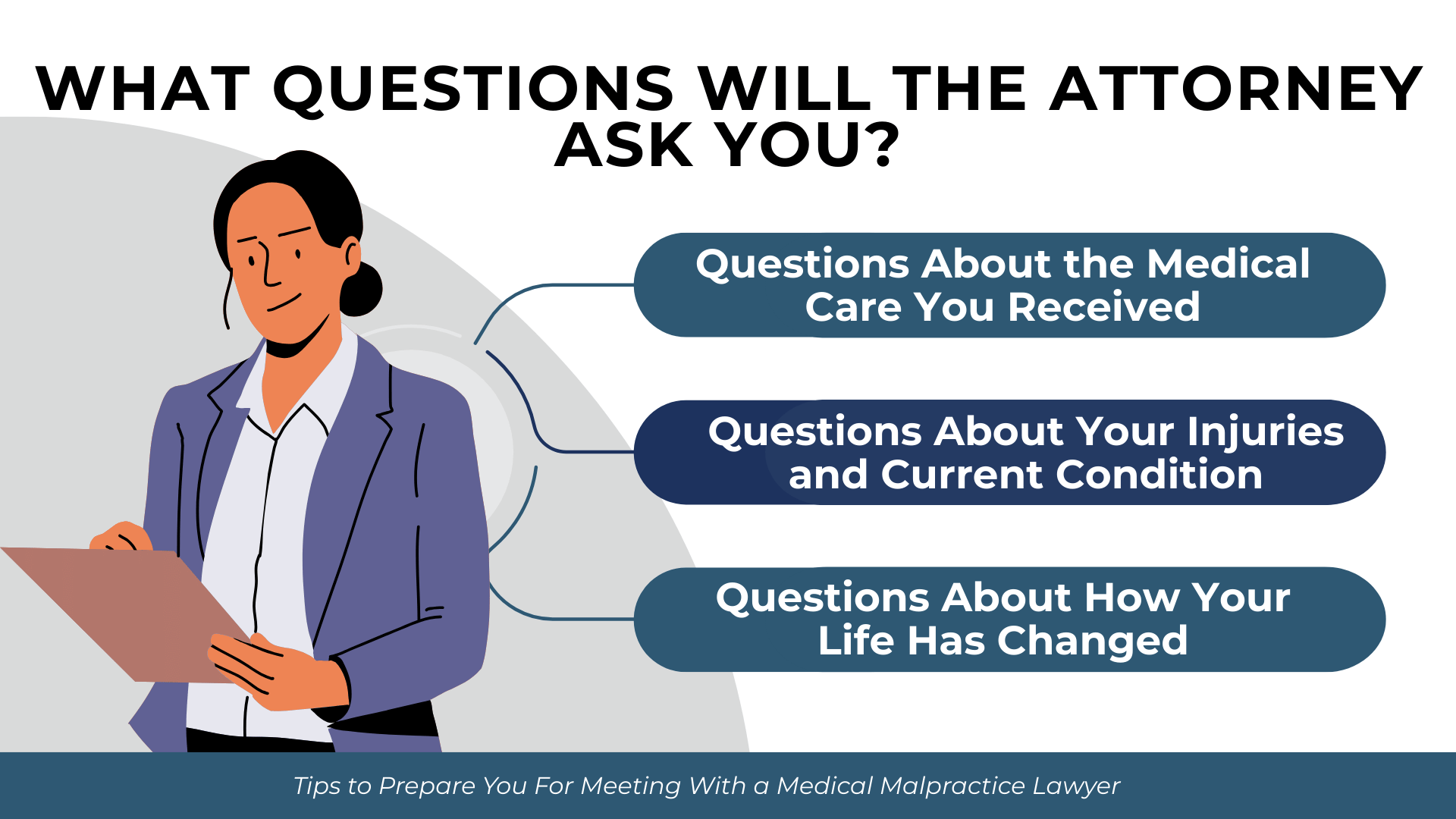
What Questions Will the Attorney Ask You?
Questions About the Medical Care You Received
The attorney will ask detailed questions about the medical treatment at issue. Expect questions about why you sought medical care, what symptoms you reported, what diagnoses you received, and what treatments were recommended or performed.
Be prepared to answer questions such as:
- What symptoms or concerns brought you to the healthcare provider?
- What did the provider tell you about your diagnosis?
- What treatment options were discussed with you?
- Did you follow the treatment plan as prescribed?
- Were there any complications during your treatment?
- Did you raise concerns with your healthcare providers, and how did they respond?
- When did you first realize that something had gone wrong?
Answer these questions as completely and accurately as possible. If you do not remember something, say so rather than guessing.
Questions About Your Injuries and Current Condition
The attorney will ask about the injuries you believe resulted from medical negligence and your current health status. Describe your symptoms, limitations, and ongoing medical needs.
Explain how your condition compares to before the alleged malpractice occurred. If your injury required additional medical treatment, describe what treatment you have received and what treatment you expect to need in the future.
Questions About How Your Life Has Changed
Medical malpractice damages extend beyond medical bills to include how the injury has affected your daily life. The attorney may ask about your ability to work, care for yourself, participate in activities you previously enjoyed, and maintain relationships.
Florida law permits recovery for non-economic damages including pain and suffering, mental anguish, and loss of enjoyment of life. Following North Broward Hospital District v. Kalitan, 219 So. 3d 49 (Fla. 2017), statutory caps on non-economic damages in medical malpractice cases are currently unenforceable. Understanding the full impact of your injury helps the attorney evaluate the potential value of your claim.
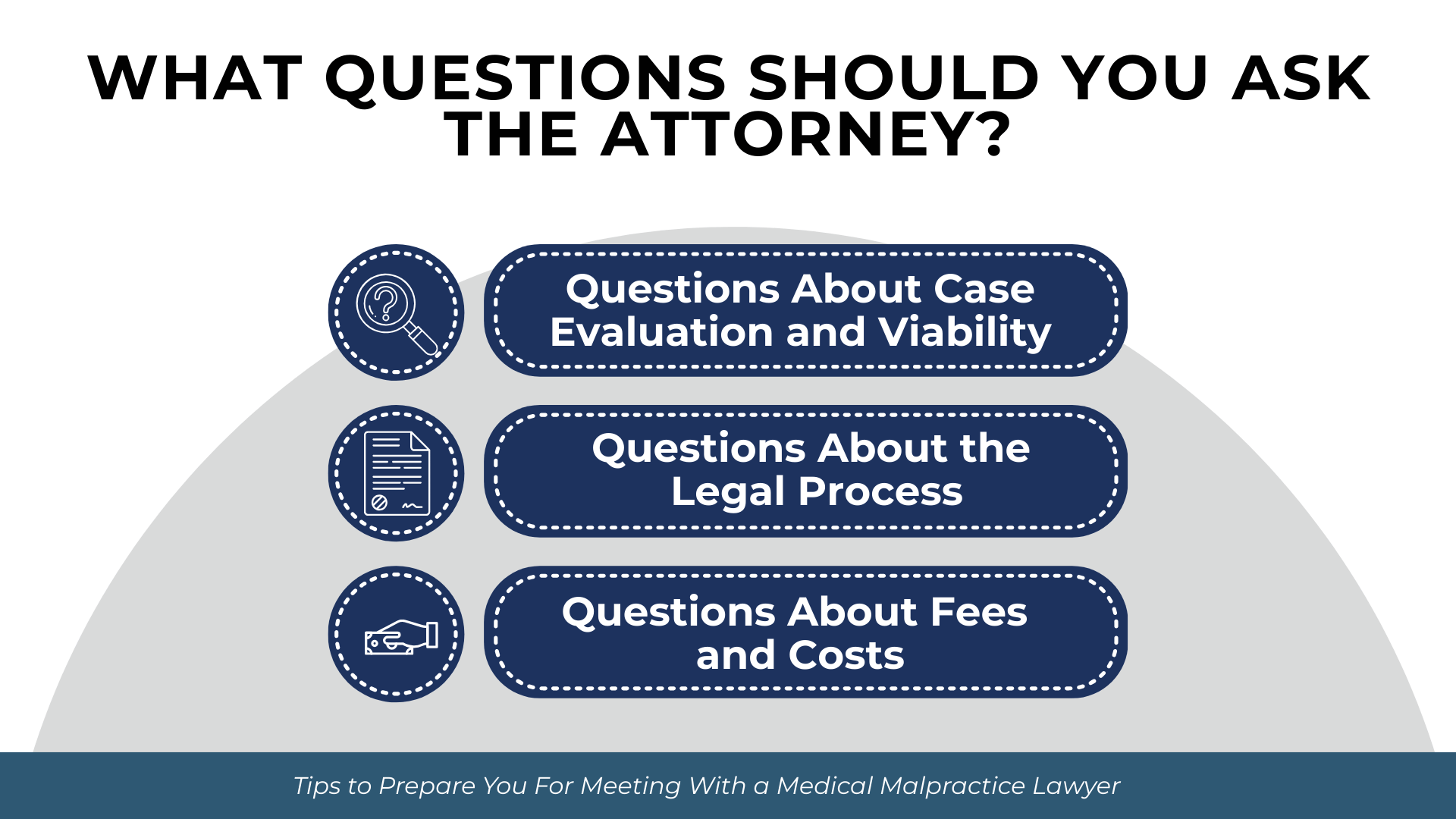
What Questions Should You Ask the Attorney?
Questions About Case Evaluation and Viability
The consultation is also your opportunity to evaluate whether this attorney is right for your case. Consider asking questions that help you understand how the attorney views your potential claim.
Appropriate questions include:
- Based on what I have told you, do you believe I have a viable medical malpractice claim?
- What additional information or records would you need to fully evaluate my case?
- What are the strengths and weaknesses you see in my potential claim?
- What type of medical expert would be needed to support this case?
- Have you handled cases involving similar medical issues before?
- What challenges do you anticipate in proving my case?
- How long do medical malpractice cases typically take to resolve?
Questions About the Legal Process
Understanding the legal process helps you make an informed decision about pursuing your claim. Florida’s medical malpractice procedures include mandatory pre-suit requirements that add time before a lawsuit can be filed.
Ask the attorney to explain the pre-suit investigation process required under Fla. Stat. § 766.106, including the 90-day period following the Notice of Intent during which the defendant can respond. Ask about the typical timeline from initial case acceptance through resolution and what your role will be throughout the process.
Questions About Fees and Costs
Most medical malpractice attorneys work on a contingency fee basis, meaning they receive a percentage of any recovery rather than charging hourly fees. Ask the attorney to explain their fee structure and what percentage they charge.
Medical malpractice cases involve significant costs for medical expert review, obtaining records, filing fees, and other expenses. Ask how these costs are handled—whether they are advanced by the firm and deducted from any recovery, or whether you are responsible for costs if the case is unsuccessful.
Understanding Florida’s Medical Malpractice Timeline
The Statute of Limitations Deadline
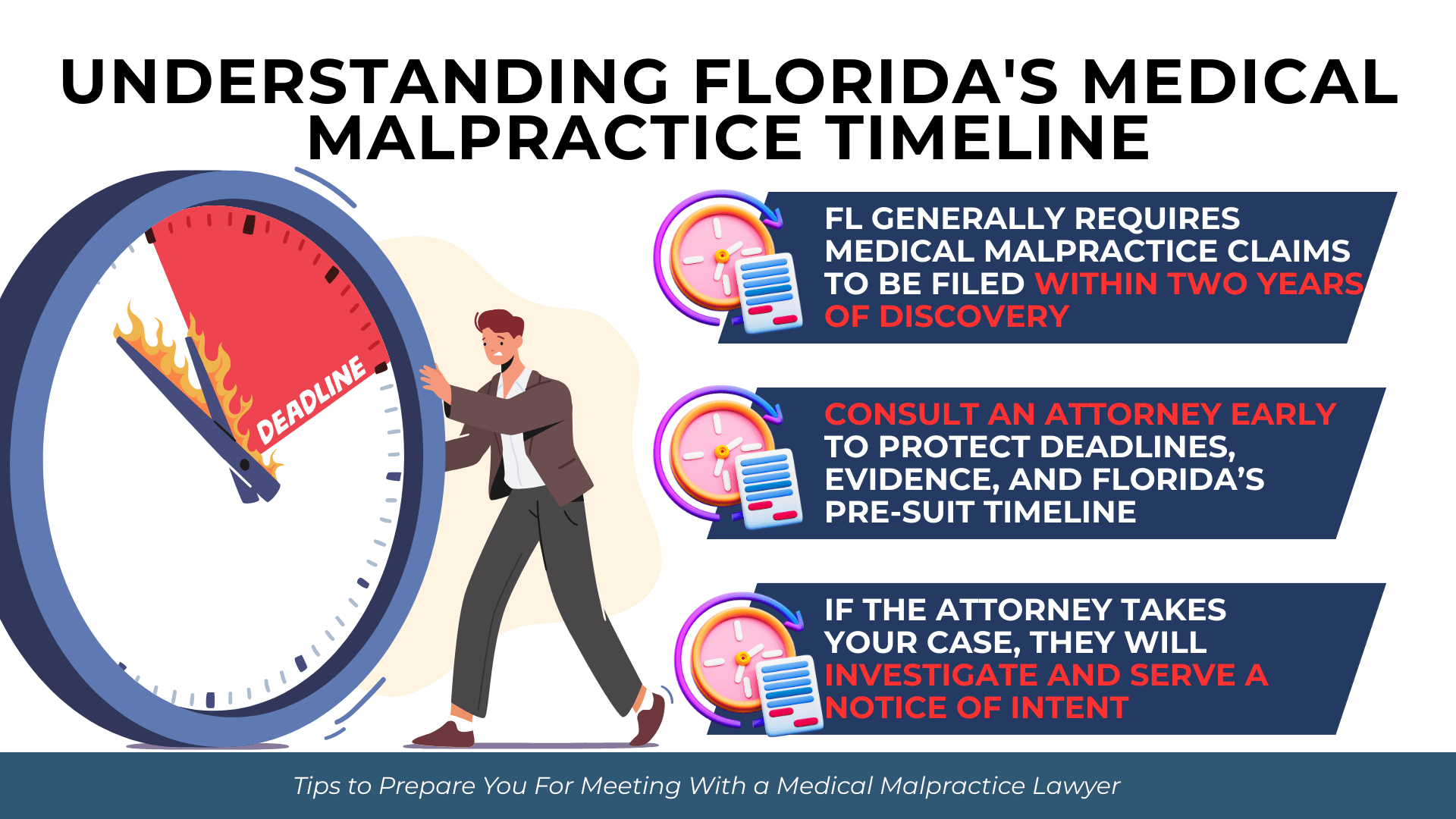
Florida imposes strict deadlines for filing medical malpractice claims. Under Fla. Stat. § 95.11(5)(c), a medical malpractice action must be commenced within two years from the time the incident is discovered or should have been discovered with due diligence. An absolute four-year statute of repose bars claims filed more than four years after the incident occurred, regardless of when the injury was discovered.
The statute of limitations creates urgency for scheduling your consultation. The two-year period begins running when you have knowledge of both your injury and a reasonable possibility that it resulted from malpractice, as established in Tanner v. Hartog. Waiting too long to consult an attorney risks losing your right to pursue a claim entirely.
Why Early Consultation Protects Your Rights
Early consultation with an attorney protects your rights in several ways:
- It ensures you understand applicable deadlines before they pass
- It allows time for thorough investigation before the pre-suit period begins
- It preserves evidence that may become unavailable over time
- It permits early identification of all potential defendants
- It provides time to locate and retain qualified medical experts
- It allows the attorney to obtain records while they remain accessible
Florida’s mandatory pre-suit requirements add months to the timeline before a lawsuit can be filed. The 90-day pre-suit investigation period tolls the statute of limitations under Fla. Stat. § 766.106(4), but waiting until close to the deadline leaves little room for complications in obtaining records or expert opinions.
What Happens After the Consultation
If the attorney believes you have a viable case and agrees to represent you, you will sign a retainer agreement establishing the attorney-client relationship. The attorney will then begin gathering medical records, identifying potential expert witnesses, and investigating the facts of your case.
The investigation may take several months. Once the attorney determines that expert support exists for your claim, they will prepare and serve the Notice of Intent to Initiate Litigation on all prospective defendants. The 90-day pre-suit screening period begins when defendants receive this notice.
Frequently Asked Questions
How long does a medical malpractice consultation typically take?
Initial consultations generally last between 30 minutes and one hour, depending on the complexity of your situation. Arriving with organized documentation allows the attorney to focus on evaluating your case rather than sorting through papers. Some attorneys may request that you submit records in advance so they can review them before meeting with you.
Do I need to pay for the initial consultation?
Many medical malpractice attorneys offer free initial consultations. During scheduling, confirm whether there is any charge for the consultation. Even attorneys who typically charge for consultations may waive the fee for potential malpractice cases they are interested in evaluating.
What if I do not have all my medical records yet?
You should still schedule your consultation even if your records are incomplete—or even if you do not have any records at all. Most clients do not bring every record to the first meeting, and some have none. That will not prevent an attorney from evaluating your situation and getting the process started.
Having whatever records you can obtain is helpful because it can make things move faster. If you already have key documents (discharge paperwork, imaging reports, operative reports, bills, or a timeline of providers), your attorney can begin reviewing them immediately instead of waiting for records requests to be processed.
But you do not need to track down everything yourself. Once you hire counsel, your attorney can request medical records directly from providers using HIPAA-compliant authorizations. The important thing is not to delay the consultation—deadlines can run while records are being gathered.
Can a family member attend the consultation with me?
Yes, bringing a trusted family member or friend can be helpful, particularly if your injury affects your memory or ability to communicate. A family member who witnessed your medical care or its aftermath may provide additional information. Let the attorney know in advance if someone will accompany you.
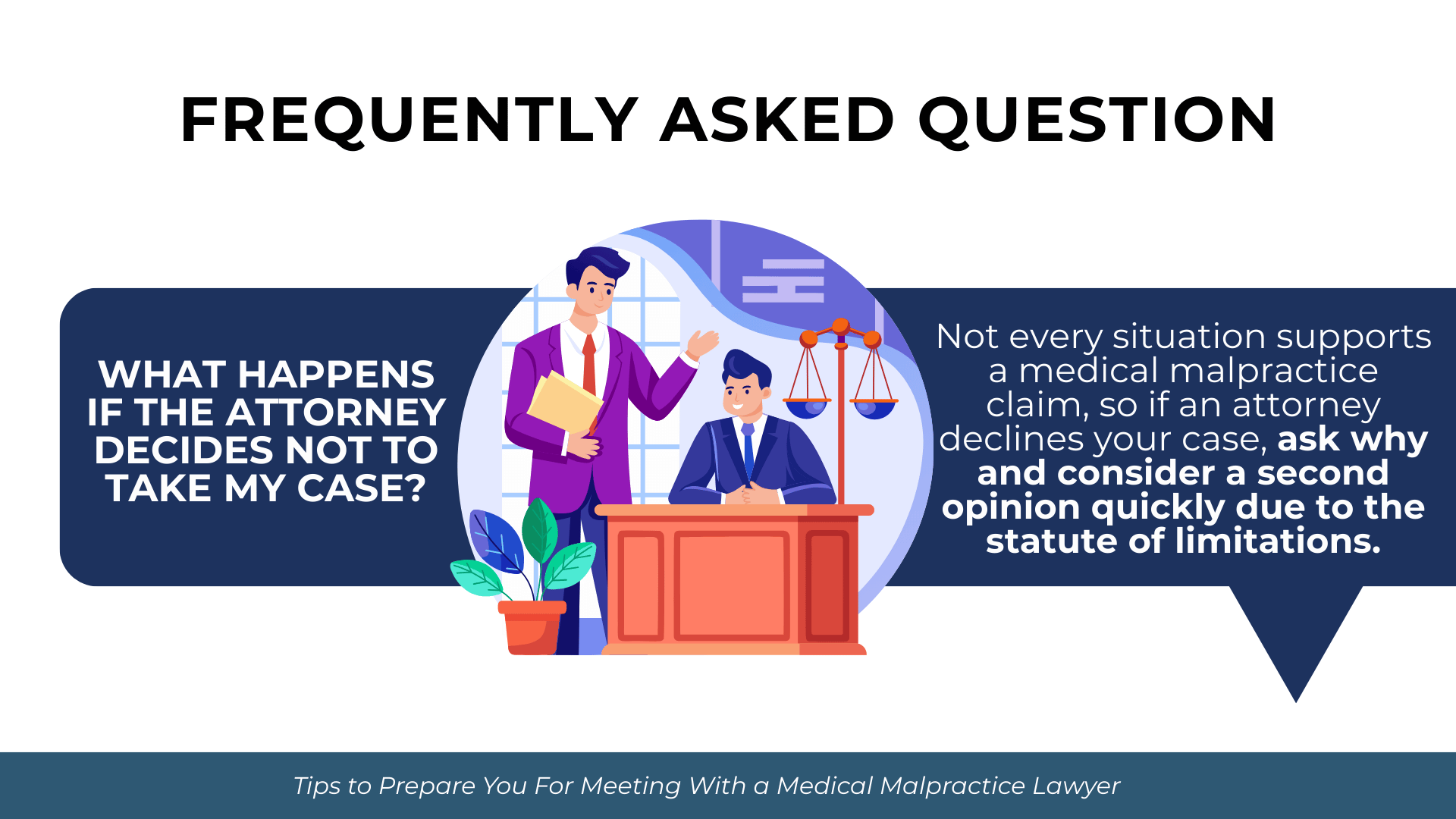
What happens if the attorney decides not to take my case?
Not every potential case meets the criteria for a medical malpractice claim. If an attorney declines to take your case, ask for an explanation. The attorney may identify issues with proving the standard of care was breached, establishing causation, or demonstrating sufficient damages. You may wish to consult with another attorney for a second opinion, but be mindful of the statute of limitations.
Taking the Next Step
Preparing for your medical malpractice consultation gives you the best opportunity for a productive meeting and a thorough case evaluation. Gathering your medical records, organizing a timeline of events, documenting your losses, and preparing questions allows the attorney to focus on the legal merits of your potential claim.
Florida’s two-year statute of limitations and mandatory pre-suit requirements make timing critical in medical malpractice cases. Early consultation ensures you understand your legal options while there is still time to pursue them. The sooner you meet with an attorney, the more time exists for proper investigation and preparation.
If you have questions about a potential medical malpractice claim, contact Prosper Injury Attorneys to discuss your situation.