Renting a boat in Miami should be a relaxing day on the water—not the start of a medical emergency. But when rental boats have faulty steering, inadequate safety briefings, or equipment that fails without warning, serious injuries happen. If you’ve been hurt while operating a rental boat in Biscayne Bay, along the Miami coastline, or in nearby waterways, you may be wondering whether the rental company bears legal responsibility for your injuries.
The answer depends on several factors: what caused the accident, what the rental company did or failed to do, and whether any waiver you signed actually bars your claim. This guide explains when Miami boat rental companies can be held liable, what legal duties they owe under maritime and Florida law, and how injured renters can pursue compensation.
Can You Sue a Boat Rental Company After Signing a Waiver?
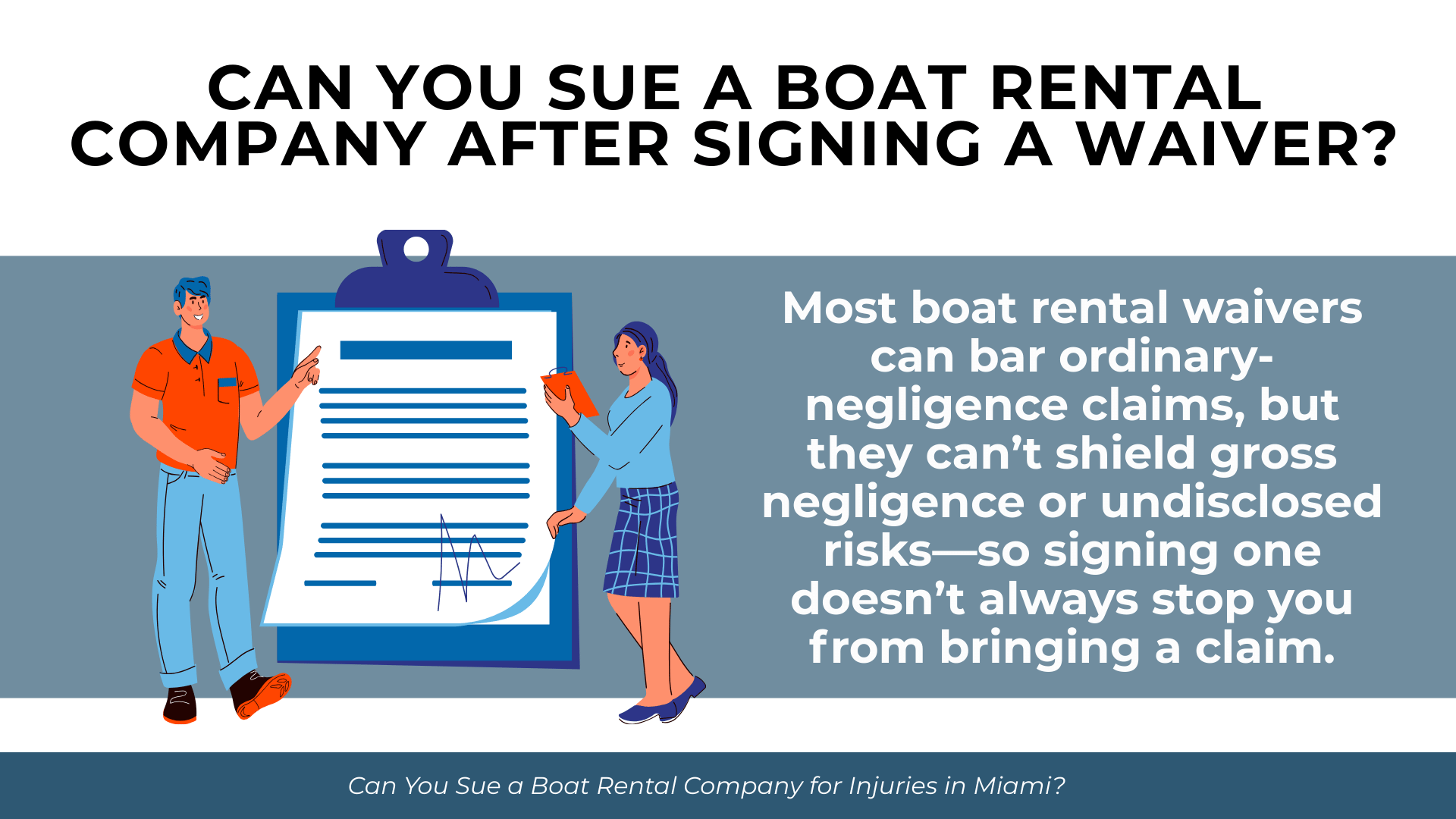
Most boat rental companies require customers to sign liability waivers before handing over the keys. These documents often contain broad language releasing the company from responsibility for injuries. Many injured renters assume signing a waiver eliminates any legal recourse. That assumption is often wrong.
When waivers hold up in court
Maritime law governs liability waivers for recreational activities on navigable waters like Biscayne Bay and the Atlantic Ocean. Under this framework, exculpatory clauses are generally enforceable if they meet specific requirements. A valid waiver must clearly state that the participant is releasing the operator from liability for negligence. The language must be conspicuous—typically in bold text or capital letters with prominent placement. The waiver must also demonstrate voluntary participation and knowing assumption of risk.
If a waiver meets these standards and covers the type of accident that occurred, courts may enforce it to bar claims based on ordinary negligence. However, this is not the end of the analysis.
The gross negligence exception
Maritime public policy prohibits waivers of liability for intentional misconduct, recklessness, or gross negligence. This carve-out is universal under maritime law regardless of what state law might otherwise allow. A rental company cannot contractually shield itself from responsibility for conduct that goes beyond simple carelessness.
Gross negligence involves a conscious disregard for safety—such as renting boats with known steering defects, ignoring repeated customer complaints about equipment problems, or operating despite awareness of dangerous conditions. When rental company conduct crosses this threshold, no waiver language can provide protection.
What makes a waiver unenforceable
Even for ordinary negligence claims, waivers fail when they don’t meet legal requirements. Overly broad language releasing “all claims whatsoever” without specifically mentioning negligence may not hold up. Hidden or confusing terms buried in lengthy documents can also invalidate a waiver. Courts will not enforce releases that purport to waive statutory safety obligations or Coast Guard compliance requirements.
Misrepresentation or concealment of known risks also voids waivers. If the rental company knew about a specific danger—like a history of engine failures on a particular boat—and failed to disclose it, the waiver may not apply. If you’re unsure whether a waiver affects your case, a maritime injury attorney can evaluate your specific circumstances.
What Legal Duties Do Miami Boat Rental Companies Owe You?
Call us today at (305) 694-2676 or
contact us online for a free case evaluation.
Hablamos español.


Boat rental companies are not merely providing access to equipment. Under maritime law, they assume specific legal obligations to protect renters from foreseeable harm. Understanding these duties helps identify when a company’s failures justify a lawsuit.
Equipment inspection requirements
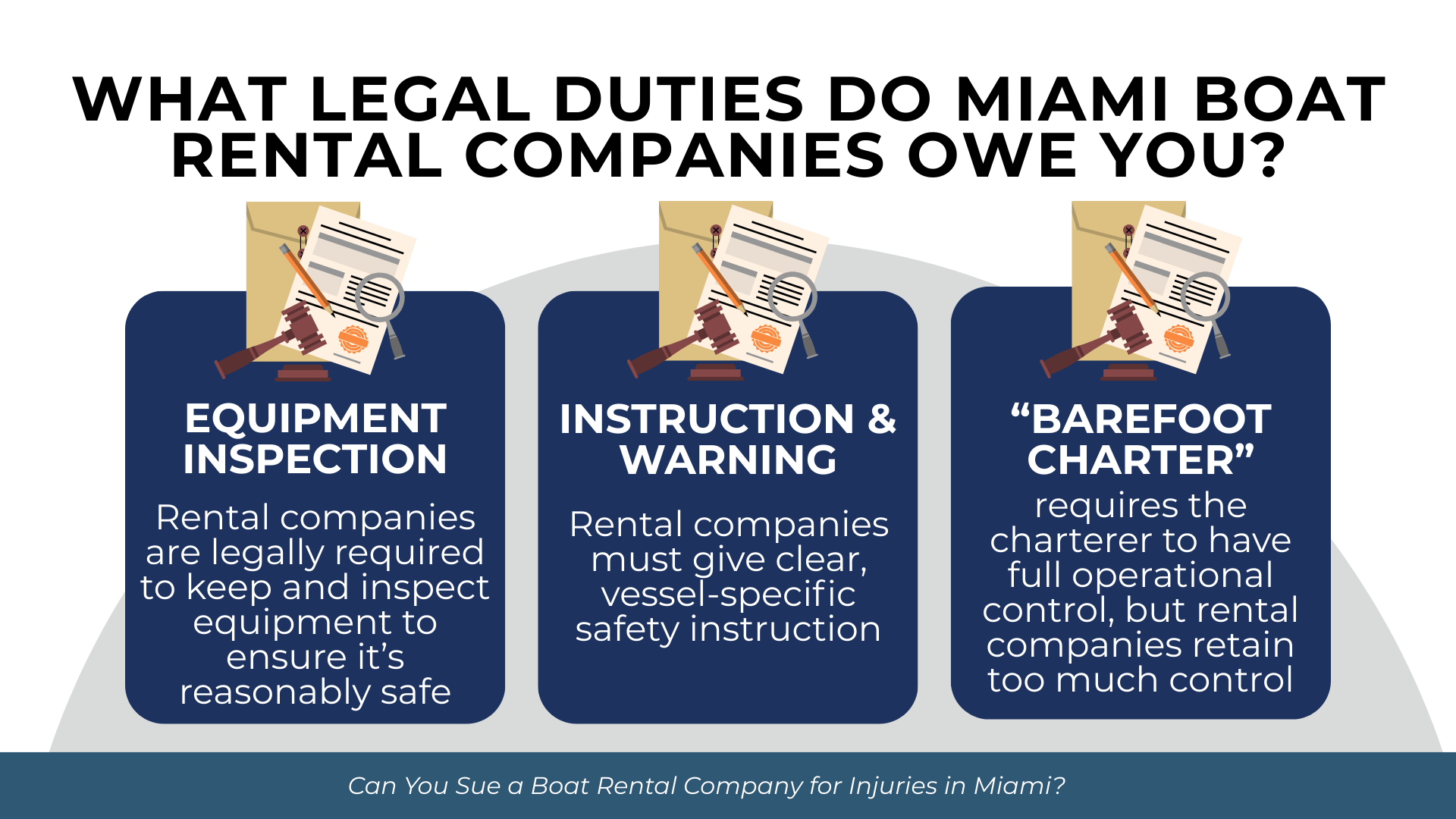
Rental companies must maintain their fleet in reasonably safe condition and inspect equipment before each rental. This is not a suggestion—it’s a legal duty that forms the foundation of negligence claims when equipment fails.
Miami boat rental companies must exhibit reasonable care under the circumstances. This may include:
- Pre-rental inspection. The company must check for hazards before each rental, not just periodic maintenance.
- Steering system verification. Steering cables, hydraulic components, and connections must be examined for corrosion or wear.
- Engine and fuel system checks. Fuel leaks, clogged filters, and stalling issues should be identified before the boat leaves the dock.
- Electrical system review. Corroded connections, poor wiring, and potential shorts must be addressed to prevent engine stalls or fires.
- Safety equipment confirmation. Life jackets, fire extinguishers, and required Coast Guard equipment must be present and functional.
- Bilge pump testing. Failed bilge pumps can lead to swamping in rough conditions.
When accidents result from equipment that should have been identified as defective during routine inspection, the rental company may be liable regardless of any waiver.
Instruction and warning obligations
Beyond equipment maintenance, rental companies must provide adequate instruction on safe operation. This duty covers several categories of information that renters need before taking control of an unfamiliar vessel.
The company must explain vessel-specific controls and characteristics—how the throttle responds, where the kill switch is located, and how the steering handles. Local hazards require specific warnings: no-wake zones, traffic patterns, shallow areas, and strong current locations. Weather conditions and forecasts relevant to the rental period should be communicated. The company must also verify minimum age requirements and assess whether the renter appears fit to operate the vessel.
Florida’s Boating Safety Act of 2022 now requires rental liveries to obtain permits, provide specific pre-rental safety instructions, and document the safety briefing. A rushed five-minute overview that skips critical information may fall short of these legal requirements.
Why the “bareboat charter” defense rarely applies
Some rental companies argue they transferred complete control of the vessel to the renter, making them a “bareboat charterer” who assumes all responsibility. Under maritime law, true bareboat charters do shift liability to the charterer. However, most recreational rentals do not qualify.
The bareboat doctrine requires full transfer of command and navigation to the charterer, with the charterer responsible for crewing, fueling, and all operational decisions. The owner must relinquish operational control entirely. Recreational rentals typically fail this test because the rental company conducts safety briefings, handles fuel management, performs maintenance, and imposes geographic or operational restrictions. Because these elements of control are retained, liability typically stays with the rental company.
What Types of Accidents Support a Lawsuit Against a Rental Company?
Not every rental boat accident creates grounds for a lawsuit. However, certain accident patterns consistently point to rental company negligence. Understanding these mechanisms helps identify whether your situation may justify legal action.
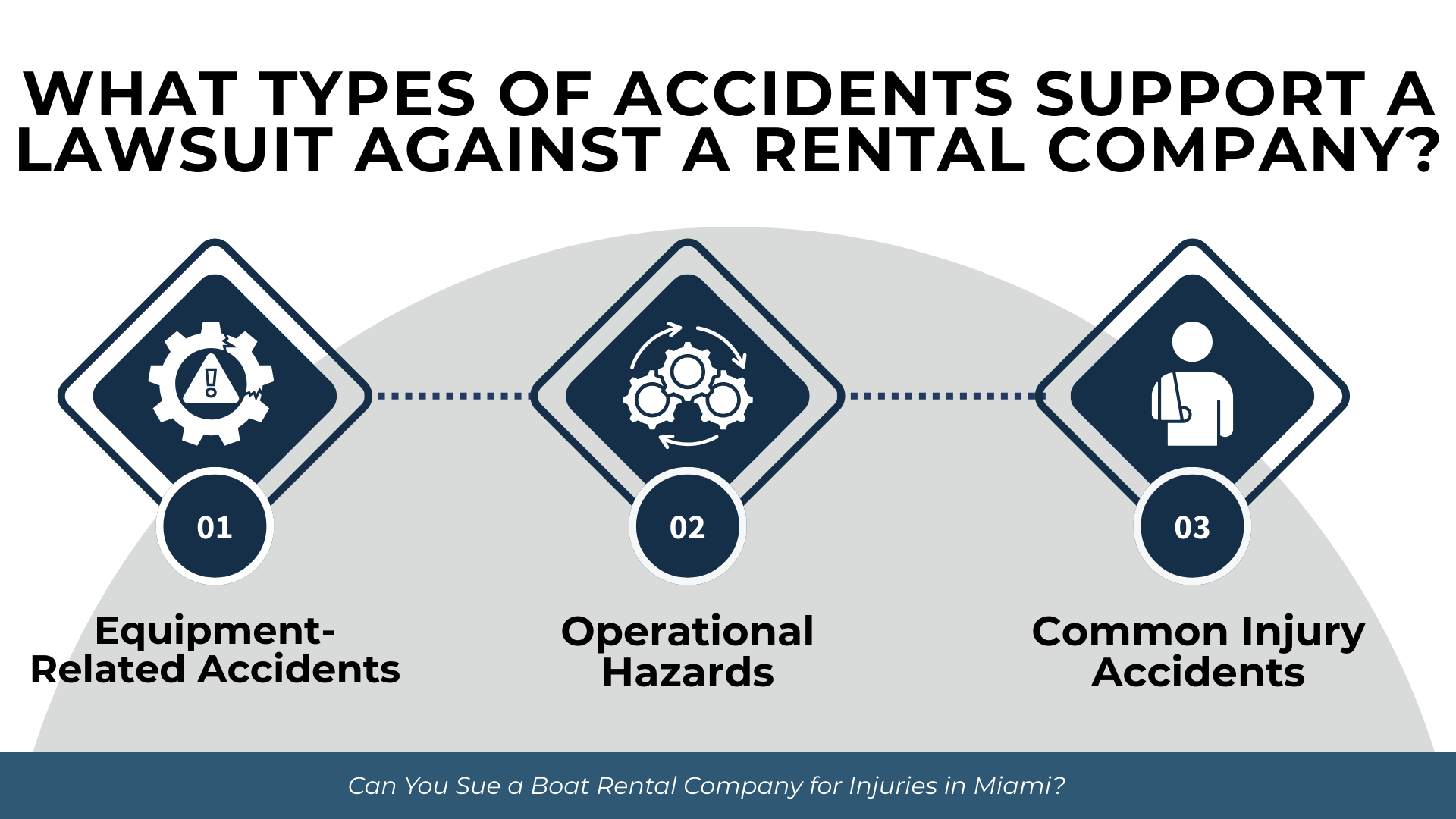
Equipment-related accidents
Equipment failures that often indicate rental company negligence include:
- Steering mechanism failures. Corroded cables, worn components, or hydraulic failures can cause complete loss of directional control, leading to collisions with docks, other vessels, or fixed objects.
- Throttle malfunctions. Salt corrosion or sand infiltration can cause throttles to stick open, resulting in uncontrolled acceleration.
- Engine stalling. Fuel system issues or electrical problems can leave renters stranded or drifting into hazards.
- Kill switch failures. Worn or damaged lanyards that fail to cut the engine create runaway vessel hazards when operators fall overboard.
- Bilge pump failures. When hulls take on water in rough conditions, failed bilge pumps can lead to swamping or sinking.
Each of these failures reflects maintenance shortfalls that proper pre-rental inspection should catch.
Operational hazards rental companies should address
Beyond equipment, rental companies should warn about and help renters avoid operational dangers. Propeller strikes occur when passengers fall overboard or enter the water near the stern, often because untrained operators put the boat in reverse or fail to kill the engine. Carbon monoxide poisoning can result from swimming near the stern while generators or engines run—a hazard rental companies should specifically warn against.
Capsizing risks affect certain vessel types, particularly pontoon boats with high passenger loads or double-decker configurations that become top-heavy when passengers congregate on upper levels.
Common injury patterns
Rental boat accidents produce serious injuries including drowning (the primary cause of boating fatalities), blunt trauma from collisions, severe lacerations or amputations from propeller strikes, carbon monoxide poisoning, and fractures from ejections when boats run aground or collide. These injuries often require extensive medical treatment and can result in permanent impairment.
Does Maritime Law or Florida Law Apply to Your Miami Boat Rental Case?
Determining which legal framework governs your case affects everything from the duties the rental company owed to the damages you can recover. Miami’s waterways create a complex jurisdictional picture.
The navigable waters test
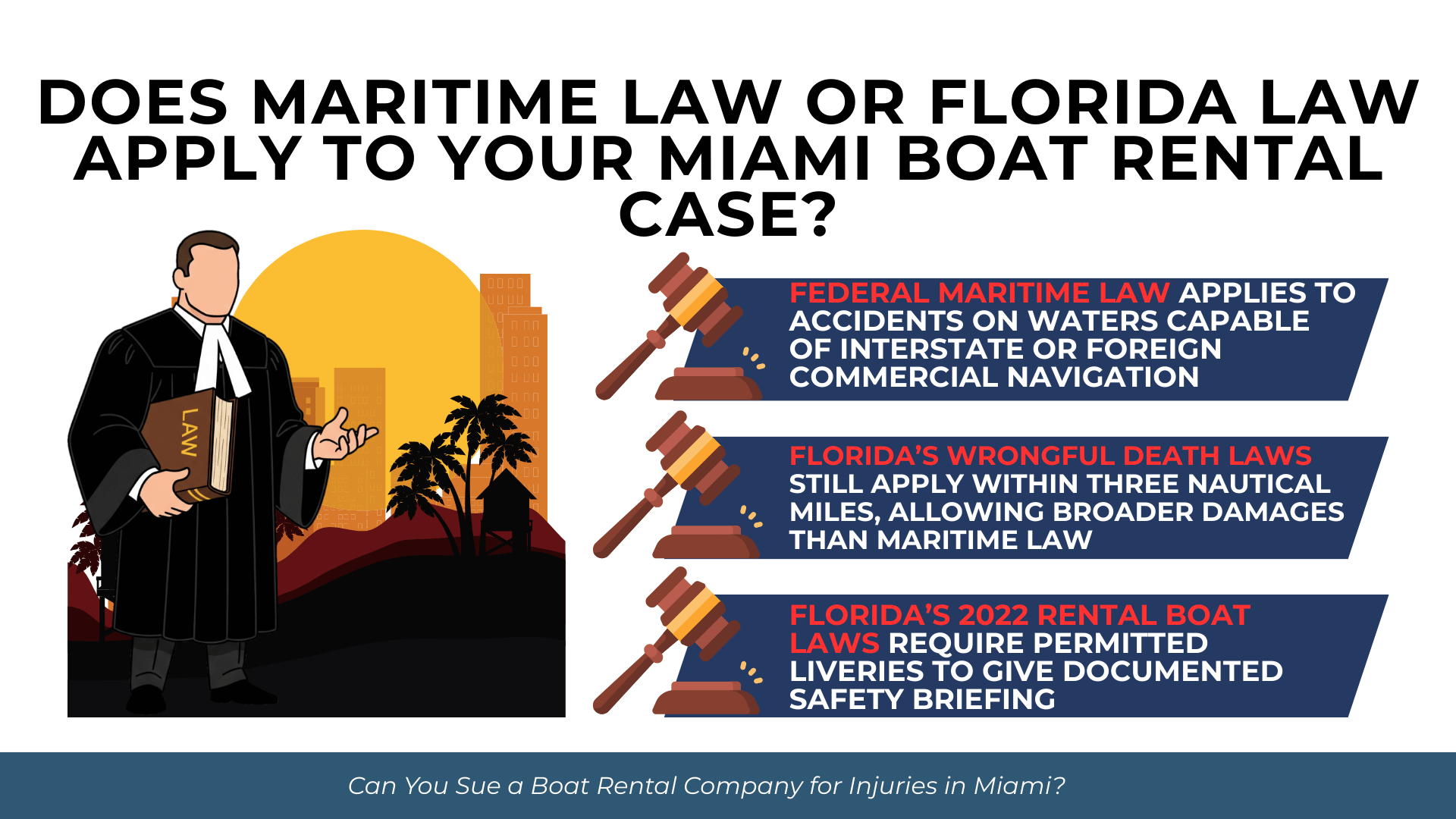
Federal maritime law applies when an accident occurs on navigable waters and bears a substantial relationship to traditional maritime activity. Waters qualify as navigable if they form highways for interstate or foreign commerce or are capable of commercial navigation.
For Miami boat rentals, this test is usually satisfied. Biscayne Bay, the Atlantic Ocean, the Intracoastal Waterway, and connected coastal waters are all navigable under maritime law. Rental boat accidents in these areas typically fall under federal maritime jurisdiction, which means maritime negligence standards and maritime remedies apply.
How Florida law supplements maritime rules
Maritime law is supreme, but state law is not entirely displaced. Florida law fills gaps where maritime law provides no remedy—most importantly in wrongful death cases. Florida’s wrongful death statutes apply to deaths occurring within three nautical miles of shore, allowing broader damages than federal maritime law typically permits.
State law also governs concurrent regulatory matters. Florida licensing requirements for rental liveries, state inspection standards, and boater education requirements apply alongside federal maritime rules unless directly preempted.
The Florida Boating Safety Act of 2022 (Fla. Stat. § 327.54 and Fla. Admin. Code 68D-34.002)
Florida enacted significant rental boat regulations in 2022 (Fla. Stat. § 327.54 and Fla. Admin. Code 68D-34.002). Rental liveries must now obtain permits and provide specific pre-rental safety instructions with documented briefings. These requirements establish a regulatory floor that rental companies must meet. Violations can constitute evidence of negligence and may undermine waiver defenses if the company failed to comply with mandatory safety protocols.
How Does Rental Company Negligence Get Proven?
Get started with your complimentary case evaluation today;
call us at (305) 694-2676 or reach us online using our
secure contact form.
Establishing that a rental company breached its legal duties requires evidence connecting the company’s failures to your injuries. Several categories of evidence typically support these claims.
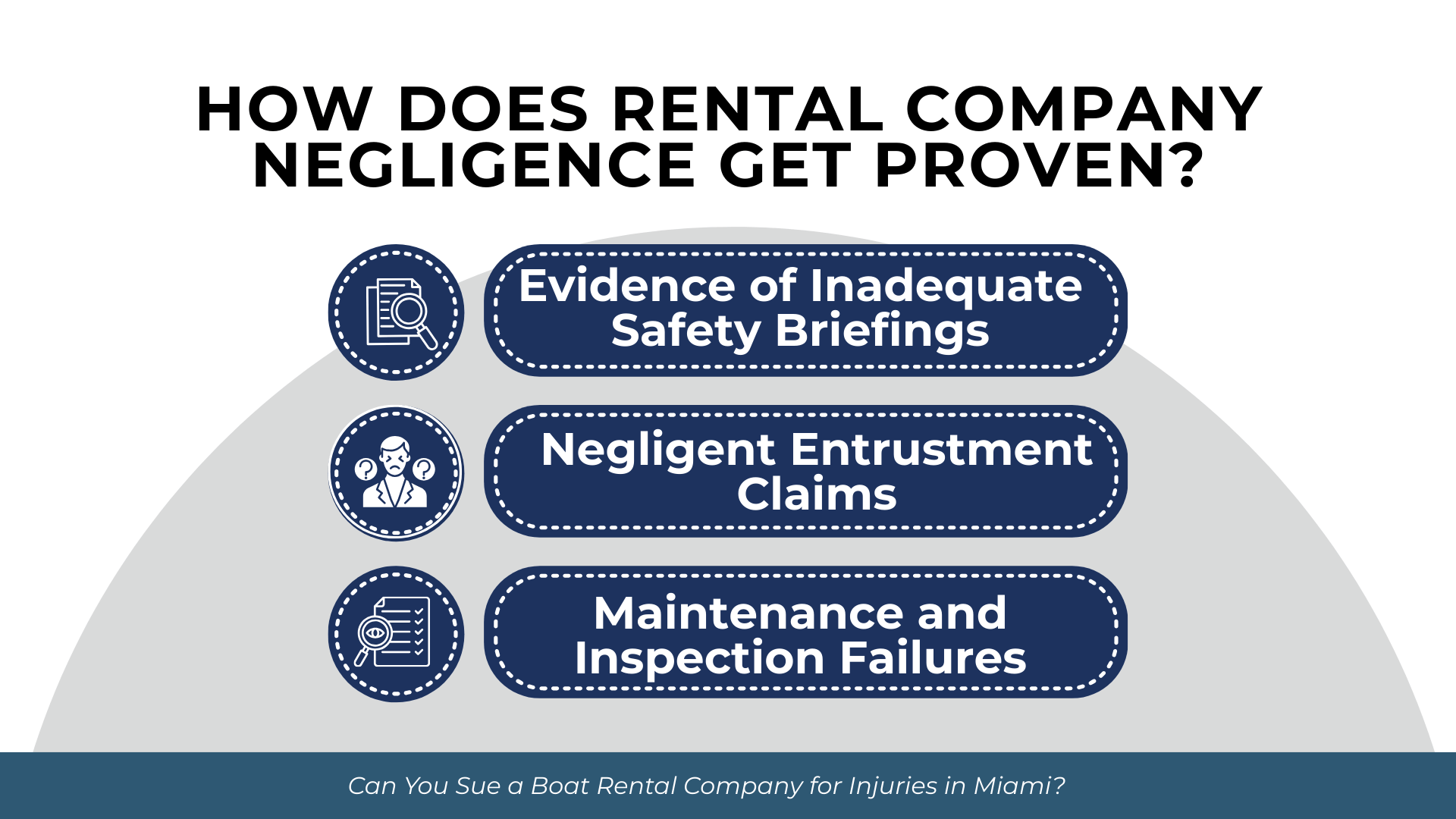
Evidence of inadequate safety briefings
Several factors indicate a rental company failed to provide adequate instruction:
- Briefing duration. A five-to-ten minute overview covering only basic controls may fall short of legal requirements, particularly for inexperienced renters.
- Missing content. Failure to explain local hazards, no-wake zones, traffic patterns, or vessel-specific characteristics suggests inadequate instruction.
- No hands-on practice. Sending renters out without demonstrating reboarding techniques or emergency procedures indicates a deficient briefing.
- No documentation. Under Florida’s 2022 regulations, briefings should be documented. Absence of documentation may indicate the briefing didn’t occur as required.
These failures become particularly significant given that 69% of boating deaths occur on vessels where the operator had no boating safety instruction. Rental companies cannot simply hand over keys and disclaim responsibility when accidents follow.
Negligent entrustment claims
Rental companies can be liable for negligent entrustment—renting to someone unfit or untrained to operate the vessel. This theory applies when the company knew or should have known the renter was unable to safely operate the boat. Renting to visibly intoxicated individuals, ignoring obvious inexperience, or failing to verify age requirements can support negligent entrustment claims.
Maintenance and inspection failures
Equipment failures often leave physical evidence of deferred maintenance: corroded steering cables, worn kill switch lanyards, or electrical connections showing green and white corrosion buildup. Maintenance records—or their absence—can reveal whether the company conducted required inspections. Documenting these failures requires prompt investigation—an attorney can help preserve critical evidence before repairs destroy it.
Maritime law applies pure comparative negligence, meaning your damages are reduced by your percentage of fault but never completely barred. Even if your own actions contributed to the accident, you may still recover compensation if the rental company’s negligence played a role.
What Damages Can You Recover in a Miami Boat Rental Lawsuit?
Understanding available compensation helps injured renters evaluate whether pursuing a claim makes sense for their situation.
Recoverable damages in injury cases
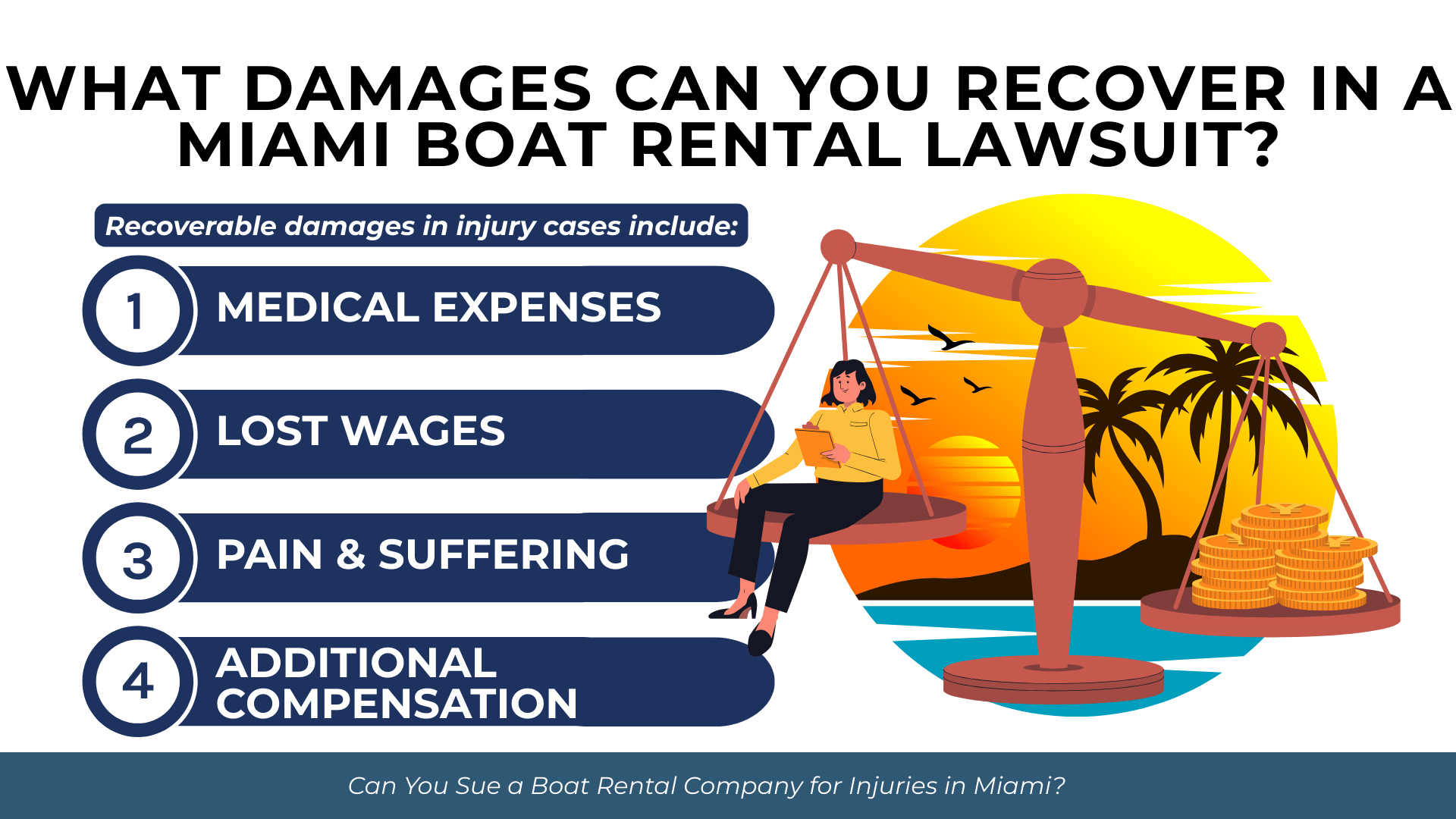
Injured renters may recover several categories of damages. Medical expenses—both past and future—form the foundation of most claims. Lost wages during recovery and reduced future earning capacity can be significant for serious injuries. Pain and suffering, including physical discomfort and emotional distress, is recoverable in maritime personal injury cases. Permanent impairment or disfigurement justifies additional compensation.
Wrongful death claims in Florida waters
When rental boat accidents prove fatal, the applicable law determines what surviving family members can recover. Most Miami-area accidents occur within three nautical miles of shore, where the Death on the High Seas Act does not apply. Instead, Florida’s wrongful death statutes govern, typically allowing recovery of both economic losses (lost support, lost services, funeral expenses) and non-economic damages (loss of companionship, pain and suffering).
This distinction matters because federal maritime wrongful death remedies are often more limited. Near-shore accidents falling under Florida law generally provide broader recovery for grieving families.
Why the Limitation of Liability Act rarely protects rental companies
Federal law allows vessel owners to limit their total liability to the post-accident value of the vessel if they lacked “privity or knowledge” of the negligence causing injury. Large shipping companies sometimes invoke this protection. For small rental operations, however, limitation is difficult to obtain.
The owner has privity or knowledge if they knew of dangerous conditions, should have known through reasonable diligence, participated in the negligent act, or failed to exercise proper oversight. Small rental operations where the owner directly supervises operations or is responsible for fleet maintenance often have the required knowledge. Maintenance issues, training failures, and equipment defects are precisely what owners are responsible for—making limitation unavailable in most rental boat cases.
Frequently Asked Questions About Miami Boat Rental Lawsuits
Does signing a waiver prevent me from suing a boat rental company in Miami?
Waivers can limit claims for ordinary negligence but cannot shield rental companies from gross negligence or reckless conduct. If the company knew about dangerous equipment defects or violated safety regulations, the waiver may not protect them. Courts also reject waivers that fail to clearly and conspicuously explain the risks being assumed.
How long do I have to file a lawsuit after a rental boat injury in Miami?
Maritime law generally allows three years to file suit under 46 U.S.C. § 30106. However, this deadline can be shortened by contract terms, and evidence like maintenance records becomes harder to obtain over time. Consulting an attorney promptly protects your options and helps preserve critical evidence.
What if I was partially at fault for the rental boat accident?
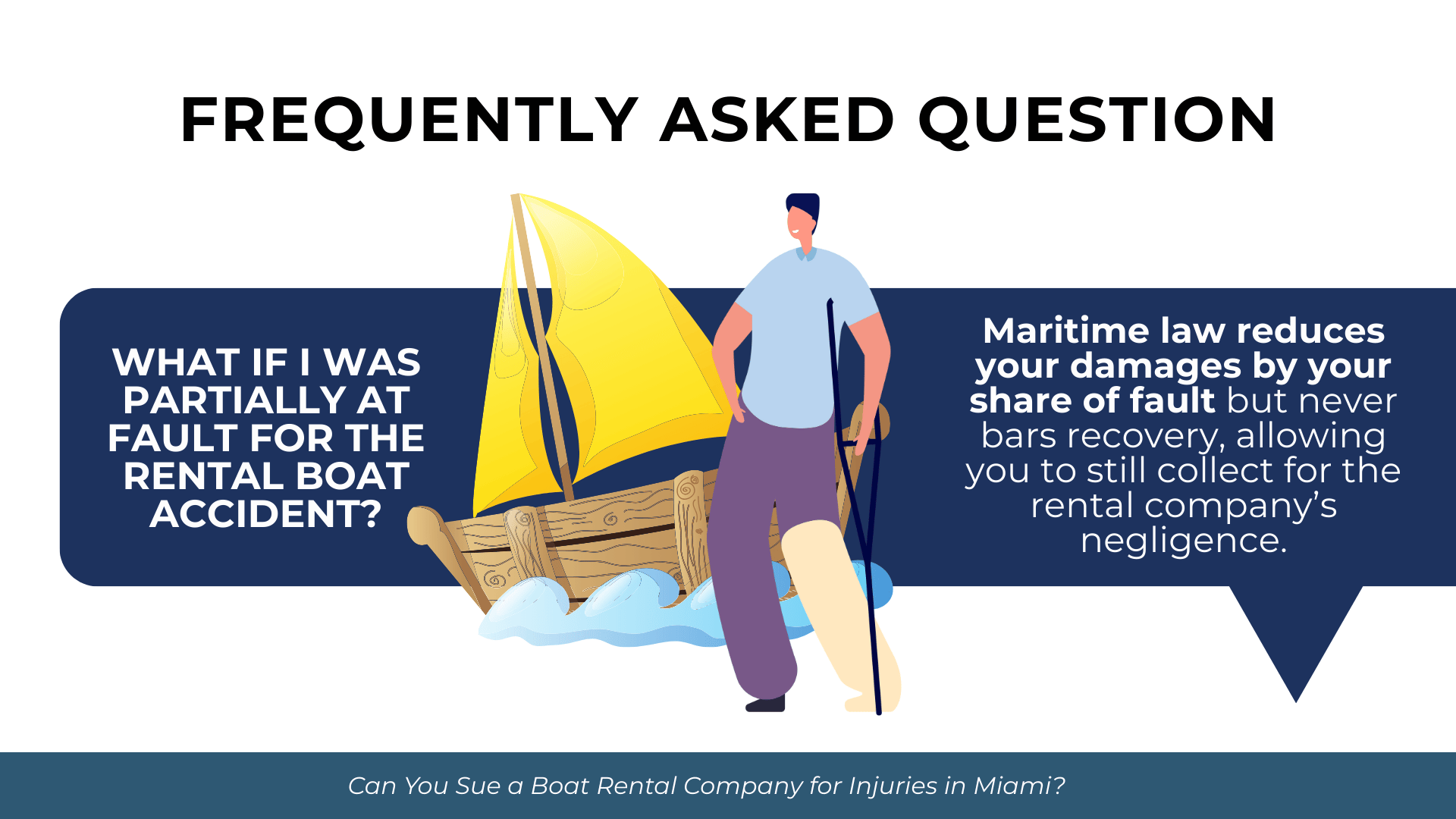
Maritime law uses pure comparative negligence as established in United States v. Reliable Transfer Co., 421 U.S. 397 (1975). Your damages are reduced by your percentage of fault but never completely barred. Even if you contributed to the accident, you may still recover compensation for the rental company’s share of responsibility.
Can I sue if the rental company’s safety briefing was inadequate?
Yes. Rental companies have a legal duty to provide adequate instruction on safe operation, including vessel-specific controls and local hazards. Under Florida’s Boating Safety Act of 2022, rental liveries must provide documented safety briefings. A rushed or incomplete briefing that contributed to your accident can support a negligence claim.
What compensation can I recover in a Miami boat rental lawsuit?
Injured renters may recover medical expenses, lost wages, pain and suffering, and other damages depending on the severity of injuries. In wrongful death cases occurring within Florida waters, state law typically allows broader recovery than federal maritime law, including non-economic damages like loss of companionship.
Protect Your Rights After a Miami Boat Rental Injury
Boat rental injuries in Miami involve a complex intersection of maritime law, Florida regulations, and contractual waiver provisions. While rental companies often rely on waivers to discourage claims, these documents have significant limitations—particularly when gross negligence, equipment failures, or regulatory violations contributed to your injuries.
The rental company’s duties didn’t end when you signed the paperwork. They had ongoing obligations to maintain safe equipment, provide adequate instruction, and warn of known hazards. When those duties were breached and you were injured as a result, the law may provide a path to compensation.
Time matters in these cases. Evidence of equipment failures, maintenance records, and witness recollections become harder to obtain as weeks pass. Florida’s regulatory requirements create documentation that may support your claim—but only if preserved promptly.
Contact Prosper Injury Attorneys to discuss your Miami boat rental injury case.