When medical care goes wrong and causes serious harm, finding the right attorney becomes one of the most important decisions you will make. Medical malpractice cases in Florida are among the most complex areas of civil litigation, requiring sophisticated legal knowledge, access to qualified medical experts, and substantial resources to investigate and prove your claim. Not every personal injury attorney is equipped to handle these demanding cases.
Understanding what separates qualified medical malpractice attorneys from general practitioners will help you make an informed choice. This guide explains why these cases require focused representation, what credentials to prioritize, what questions to ask during consultations, and how Florida’s strict legal requirements should influence your timeline.
Why Medical Malpractice Cases Require Focused Legal Representation
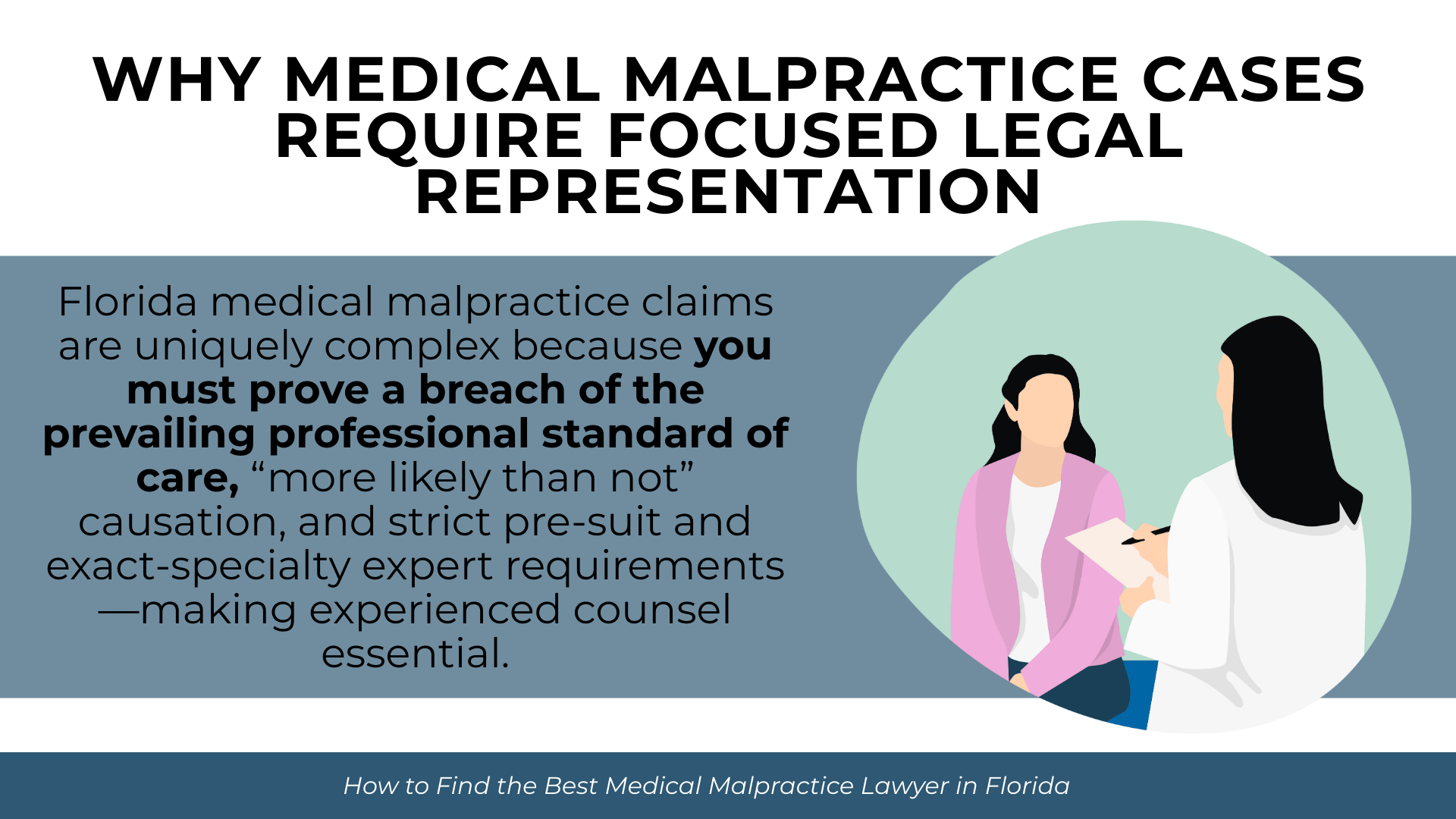
Medical malpractice litigation differs fundamentally from other personal injury claims. These cases involve proving that a healthcare provider’s conduct fell below professional standards and that this failure caused your injury. This requires an attorney who understands both medicine and law.
The Complexity of Proving Medical Negligence in Florida
Florida law defines medical malpractice as a breach of the “prevailing professional standard of care,” meaning the level of care that reasonably prudent similar healthcare providers would recognize as acceptable. Under Fla. Stat. § 766.102, you must prove this standard, show the provider violated it, and establish that the violation caused your injuries.
The causation requirement presents particular challenges. Florida courts apply a “more likely than not” standard, meaning you must prove your injury resulted from the provider’s negligence with greater than 50% probability. The Florida Supreme Court in Gooding v. University Hospital Building, Inc., 445 So. 2d 1015 (Fla. 1984), rejected the “loss of chance” doctrine entirely. If you cannot establish that proper care would more likely than not have prevented your injury, you cannot recover damages regardless of how clear the negligence was.
An attorney unfamiliar with these requirements may not recognize when causation will be difficult to prove or may fail to develop the medical evidence needed to meet this threshold.
Florida’s Mandatory Pre-Suit Investigation Process
Before filing a medical malpractice lawsuit in Florida, you must complete a mandatory pre-suit investigation. Under Fla. Stat. § 766.203, this investigation requires obtaining a verified written medical expert opinion confirming that reasonable grounds exist to support your claim.
Your attorney must serve a Notice of Intent to Initiate Litigation on each prospective defendant under Fla. Stat. § 766.106(2). This notice must include copies of all medical records the expert relied upon and an executed HIPAA authorization. Once the notice is received by the potential defendant, no lawsuit may be filed for 90 days. However, the 90-day period is a ceiling, not a mandatory waiting period in every case. If the defendant issues a written rejection/denial before day 90, that response generally ends the presuit screening period as to that defendant, and suit may be filed without waiting for the full 90 days.
During that 90 days window, the defendant conducts a presuit investigation and must respond with a rejection, settlement offer, or offer to arbitrate. If the defendant fails to respond within 90 days after receipt of the notice, the claim is treated as a final rejection for presuit purposes.
This process requires an attorney who can quickly identify qualified experts, obtain and organize voluminous medical records, and navigate strict procedural requirements. Failure to comply with pre-suit requirements can result in dismissal of your case.
The Expert Witness Challenge
Medical malpractice cases live or die on expert testimony. Florida imposes strict requirements on who can serve as an expert witness under Fla. Stat. § 766.102(5).
For specialist defendants, your expert must practice in the same specialty as the defendant and must have devoted professional time during the three years immediately preceding the incident to active clinical practice, instruction, or research in that specialty. The 2013 amendments eliminated the prior “similar specialty” allowance, requiring exact specialty matching.
Finding qualified experts who meet these requirements, are willing to testify against colleagues, and can explain complex medical issues persuasively is one of the most challenging aspects of these cases. Attorneys who regularly handle medical malpractice claims have established relationships with experts across multiple specialties, while attorneys new to this area must build these connections from scratch.
What Credentials Should a Medical Malpractice Attorney Have?

The attorney you choose should demonstrate specific qualifications that indicate their ability to handle complex medical negligence claims successfully.
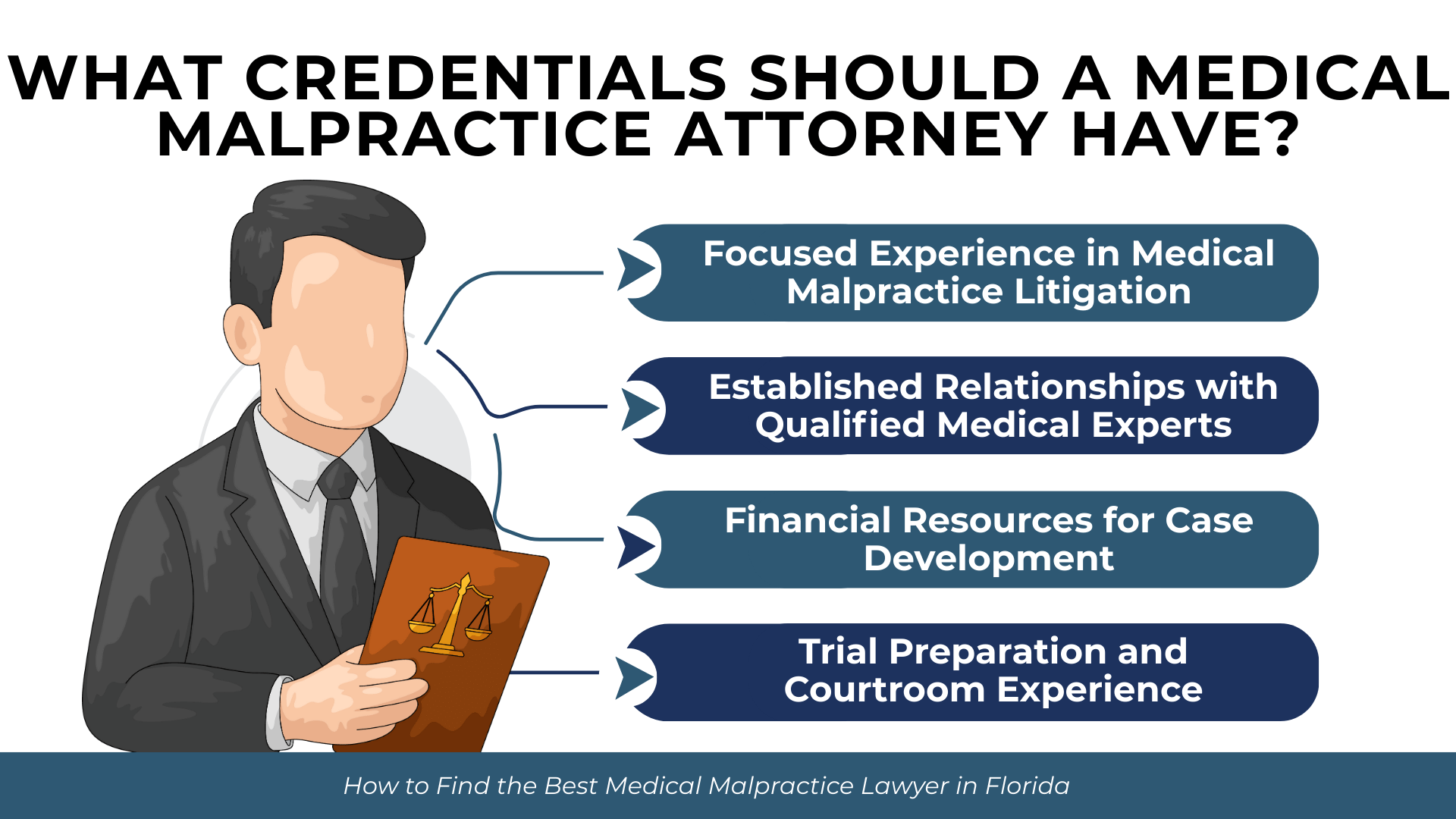
Focused Experience in Medical Malpractice Litigation
Look for an attorney whose practice concentrates on medical malpractice rather than one who handles these cases occasionally among other personal injury matters. Ask how many medical malpractice cases they have handled and what types of injuries or specialties they have experience with.
An attorney who regularly litigates against hospitals, physicians, and their insurers will understand the tactics defense counsel commonly employs. They will know how to navigate the discovery process effectively, depose medical witnesses, and present complex medical evidence to juries.
Established Relationships with Qualified Medical Experts
Your attorney must have access to medical experts across relevant specialties. Ask whether they have relationships with experts who can review your case promptly and, if your case proceeds, testify effectively at trial.
The pre-suit requirement means your attorney needs expert access before they can even file your lawsuit. Attorneys who handle these cases regularly maintain networks of physicians, nurses, and other healthcare professionals who review cases and provide opinions on standard of care and causation.
Financial Resources for Case Development
Medical malpractice cases are expensive to pursue. Before a case reaches trial, an attorney may need to pay for:
- Medical record retrieval from multiple providers
- Expert witness reviews and written opinions
- Deposition costs including court reporters and videographers
- Medical illustrations, animations, or demonstrative exhibits
- Economic experts to calculate future damages
- Life care planners to document ongoing care needs
These costs can reach tens of thousands of dollars before trial, and six figures in complex cases. Ask how your potential attorney handles case expenses and whether they have the resources to fully develop your claim.
Trial Preparation and Courtroom Experience
While most cases settle before trial, your attorney must be prepared to try your case if necessary. Defense attorneys and insurance companies recognize which plaintiff attorneys have trial experience and adjust their settlement postures accordingly.
Ask about the attorney’s trial experience specifically in medical malpractice cases. Inquire about verdicts they have obtained and their experience presenting complex medical testimony to juries.
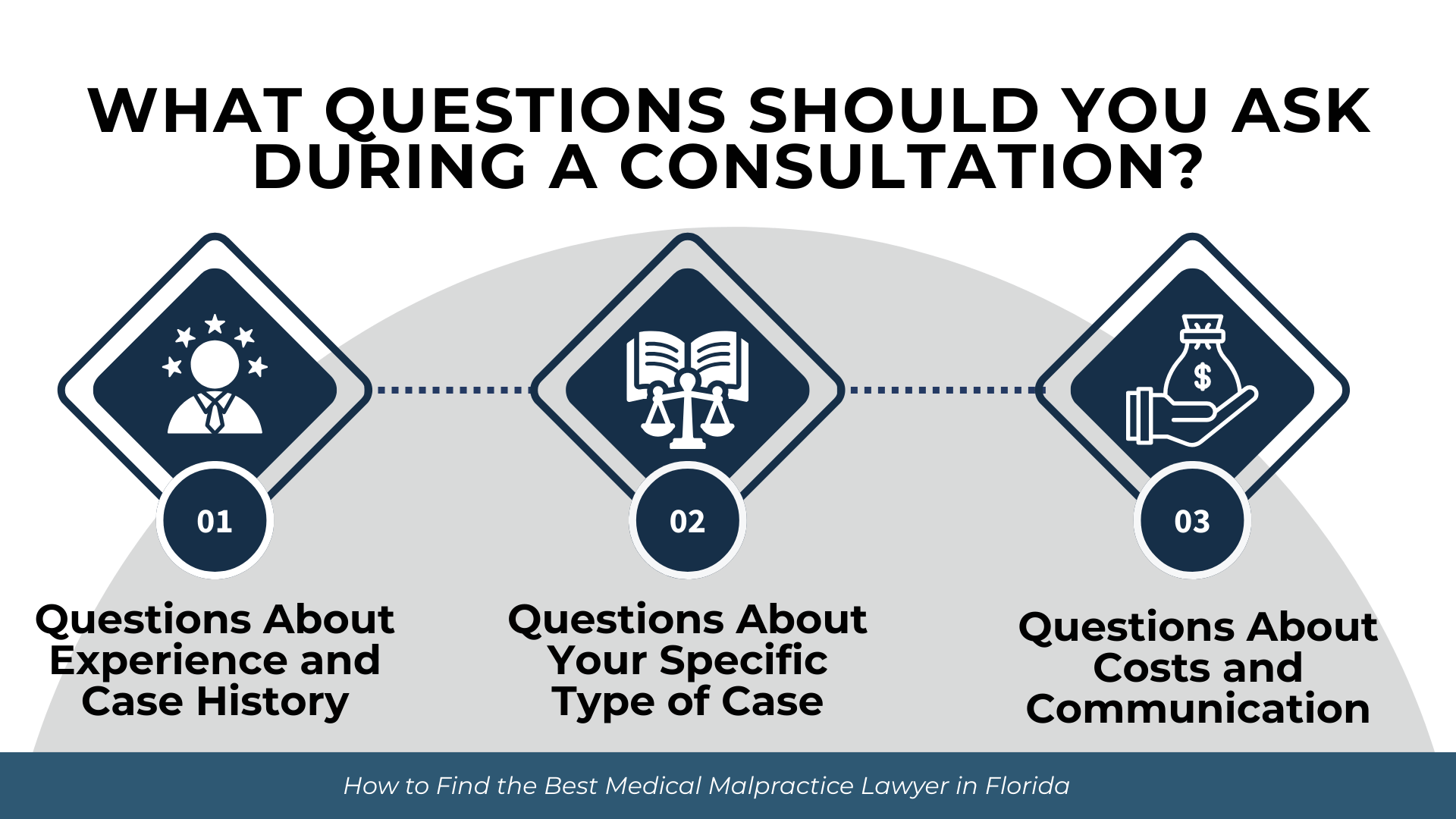
What Questions Should You Ask During a Consultation?
Use your initial consultation to evaluate whether an attorney has the qualifications and approach that fit your needs. Most medical malpractice attorneys offer free initial consultations.
Questions About Experience and Case History
Prepare specific questions that will reveal the attorney’s actual experience with cases like yours:
- How long have you been handling medical malpractice cases specifically?
- What percentage of your practice involves medical malpractice claims?
- Have you handled cases involving my type of injury or the same medical specialty?
- How many medical malpractice cases have you taken to trial?
- What results have you achieved in similar cases?
- Who will actually work on my case day-to-day?
- How do you stay current on developments in medical malpractice law?
- Do you have experts available to review my case promptly?
Pay attention not just to the answers but to how the attorney responds. An experienced attorney should answer these questions confidently and specifically.
Questions About Your Specific Type of Case
Ask the attorney to explain their initial assessment of your case, including potential challenges:
- Based on what I have described, do you see viable claims here?
- What do you see as the main obstacles in proving this case?
- What additional information or records would you need to evaluate my claims?
- How long do you estimate the pre-suit investigation will take?
- What is a realistic timeline for resolving a case like mine?
An attorney who immediately promises a favorable outcome without thoroughly reviewing your records should raise concerns. Legitimate medical malpractice claims require careful analysis before any predictions are appropriate.
Questions About Costs and Communication
Understand the financial arrangement and how the attorney will keep you informed:
- Do you work on a contingency fee basis, and what percentage do you charge?
- How are case expenses handled during litigation?
- If we do not win, am I responsible for any costs?
- How often will you update me on case developments?
- Will I be able to reach you directly with questions?
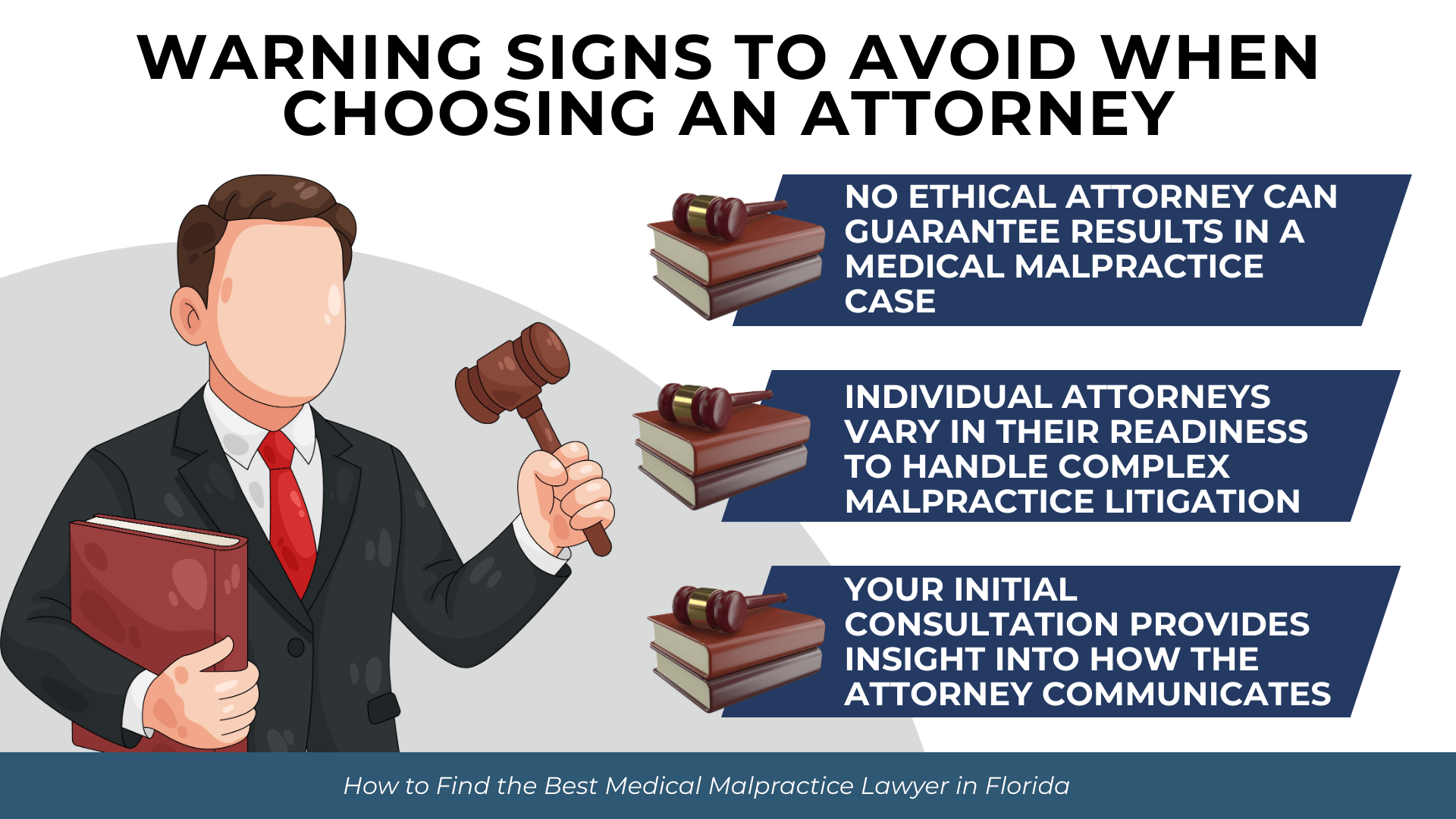
Warning Signs to Avoid When Choosing an Attorney
Not every attorney who accepts medical malpractice cases is equipped to handle them effectively. Watch for these warning signs during your search.
Guarantees or Promises About Outcomes
No ethical attorney can guarantee results in a medical malpractice case. These claims involve complex factual disputes, conflicting expert opinions, and unpredictable juries. Be wary of any attorney who:
- Promises a specific settlement amount before reviewing your records
- Guarantees they will win your case
- Predicts trial outcomes with certainty
- Minimizes the challenges your case may face
- Pressures you to sign a retainer immediately without answering your questions
Confident attorneys will explain their approach and experience without making promises they cannot keep.
Signs an Attorney May Not Be Prepared for Your Case
Regardless of a firm’s practice areas, individual attorneys vary in their readiness to handle complex medical malpractice litigation. Concerns arise when an attorney:
- Cannot clearly explain Florida’s pre-suit requirements
- Seems unfamiliar with expert witness qualification standards
- Lacks established relationships with medical experts
- Has limited experience with cases similar to yours
- Cannot articulate a clear strategy for investigating and building your claim
Medical malpractice defense attorneys and their insurers are well-resourced and experienced. You deserve plaintiff’s counsel who demonstrates equivalent preparation and capability for the demands of your specific case.
Poor Communication and Pressure Tactics
Your initial consultation provides insight into how the attorney communicates. Red flags include:
- Difficulty reaching the attorney or getting questions answered
- Pressure to make immediate decisions
- Reluctance to explain their evaluation of your case
- Dismissive responses to your concerns
- Lack of clear explanation about fees and costs
You will work with this attorney for years if your case proceeds. Trust and communication matter.
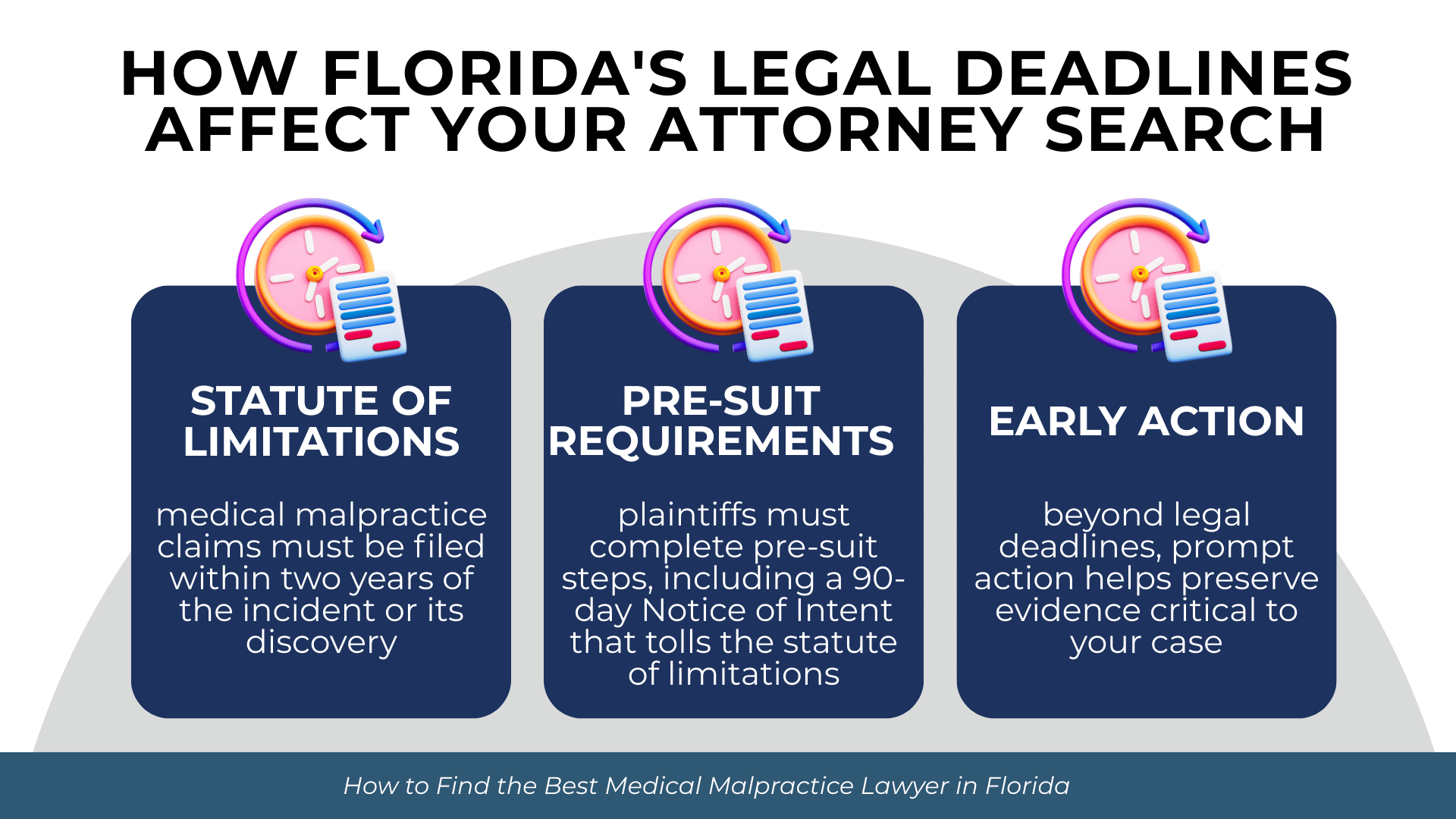
How Florida’s Legal Deadlines Affect Your Attorney Search
Florida’s strict deadlines should create urgency in your search for qualified representation. Waiting too long can eliminate your ability to pursue claims entirely.
Understanding the Statute of Limitations
Under Fla. Stat. § 95.11(5)(c), medical malpractice actions must be commenced within two years from when the injury is discovered or should have been discovered with due diligence. The Florida Supreme Court in Tanner v. Hartog, 618 So. 2d 177 (Fla. 1993), clarified that this requires knowledge of both the injury and a “reasonable possibility that the injury was caused by medical malpractice.”
However, Florida also imposes a four-year statute of repose. Regardless of when you discover your injury, you generally cannot file suit more than four years after the incident occurred. This creates an absolute outer deadline that cannot be extended in most circumstances.
Building in Time for Pre-Suit Requirements
Remember that the 90-day pre-suit notice period must be completed before you can file your lawsuit. This means your attorney needs time before the statute of limitations expires to investigate your claim, retain an expert, obtain the expert’s written opinion, and serve the Notice of Intent.
An attorney who begins working on your case with only weeks remaining before the deadline may not have adequate time to complete proper pre-suit investigation. Starting early provides flexibility to conduct thorough investigation.
Why Early Action Matters for Evidence Preservation
Beyond legal deadlines, prompt action helps preserve evidence critical to your case:
- Medical records may be modified, lost, or destroyed over time
- Witness memories fade as months and years pass
- Healthcare providers may relocate or become unavailable
- Electronic medical records and imaging may have retention limits
- Physical evidence like medical devices may be discarded
Beginning your attorney search promptly gives qualified counsel time to identify and preserve evidence before it disappears.
Frequently Asked Questions About Finding a Medical Malpractice Attorney
How much does a medical malpractice attorney cost?
Most medical malpractice attorneys work on contingency fees, meaning they receive a percentage of any recovery rather than charging hourly rates. You typically pay nothing upfront for attorney fees. Case costs and expenses are often advanced by the attorney and repaid from any settlement or verdict. If you do not recover, you may owe nothing depending on your fee agreement.
How long do I have to find an attorney after a potential malpractice incident?
Florida generally allows two years from discovery of injury to file suit, with a four-year absolute deadline from the incident. However, the mandatory 90-day pre-suit process means you need to engage an attorney well before these deadlines to allow time for investigation and expert review.
Can any personal injury lawyer handle a medical malpractice case?
While any licensed attorney can technically accept a medical malpractice case, these claims require sophisticated knowledge of medical standards, expert witness requirements, and pre-suit procedures that general personal injury attorneys may lack. The complexity of proving medical negligence makes focused experience important.
What if multiple attorneys decline my case?
Attorneys decline medical malpractice cases for various reasons including causation challenges, expired deadlines, limited damages, or difficulty finding supporting experts. If multiple experienced attorneys decline, ask for honest feedback about why. This information may help you understand whether your case has viability or specific obstacles.
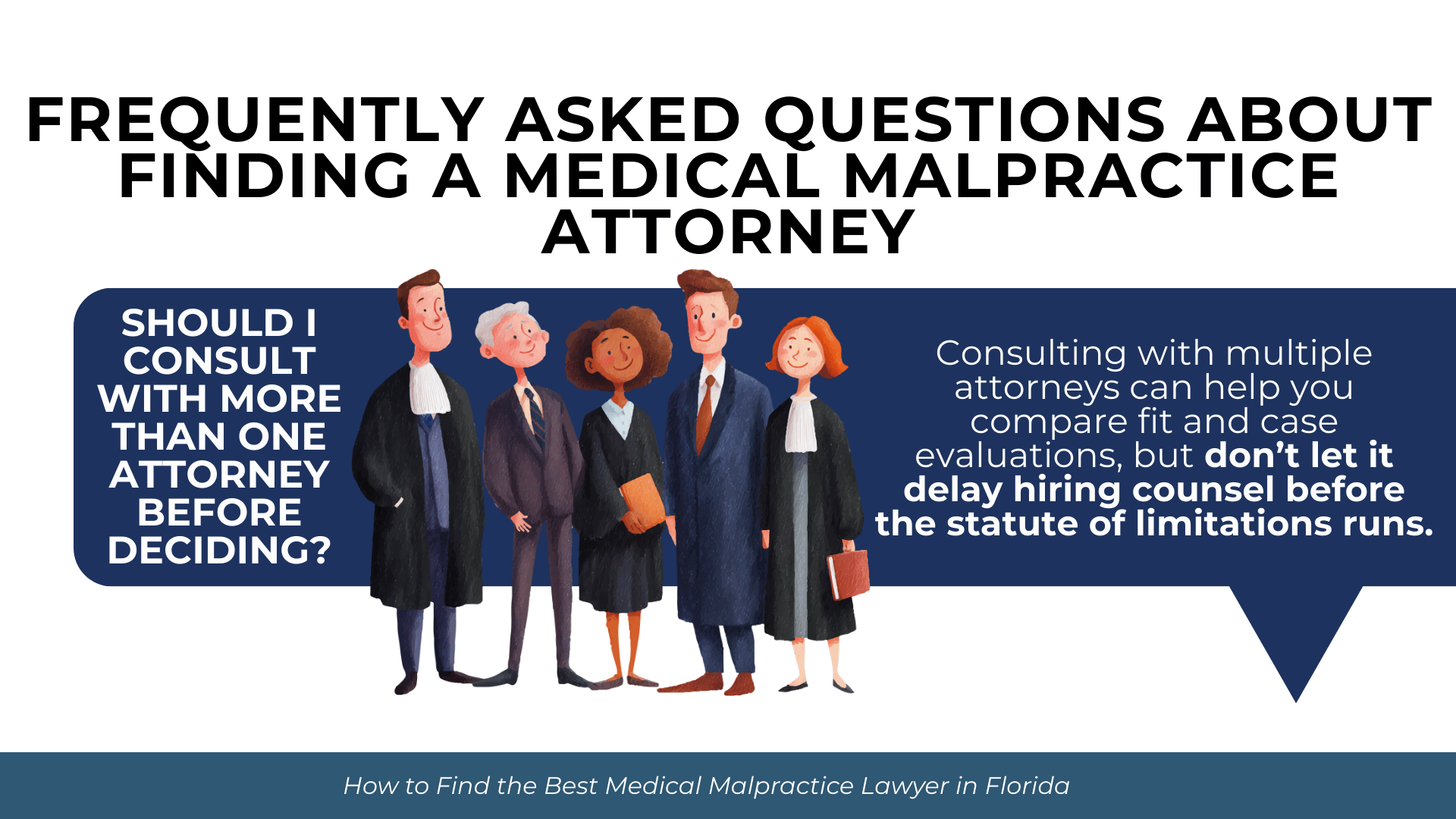
Should I consult with more than one attorney before deciding?
Consulting with multiple attorneys can help you compare experience levels, communication styles, and case assessments. However, be mindful of statute of limitations deadlines. Do not let comparison shopping delay action beyond the point where a qualified attorney can help you.
What documents should I bring to my first consultation?
Bring any medical records you have obtained, a chronological summary of your medical treatment, names and addresses of treating providers, and any correspondence with healthcare facilities. If you have photographs of injuries or other relevant documentation, include those as well.
Taking the Next Step
Finding the right medical malpractice attorney requires understanding what makes these cases uniquely challenging and what qualifications an attorney needs to handle them effectively. Florida’s pre-suit requirements, expert witness standards, and strict deadlines demand sophisticated legal knowledge that general practitioners may not possess.
Focus your search on attorneys who concentrate their practice on medical malpractice, have established expert relationships, possess adequate resources for case development, and communicate clearly about their approach and your case’s challenges. Trust your instincts about communication and fit during consultations.
If you have questions about a potential medical malpractice claim or want to discuss your situation, contact Prosper Injury Attorneys to schedule a consultation.