
Florida imposes strict pre-suit requirements for medical malpractice claims that do not apply to other types of personal injury lawsuits. Before filing a medical malpractice complaint in court, you must complete a formal investigation, obtain a written expert opinion supporting your claim, and provide written notice to every healthcare provider you intend to sue. Failing to follow these mandatory steps can result in dismissal of your case.
Understanding Florida’s pre-suit requirements is essential for protecting your right to pursue compensation. These procedures involve specific deadlines, detailed documentation, and compliance with statutes that courts enforce rigorously.
Why Does Florida Require Pre-Suit Investigation for Medical Malpractice?
The Purpose of Mandatory Pre-Suit Screening
Florida’s pre-suit requirements serve two primary purposes: filtering out claims that lack merit and encouraging early settlement of valid claims. The Florida Legislature enacted these provisions under Chapter 766 of the Florida Statutes to address concerns about frivolous litigation while ensuring injured patients with legitimate claims can proceed efficiently.
The pre-suit process requires claimants to verify that their case has reasonable grounds before incurring the costs of litigation. By mandating expert review before filing suit, the system aims to ensure that only claims supported by qualified medical opinion proceed to court.
How Florida’s Requirements Differ from Other States
Florida’s pre-suit framework is among the most detailed in the nation. According to the Florida Office of Insurance Regulation’s 2024 Medical Malpractice Report, Florida’s medical malpractice insurance market totaled $908 million in direct written premium in 2023, making it the third largest state market nationally. This substantial volume of claims has shaped a comprehensive statutory scheme.
Unlike many states that allow plaintiffs to file suit first and develop expert support during discovery, Florida requires the expert opinion before the lawsuit begins. The mandatory 90-day waiting period after serving notice gives both parties an opportunity to investigate and potentially resolve the claim without litigation.
Consequences of Failing to Complete Pre-Suit Steps
Non-compliance with Florida’s pre-suit requirements carries serious consequences:
- Dismissal of the medical malpractice claim under Fla. Stat. § 766.106(3)(a)
- Potential award of attorney’s fees against the claimant’s counsel
- Possible referral to the Florida Bar for disciplinary review
- Loss of the ability to refile if the statute of limitations has expired
Courts enforce these requirements strictly. The pre-suit investigation is not optional. A defect caught while the limitations period is still open can often be cured; one discovered after it closes can end the case.
What Must the Pre-Suit Investigation Include?

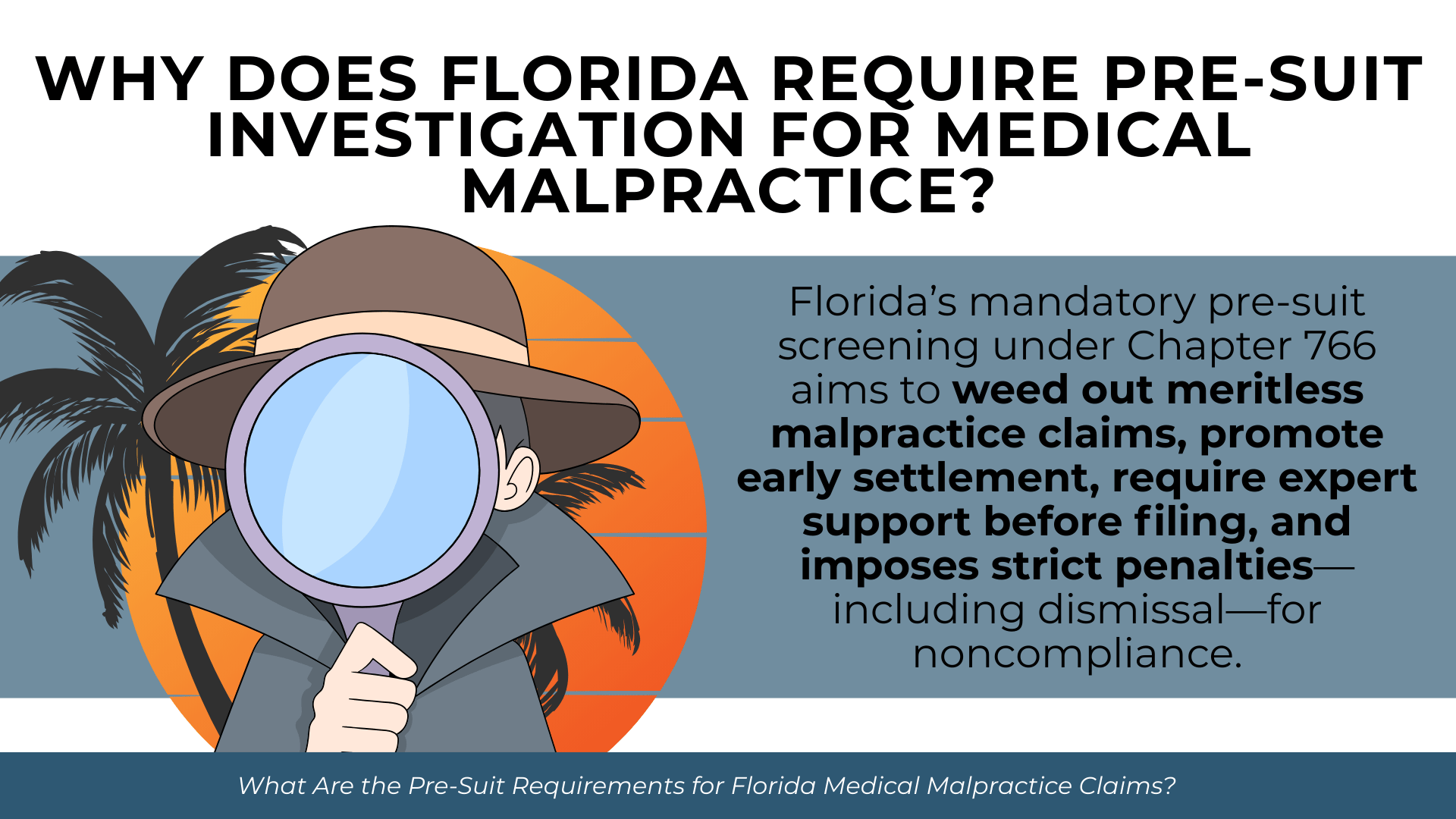
Conducting a Reasonable Investigation
Under Fla. Stat. § 766.203, before mailing a notice of intent to initiate litigation, the claimant must complete a pre-suit investigation to determine whether reasonable grounds exist to believe that the healthcare provider was negligent and that the negligence caused the injury.
This investigation must be thorough enough to support a good-faith determination that the claim has merit. A superficial review will not satisfy the statutory requirement.
Obtaining and Reviewing Medical Records
The investigation typically involves gathering and analyzing all relevant medical records. This includes:
- Records from the healthcare provider you intend to sue
- Records from all providers who treated you for the injury afterward
- Records from providers who treated you in the two years before the alleged negligence
- Imaging studies, laboratory results, and diagnostic test reports
- Nursing notes, progress notes, and medication administration records
Complete records are essential because the corroborating expert must conduct a thorough review before signing the required affidavit.
Identifying All Potential Defendants
The pre-suit investigation should identify every healthcare provider who may bear responsibility for your injury. This matters because each defendant must receive proper notice, and adding defendants after the statute of limitations has run may be impossible.
Potential defendants may include treating physicians, consulting specialists, nurses, hospitals (with limitations for sovereign hospitals), surgical centers, radiology groups, and laboratory facilities. Determining the correct parties requires careful review of who participated in your care and what role each played.
What Is Required in the Corroborating Expert Opinion?
Who Qualifies as an Expert Under Florida Law
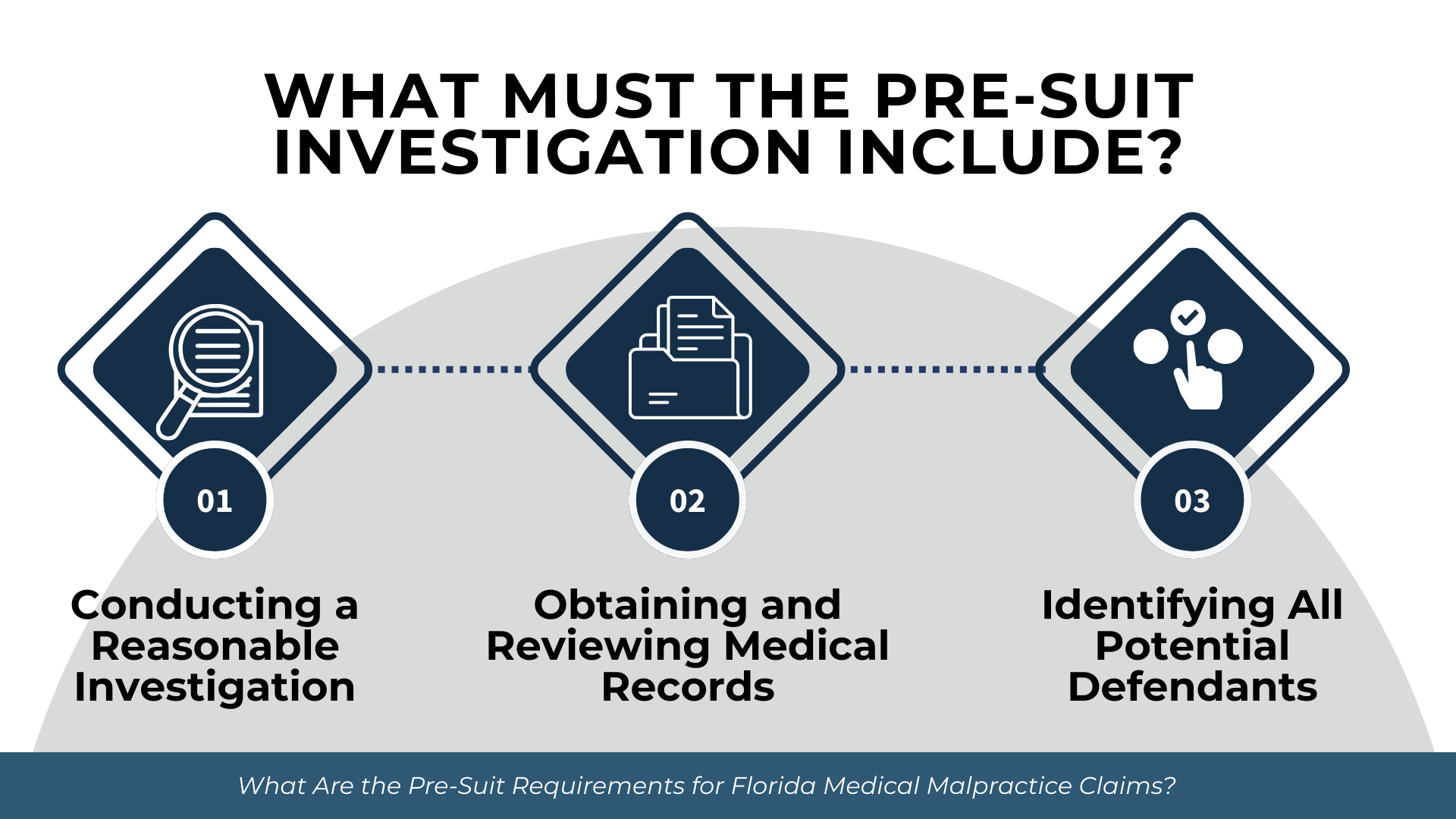
Florida imposes specific qualification requirements for medical experts in malpractice cases. Under Fla. Stat. § 766.102(5), the expert must hold an active and valid license as a healthcare provider.
For specialists, the expert must specialize in the same specialty as the defendant and must have devoted professional time during the three years immediately preceding the incident to active clinical practice, instruction, or clinical research in that same specialty. The 2013 amendments to this statute eliminated the previous allowance for “similar specialty” experts—the match must now be exact.
For general practitioners, the expert must have devoted professional time during the five years preceding the incident to active clinical practice, instruction, or research in general medicine.
What the Expert Opinion Must Address
The corroborating expert opinion required by Fla. Stat. § 766.203 must be a verified written statement that addresses both negligence and causation. The expert must confirm that reasonable grounds exist to support the claim that:
The healthcare provider breached the prevailing professional standard of care—the core element in any medical malpractice claim.. Under Fla. Stat. § 766.102(1), this standard is defined as “that level of care, skill, and treatment which, in light of all relevant surrounding circumstances, is recognized as acceptable and appropriate by reasonably prudent similar health care providers.”
The breach caused the claimant’s injury. Florida requires proof of causation under the “more likely than not” standard—the plaintiff must establish that the defendant’s negligence was more than 50% likely to have caused the harm. As the Florida Supreme Court established in Gooding v. University Hospital Building, Inc., 445 So. 2d 1015 (Fla. 1984), Florida does not recognize the loss of chance doctrine, meaning patients cannot recover for a reduced chance of survival or recovery.
Specialty-Matching Requirements
The specialty-matching requirement is strictly enforced. If you are suing an orthopedic surgeon, your corroborating expert must be an orthopedic surgeon with recent clinical activity. A general surgeon or another type of specialist will not satisfy the statutory requirement.
One exception exists under Fla. Stat. § 766.102(8): if the defendant was treating a condition outside their own specialty, an expert trained in treating that condition qualifies as a “similar health care provider.” This exception applies to the substance of the treatment, not merely the defendant’s board certification.
What Must Be Included in the Notice of Intent?
Required Contents of the Notice
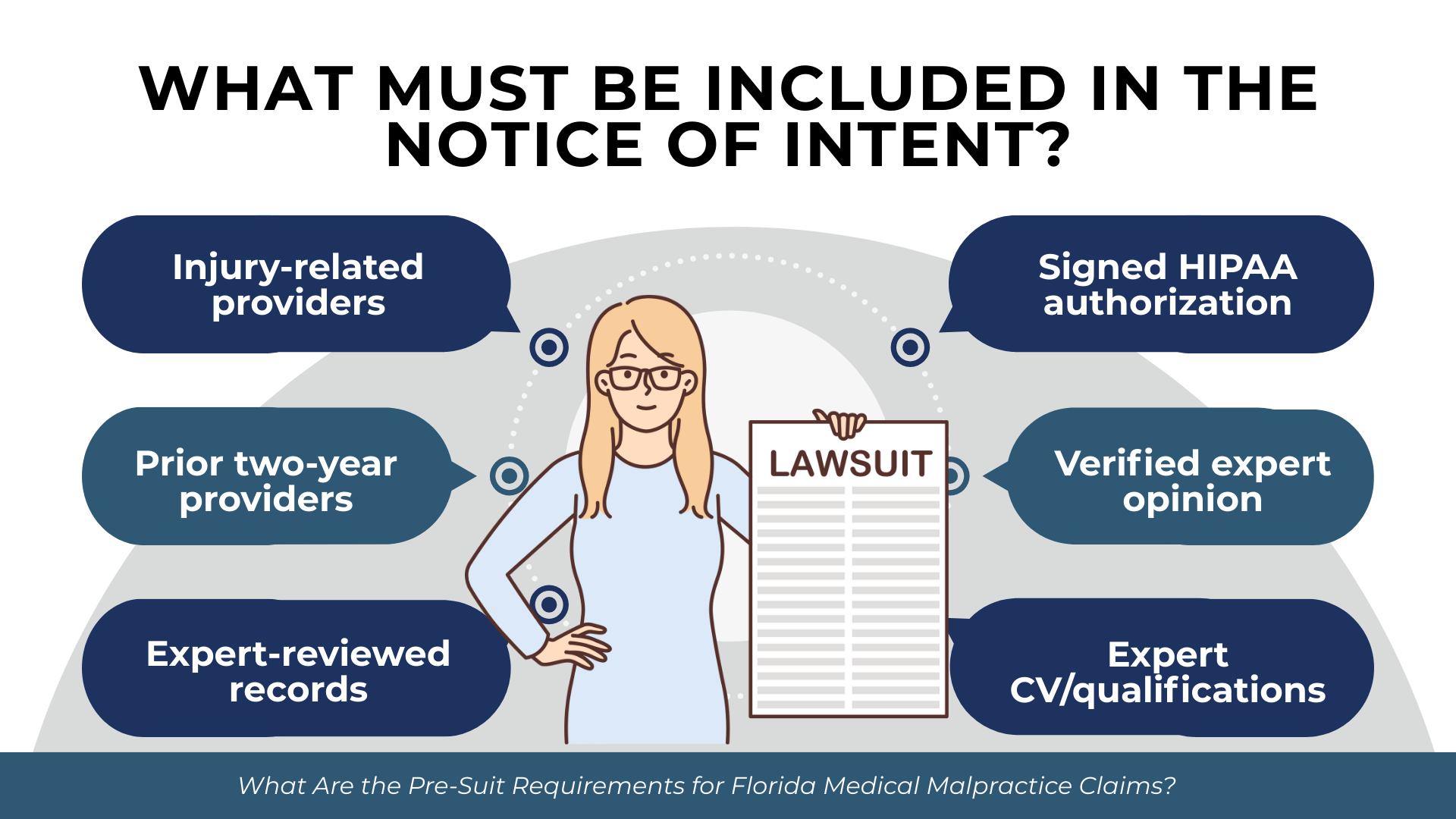
The Notice of Intent to Initiate Litigation must comply with Fla. Stat. § 766.106(2). The notice must include:
- A list of all known healthcare providers who saw you for injuries resulting from the alleged negligence
- A list of all known providers who treated you during the two years before the alleged act of negligence
- Copies of all medical records relied upon by the expert in forming the corroborating opinion
- An executed HIPAA-compliant medical authorization form per Fla. Stat. § 766.1065
- The corroborating expert’s verified written opinion
- The expert’s curriculum vitae or statement of qualifications
Each element is mandatory. Omitting required components can expose the notice to challenge and potentially require restarting the pre-suit process.
Proper Service on Prospective Defendants
The Notice of Intent must be served on each prospective defendant by one of the verifiable means the statute allows: certified mail with return receipt, U.S. mail with a tracking number, a commercial carrier, or a process server (Fla. Stat. 766.106(2)(a)). Suit generally cannot be filed against a defendant until 90 days after the notice is delivered (Fla. Stat. 766.106(3)(a)), unless that defendant rejects the claim in writing sooner (Fla. R. Civ. P. 1.650(d)). Under Boyle v. Samotin, 337 So. 3d 313 (Fla. 2022), the statute of limitations is tolled from the date the notice is mailed, not when it is received.
This means mailing the notice on the last day of the limitations period preserves your claim, even if the defendant does not receive it until afterward. The defendant’s 90-day investigation period, however, runs from the date of receipt.
HIPAA Authorization Requirements
Fla. Stat. § 766.1065 requires that the Notice of Intent include an executed authorization form that complies with federal HIPAA regulations. This authorization permits prospective defendants to obtain your medical records for their own investigation during the pre-suit period.
The authorization must be valid and properly executed. An expired or defective authorization can undermine the sufficiency of your notice.
How Does the 90-Day Pre-Suit Period Work?
When the 90-Day Clock Starts
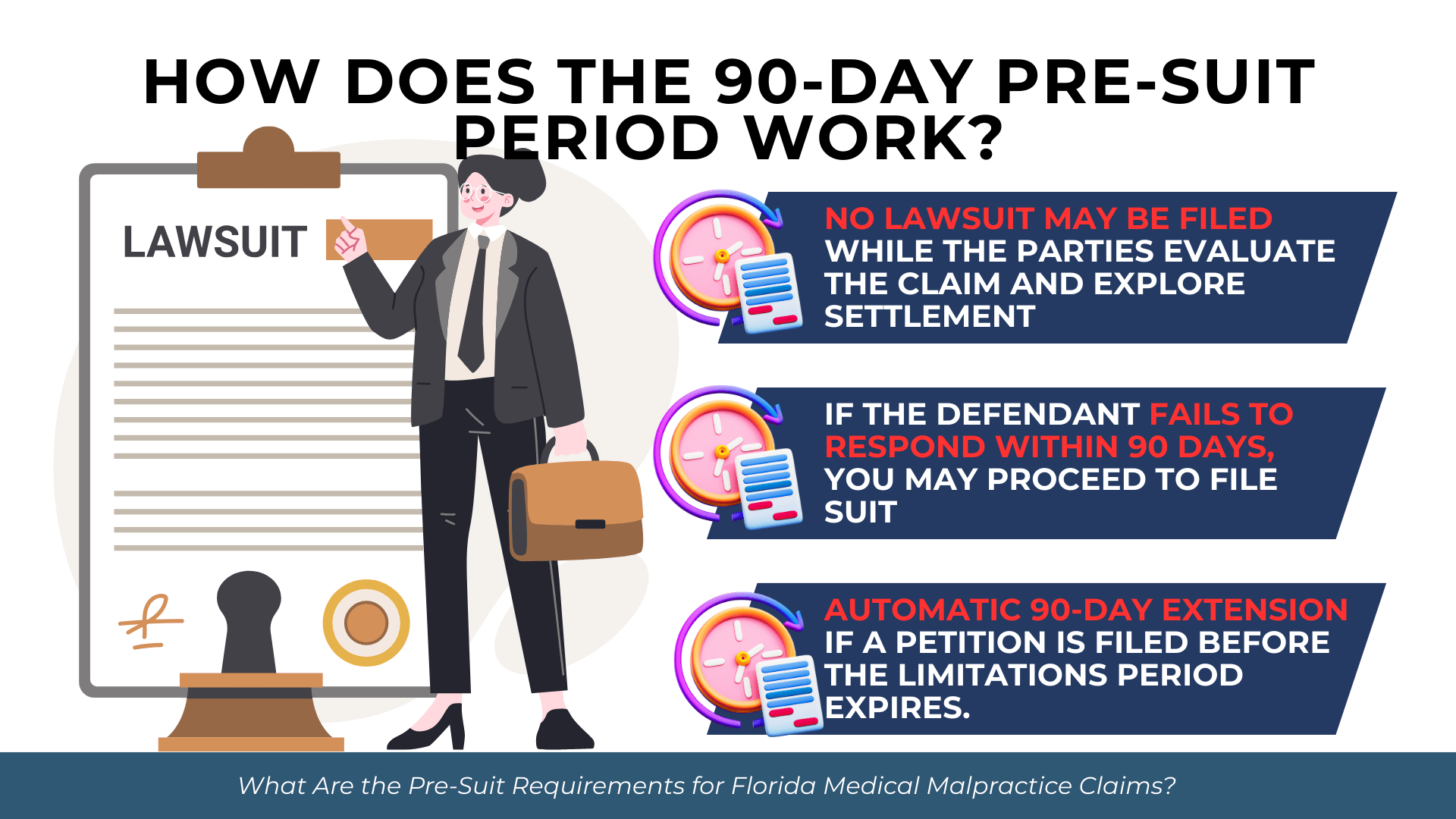
Once the prospective defendant receives the Notice of Intent, a mandatory 90-day investigation period begins under Fla. Stat. § 766.106. During this period, you cannot file your lawsuit. The purpose is to allow both sides to evaluate the claim and explore settlement.
The 90-day period runs from receipt of notice, not from mailing. If notice is sent to multiple defendants on the same day, the period may start on different dates depending on when each defendant actually receives the notice.
What Defendants Must Do During This Period
Prospective defendants must respond within the 90-day period. Under Fla. Stat. § 766.106, the defendant may:
Reject the claim outright. If the defendant denies liability, you may proceed to file suit after the 90-day period expires.
Make a settlement offer. The defendant may offer a specific amount to resolve the claim. You may accept, reject, or counter the offer.
Offer to arbitrate. Florida’s voluntary binding arbitration provisions under Fla. Stat. § 766.207 allow defendants to offer arbitration as an alternative to litigation. Accepting arbitration has significant consequences for damage recovery and should be evaluated carefully.
If the defendant fails to respond within 90 days, you may proceed to file suit.
Extending the Investigation Period
Fla. Stat. § 766.104(2) permits claimants to obtain an automatic 90-day extension of the limitations period by filing a petition with the clerk of court and paying a filing fee. This petition must be filed within the original limitations period—it cannot rescue a claim after the deadline has passed.
As the Florida Supreme Court clarified in Kagan v. Pollock, 638 So. 2d 151 (Fla. 1994), the petition for extension need not specifically name prospective defendants. The extension provides additional time to complete the investigation when complexities arise.
Additionally, under Hillsborough County Hospital Authority v. Coffaro, 829 So. 2d 862 (Fla. 2002), this purchased extension may be added to the 60-day period following completion of pre-suit investigation, providing flexibility in calculating filing deadlines.
How Do Pre-Suit Requirements Affect the Statute of Limitations?
Tolling During the Pre-Suit Period
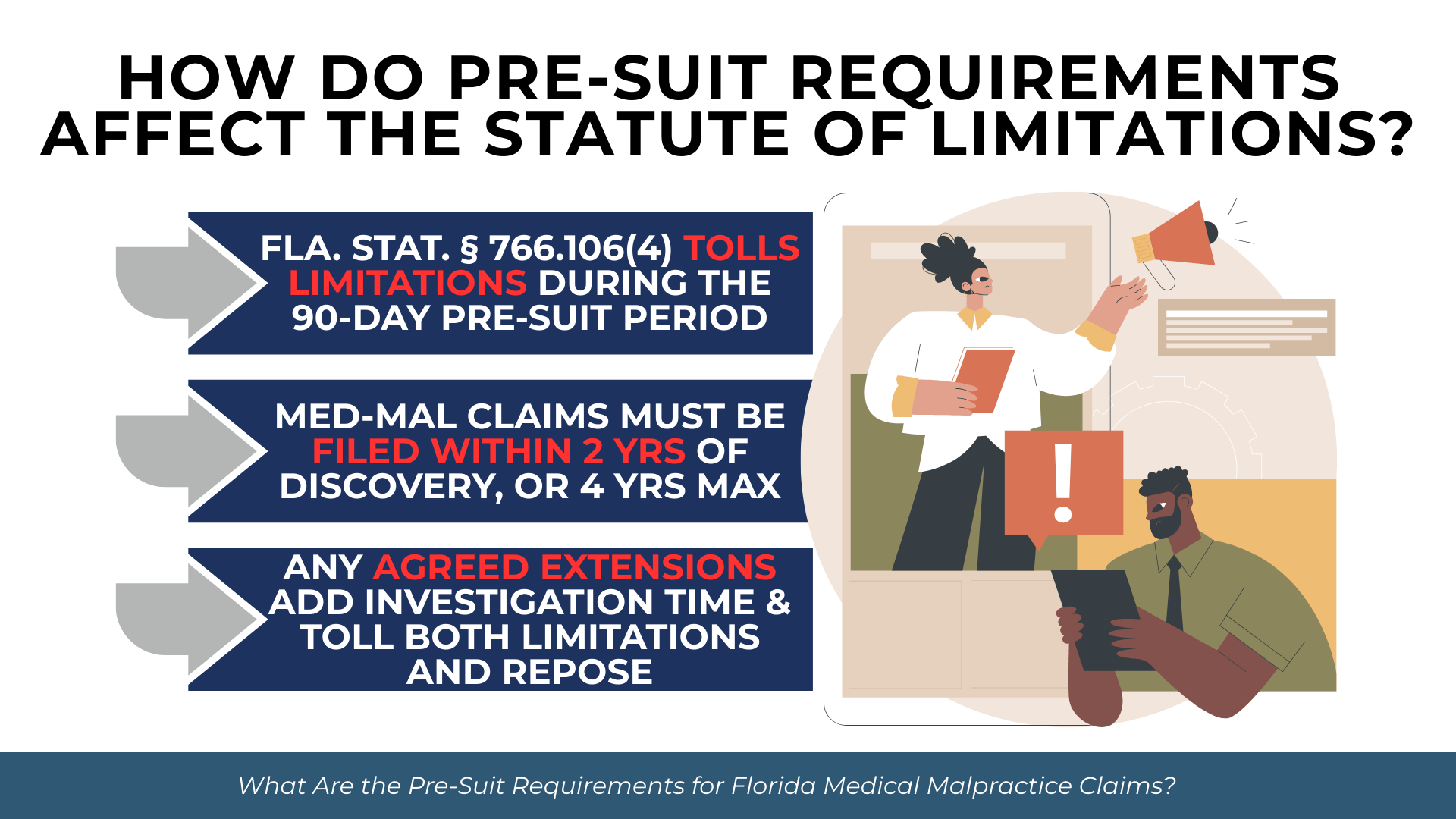
One critical protection for claimants is that the 90-day pre-suit investigation period tolls (pauses) the statute of limitations. Under Fla. Stat. § 766.106(4), the limitations period stops running while the mandatory investigation proceeds.
As the Florida Supreme Court explained in Hankey v. Yarian, 755 So. 2d 93 (Fla. 2000), this tolling ensures claimants receive the full benefit of their original statutory time period plus the 90-day pause. The pre-suit requirements do not consume your limitations period.
Importantly, Musculoskeletal Institute Chartered v. Parham, 745 So. 2d 946 (Fla. 1999), established that filing the Notice of Intent tolls both the two-year statute of limitations and the four-year statute of repose.
Calculating Your Filing Deadline
Florida’s medical malpractice statute of limitations under Fla. Stat. § 95.11(5)(c) provides:
A two-year period from the date the incident was discovered or should have been discovered with due diligence. Under the modified Nardone rule established in Tanner v. Hartog, 618 So. 2d 177 (Fla. 1993), discovery means knowledge of the injury and a “reasonable possibility that the injury was caused by medical malpractice.”
A four-year statute of repose from the date of the incident, regardless of discovery. This outer limit bars claims even if the injury could not reasonably have been discovered within four years.
An exception for minors: the four-year repose does not bar claims filed on behalf of a minor before the child’s eighth birthday.
Purchasing Additional Time with Extensions
The 90-day extension available under Fla. Stat. § 766.104(2) can provide crucial additional time when investigation reveals unexpected complexity. However, you must petition for this extension while the limitations period is still running.
The parties may also mutually agree to extend the investigation period beyond the statutory 90 days. Agreed extensions continue to toll both the statute of limitations and the statute of repose for the duration of the extension.
Frequently Asked Questions About Florida Pre-Suit Requirements
Can I file a medical malpractice lawsuit without completing the pre-suit requirements?
No. Florida law makes the pre-suit investigation, expert opinion, and Notice of Intent mandatory prerequisites to filing a medical malpractice complaint. Under Fla. Stat. § 766.106(3)(a), a lawsuit filed without completing these steps is subject to dismissal. Defects can sometimes be cured while the limitations period is still open, but you should not count on it.
What happens if the healthcare provider does not respond during the 90-day period?
If the prospective defendant fails to respond with a rejection, settlement offer, or arbitration offer within 90 days, you may proceed to file your lawsuit. The defendant’s failure to respond does not waive any defenses they may raise once litigation begins, but it does allow the claimant to move forward.
Does the pre-suit period count against my statute of limitations?
No. The 90-day pre-suit investigation period tolls the statute of limitations under Fla. Stat. § 766.106(4). The clock pauses while you complete the mandatory pre-suit steps, then resumes after the period ends. This ensures the pre-suit requirements do not consume your time to file.
Can I get more than 90 days to complete my investigation?
Yes. Under Fla. Stat. § 766.104(2), you may obtain an automatic 90-day extension by filing a petition with the clerk of court and paying the required filing fee. This petition must be filed within your original limitations period. Additionally, you and the prospective defendant may mutually agree to extend the pre-suit period, which continues to toll the statute of limitations.
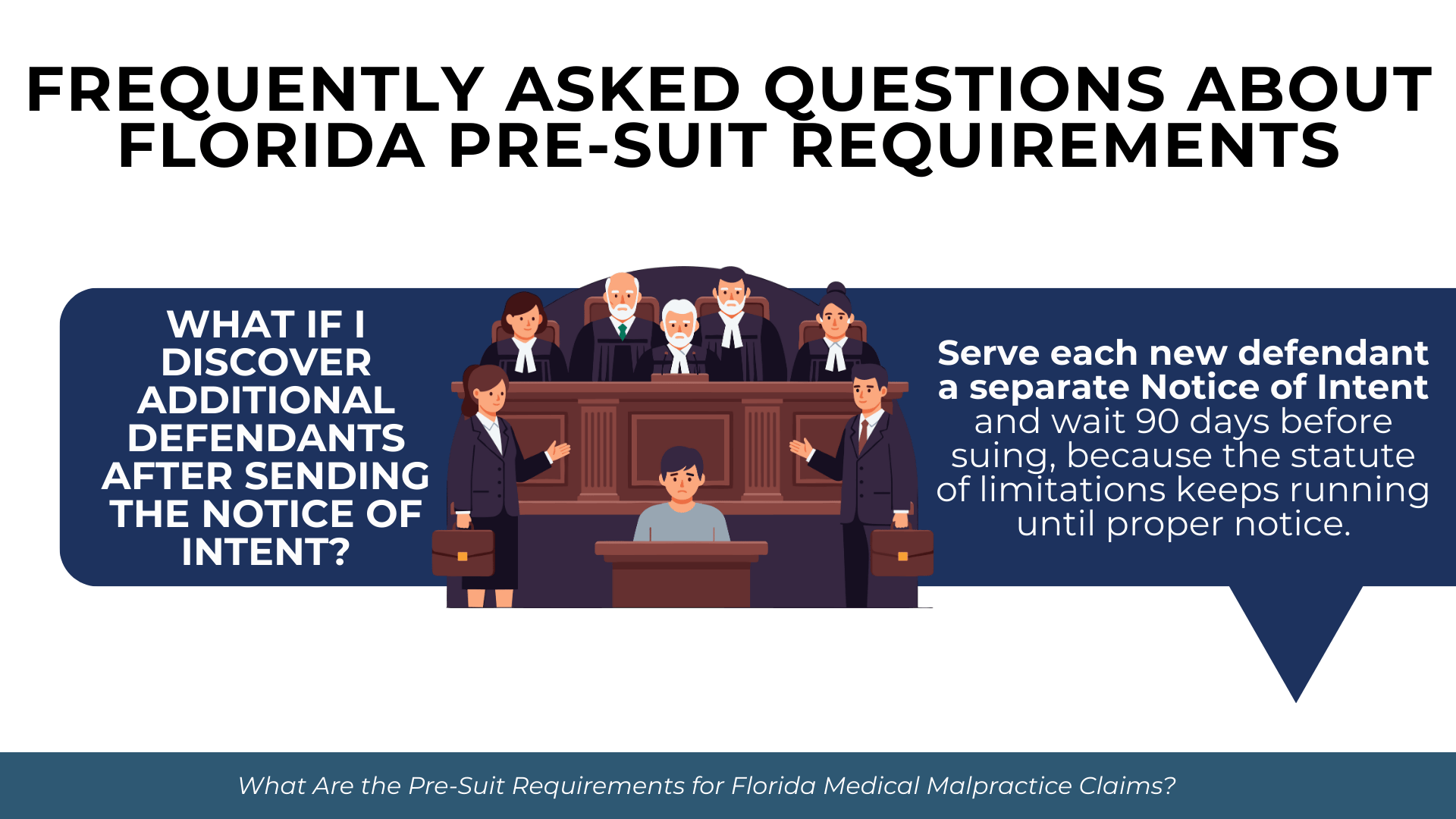
What if I discover additional defendants after sending the Notice of Intent?
Start by asking whether the new defendant is already covered by a notice you served. Mailing a notice tolls the statute of limitations as to all prospective defendants, not only the ones named in it (Fla. Stat. 766.106(4)). But a defendant not covered by a notice you already sent, which usually means one with no legal relationship to a defendant you noticed, generally needs its own notice and its own 90-day presuit period, which the parties can extend by agreement, though suit can be filed sooner once you receive that defendant’s written rejection, so time still matters.
Protecting Your Right to File a Medical Malpractice Claim
Florida’s pre-suit requirements create a structured process that must be followed precisely. The mandatory investigation, corroborating expert opinion, and Notice of Intent are not formalities—they are enforceable prerequisites that courts take seriously.
The interaction between pre-suit requirements and the statute of limitations makes timing particularly important. While the law provides tolling protections and extension options, these safeguards only work when invoked properly and within applicable deadlines.
If you have questions about pre-suit requirements for a Florida medical malpractice claim, contact Prosper Injury Attorneys to discuss your situation.