Jet ski rental injuries in Miami happen with alarming regularity. Riders collide with other watercraft, suffer internal trauma from high-pressure water jets, or lose control when equipment malfunctions. If you were hurt on a rental jet ski, you may be wondering whether you can hold the rental company accountable—especially if you signed a waiver before getting on the water. The answer depends on what the rental company did or failed to do, and whether Florida and maritime law provide you a path to recovery.
This guide explains when jet ski rental companies can be sued for injuries in Miami, what legal duties they owe, and why the waiver you signed may not protect them from liability.
Can You Sue a Jet Ski Rental Company After an Injury in Miami?
The short answer
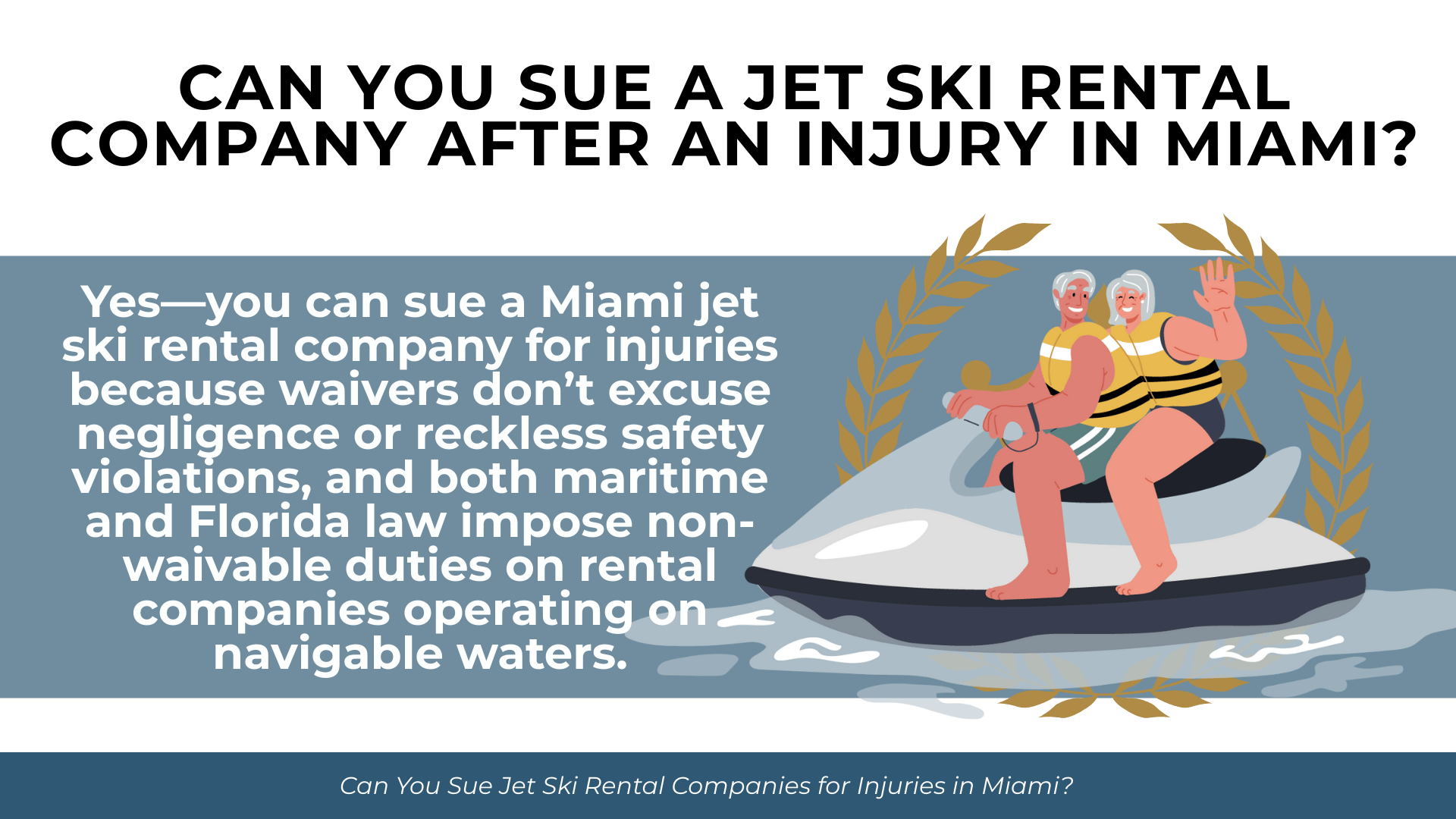
Yes, you can sue a jet ski rental company for injuries in Miami under specific circumstances. Signing a waiver does not automatically bar your claim. Florida and federal maritime law impose duties on rental companies that cannot be waived away, and when those duties are breached through negligence or recklessness, injured riders have legal recourse.
Why waivers don’t always protect rental companies
Maritime law governs liability waivers for recreational activities conducted on navigable waters. While exculpatory clauses are generally enforceable if they are clear and unambiguous, maritime public policy prohibits waivers of liability for intentional misconduct, recklessness, or gross negligence. This means a waiver cannot shield a rental company that acted with deliberate disregard for your safety or failed to meet basic operational standards.
Additionally, waivers that contain overly broad language, hidden terms, or attempts to release liability for statutory safety violations may be deemed unenforceable. If the rental company misrepresented known risks or concealed dangerous conditions, the waiver may be invalidated entirely.
What law applies to Miami jet ski injuries
Miami’s coastal waters qualify as navigable waters under federal law, which means maritime law typically applies to jet ski accidents occurring in Haulover Inlet, along the coastline, or in connected waterways. A tort falls under federal maritime jurisdiction when it occurs on navigable waters and bears a substantial relationship to traditional maritime activity. Jet ski rentals satisfy both requirements.
However, Florida state law also plays an important role. State regulations governing PWC operations and rental livery duties apply alongside maritime rules. Florida wrongful death statutes provide remedies where maritime law may not, particularly for accidents occurring within three nautical miles of shore.
What Makes Jet Ski Rental Companies Negligent Under Florida and Maritime Law?
Call us today at (305) 694-2676 or
contact us online for a free case evaluation.
Hablamos español.


Jet ski rental companies are not common carriers and do not owe the heightened duty of care that applies to passenger transportation services. However, they must exercise ordinary reasonable care under the circumstances. This standard requires rental companies to fulfill specific duties toward their customers.
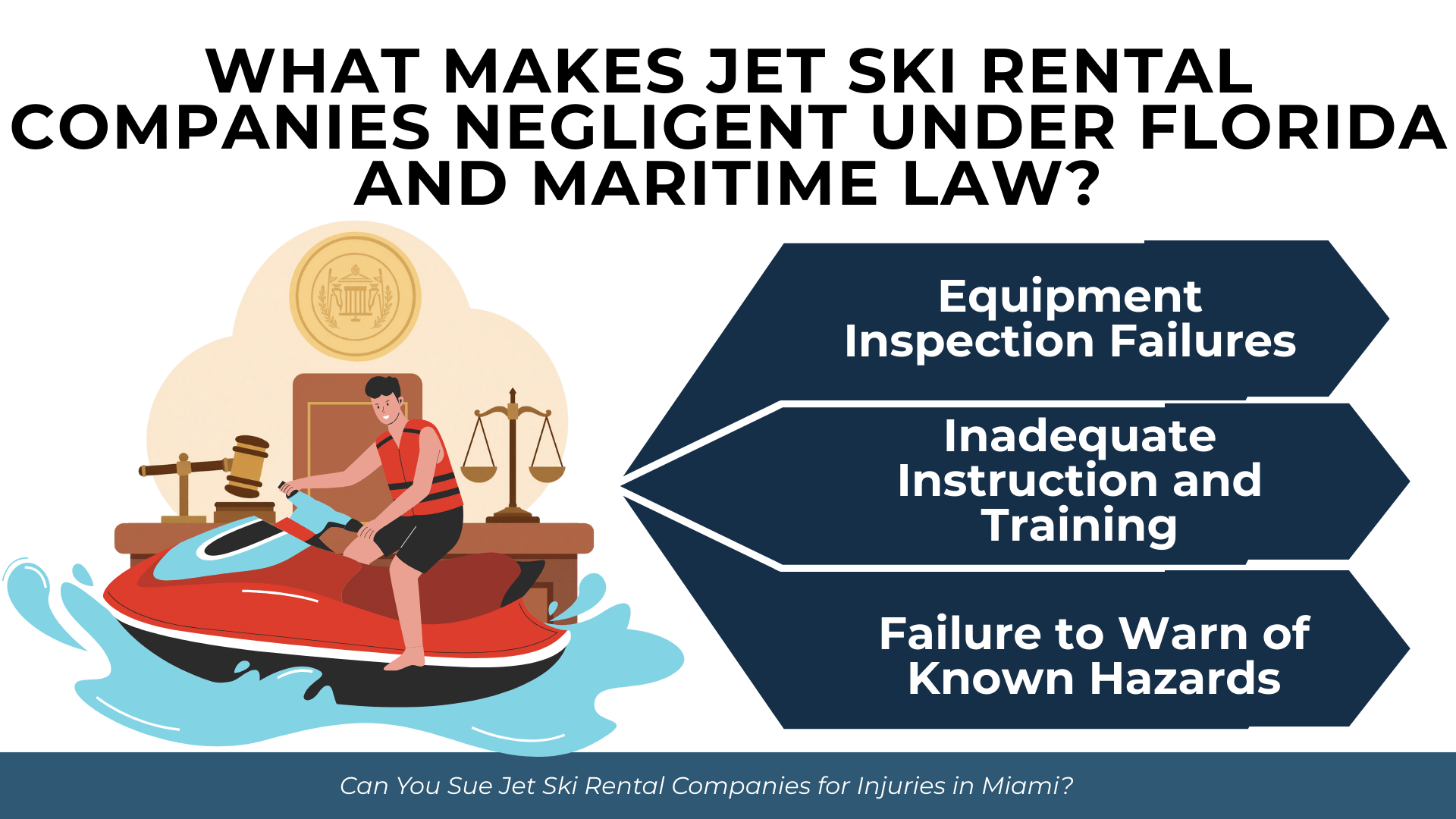
Equipment inspection failures
Rental companies must inspect jet skis for hazards before each rental. This includes checking throttle function, steering mechanisms, kill switch lanyards, and hull integrity. Salt corrosion can cause throttles to stick in the open position, creating uncontrolled acceleration. Worn steering cables can snap under stress, resulting in complete loss of directional control, mirroring common equipment issues in boat rentals where deferred maintenance creates similar hazards. When rental companies defer maintenance to maximize revenue or skip daily inspections, they breach their duty of care.
Rental companies owe customers four core duties under maritime negligence principles:
- Equipment inspection. Rental companies must maintain jet skis in reasonably safe condition, checking throttle systems, steering cables, kill switches, and hull integrity before each rental.
- Adequate instruction. Companies must provide sufficient training on safe operation, including vessel-specific controls, local hazards, and reboarding techniques.
- Warning of known hazards. Renters must be informed of foreseeable risks, including water conditions, traffic patterns, and activity-specific dangers unique to jet skis.
- Renter verification. Companies must verify minimum age requirements and assess apparent fitness to operate where required by statute.
Inadequate instruction and training
Most rental operations provide only five to ten minutes of instruction before sending customers onto the water. Briefings typically cover starting the engine, basic steering, and kill switch use. What they often fail to explain adequately is the unique characteristic that makes jet skis so dangerous: off-throttle steering loss. This critical safety information is frequently glossed over or omitted entirely.
Rental companies that rush instruction to speed turnover, fail to provide hands-on practice, or neglect to explain local hazards like no-wake zones and high-traffic areas may be liable for resulting injuries.
Failure to warn of known hazards
Beyond basic instruction, rental companies must warn customers of foreseeable risks. This includes current weather conditions, wave heights, congested waterways, and the specific dangers associated with jet ski operation. When companies fail to disclose known hazards—or actively conceal them to avoid losing business—they breach their duty to warn.
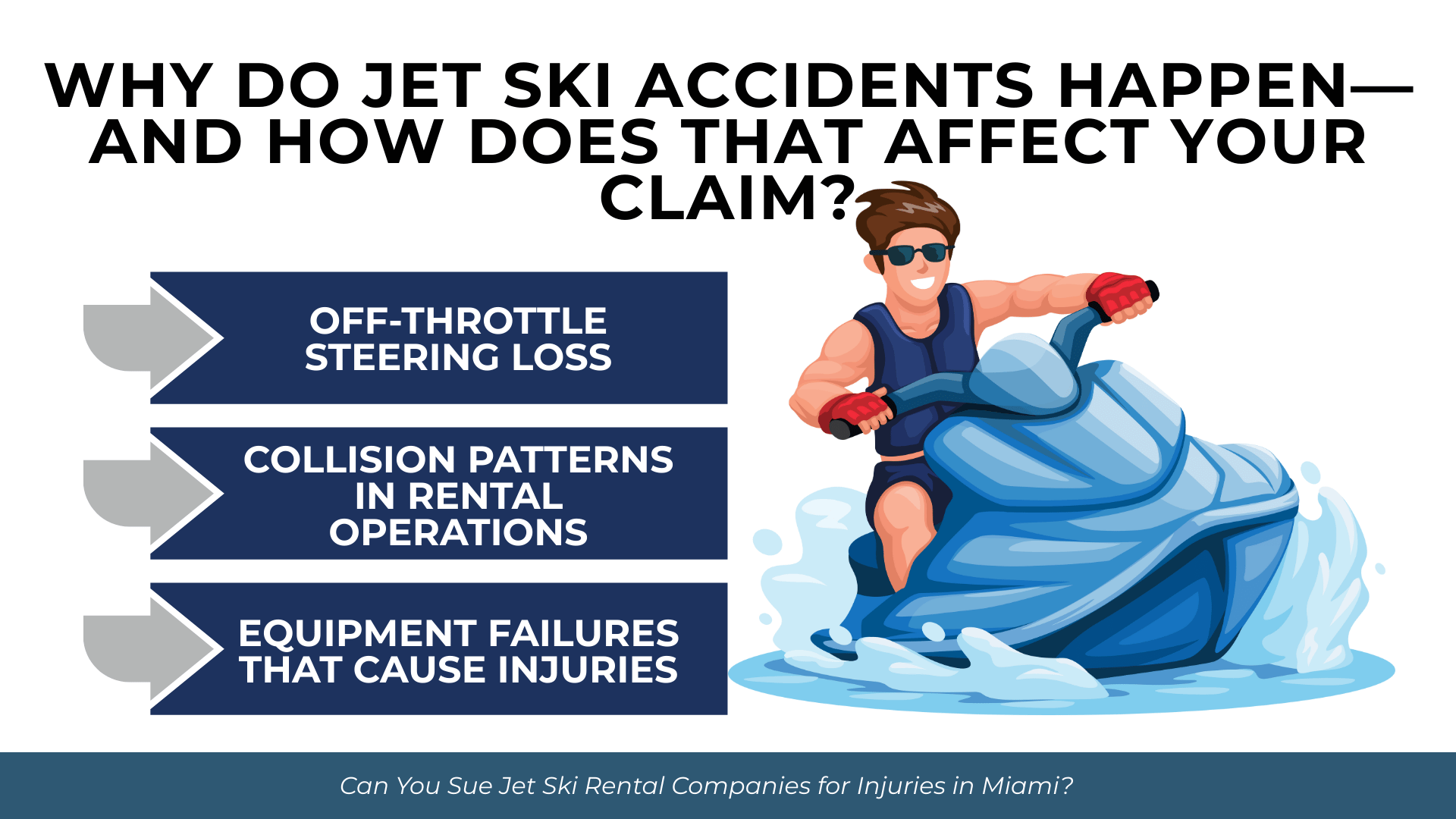
Why Do Jet Ski Accidents Happen—and How Does That Affect Your Claim?
Understanding how jet ski accidents occur is essential to building a negligence claim. The mechanisms of injury often point directly to rental company failures.
Off-throttle steering loss: the defining PWC hazard
Jet skis operate fundamentally differently from other watercraft. They require thrust to steer—the jet nozzle at the rear must be pushing water for the handlebars to have any directional effect. When an inexperienced rider sees an obstacle and instinctively releases the throttle, all steering control vanishes. The craft continues along its original trajectory directly into the collision.
This counterintuitive characteristic causes the majority of jet ski collisions. Per hour of operation, jet skis are approximately 65 times more likely to be involved in a collision than other boat types (for broader context on watercraft collision rates, see Miami boat accident statistics). If a rental company fails to adequately explain off-throttle steering loss, that failure directly contributes to the accident mechanism.
Collision patterns in rental operations
Several accident patterns emerge repeatedly in jet ski rental injuries:
- Off-throttle steering loss. Riders release throttle in emergencies, losing all steering control and colliding with obstacles, other watercraft, or swimmers.
- Group collision clusters. Friends renting multiple jet skis follow too closely; when one stops abruptly, followers cannot steer away because releasing the throttle eliminates control.
- Hydrostatic/orifice injuries. When a passenger falls off the back of a moving jet ski, the high-pressure water jet (exceeding 50-80 mph at the nozzle) can force water into body cavities, causing severe internal trauma requiring surgical intervention.
- Equipment malfunctions. Stuck throttles from salt corrosion, snapped steering cables, and failed kill switch lanyards cause loss of control.
- Wake jumping injuries. Inexperienced riders attempt to jump boat wakes, lose control upon landing, and suffer spinal compression or ejection injuries.
Ninety-nine percent of rental jet ski accidents involve operators with less than ten hours of experience. This statistic underscores why adequate instruction is so critical—and why rental companies that cut corners on training bear responsibility for resulting injuries.
Equipment failures that cause injuries
Rental fleets face constant wear from salt exposure, repeated use, and environmental stress. Throttle systems accumulate salt and sand that can jam mechanisms. Steering cables corrode and weaken. Kill switch lanyards deteriorate, failing to cut the engine when riders fall off and creating runaway vessel hazards. When rental companies defer maintenance, skip inspections, or keep aging equipment in service beyond safe operational life, they create the conditions for catastrophic failures.
When Does a Waiver NOT Protect a Jet Ski Rental Company?
The waiver you signed before boarding the jet ski may feel like an insurmountable barrier. In reality, maritime law significantly limits what rental companies can contractually disclaim.
Gross negligence and recklessness
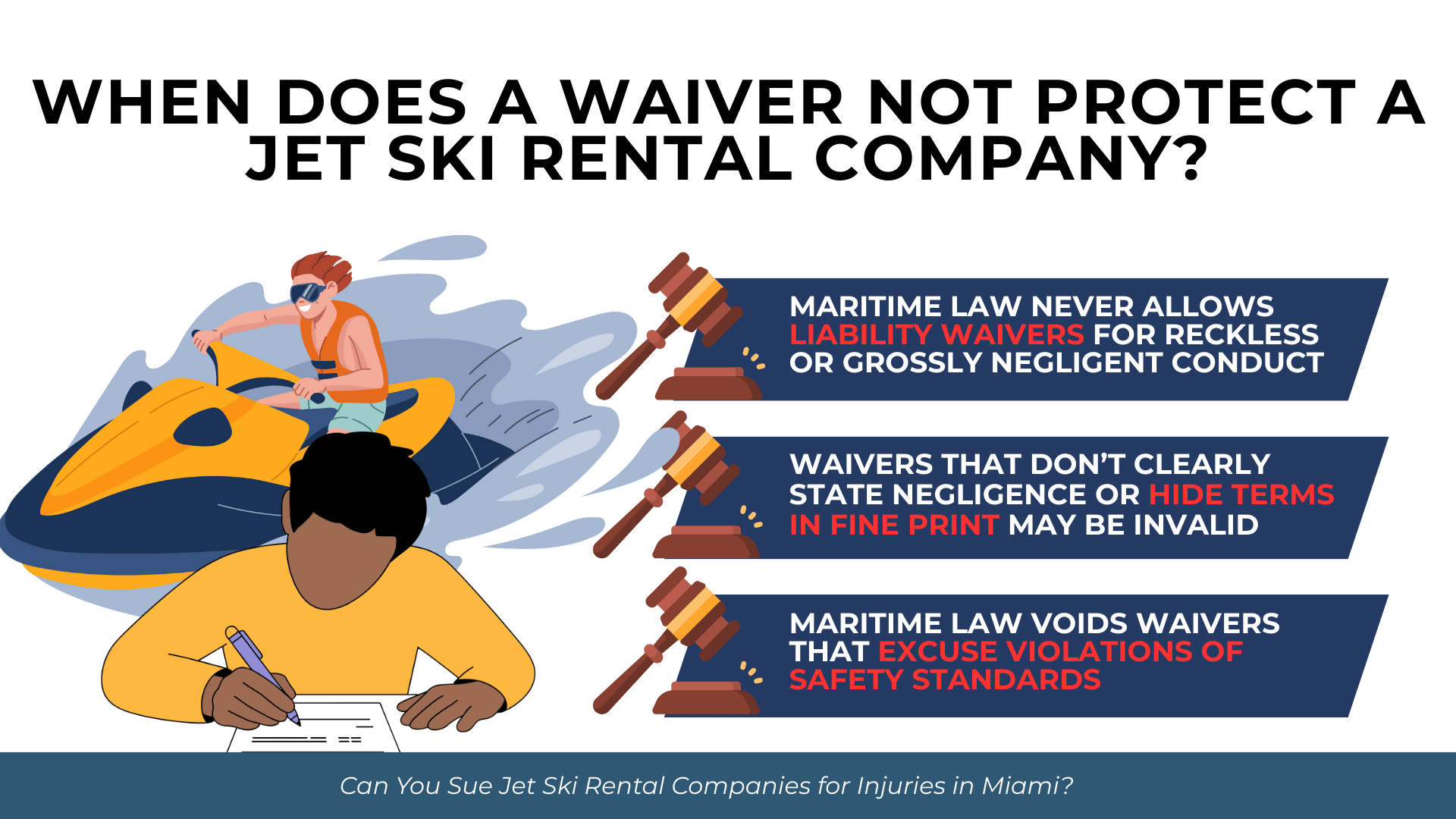
Maritime public policy prohibits waivers of liability for reckless or gross negligent conduct under any circumstances. This is a universal carve-out that applies regardless of how the waiver is worded. A rental company that demonstrates deliberate disregard for customer safety cannot hide behind an exculpatory clause.
The following circumstances can void an otherwise valid waiver:
- Recklessness or gross negligence. Waivers cannot cover conduct that shows deliberate disregard for safety, such as knowingly renting defective equipment or operating in dangerous weather conditions.
- Overly broad language. Releases that purport to waive “all claims whatsoever” without specifically mentioning negligence may be unenforceable under maritime law.
- Hidden or confusing terms. Waiver provisions buried in lengthy documents or written in unclear language may fail the conspicuousness requirement.
- Statutory safety violations. Releases that attempt to waive compliance with USCG requirements or state safety regulations are void as contrary to public policy.
- Recklessness or gross negligence. If the rental company actively hid known risks or lied about equipment condition, the waiver may be invalidated entirely.
Defective or ambiguous waiver language
For a maritime waiver to be enforceable, it must clearly state that the participant is releasing the operator from liability for negligence. The language must be conspicuous—using bold text, capital letters, or prominent placement. Waivers that fail to specifically mention negligence or that bury release provisions in fine print may not hold up in court.
Violations of safety regulations
Rental companies cannot waive their obligation to comply with Coast Guard safety equipment requirements or state PWC operation regulations. When a waiver attempts to release liability for conduct that violates federal or Florida safety standards, maritime law treats that provision as void.
What Duties Do Rental Companies Owe Under Florida Law?
Get started with your complimentary case evaluation today;
call us at (305) 694-2676 or reach us online using our
secure contact form.
Beyond general maritime negligence principles, Florida imposes specific regulatory requirements on jet ski rental operations.
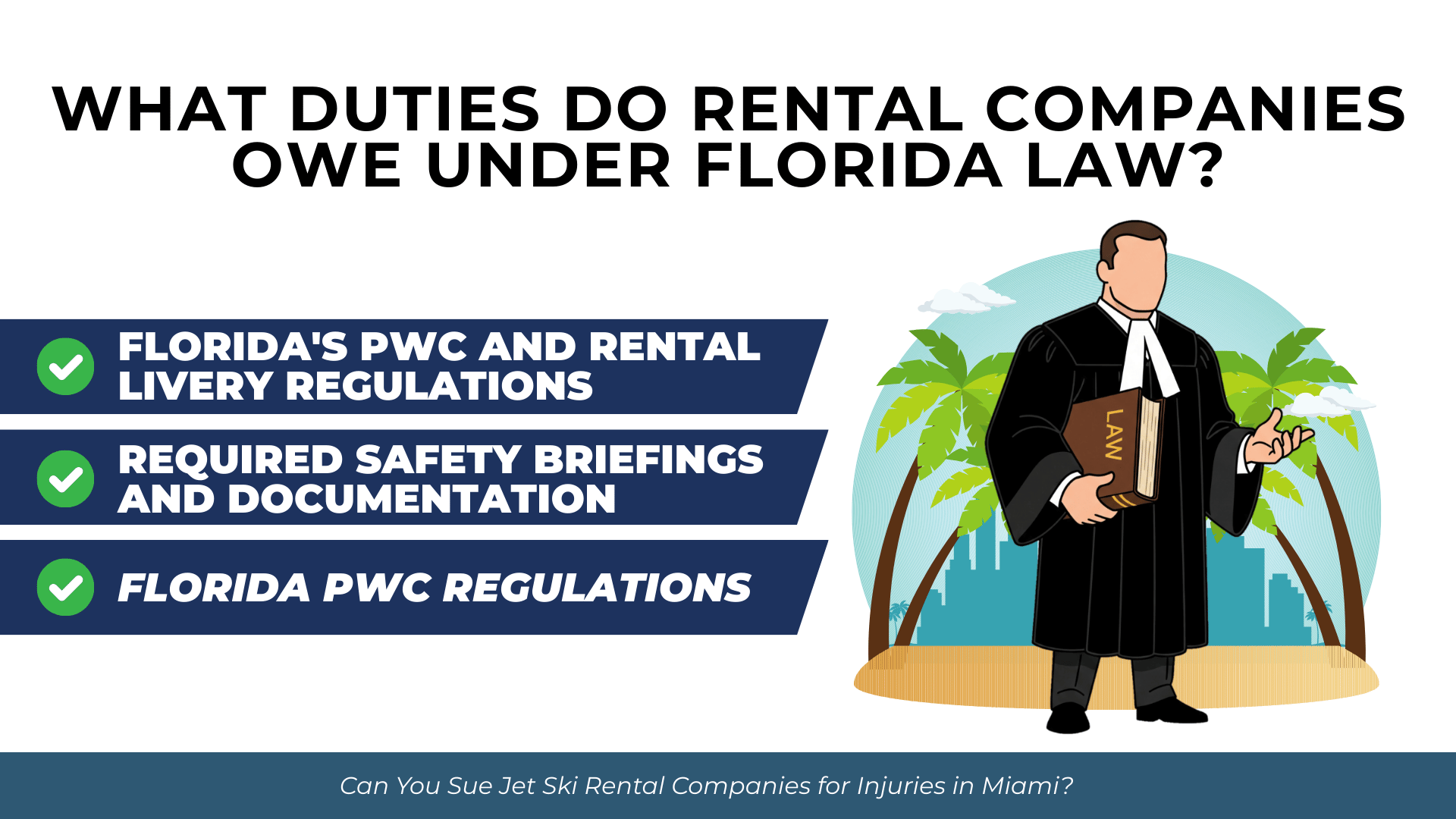
Florida’s PWC and rental livery regulations
Florida Statutes §327.02 and related provisions establish requirements for personal watercraft operations and rental liveries. These include age restrictions for PWC operators, mandatory boater education requirements for certain users, and operational standards that rental companies must follow. Violations of these statutes can support negligence claims.
Required safety briefings and documentation
The Florida Boating Safety Act of 2022 requires rental liveries to obtain permits, provide specific pre-rental safety instructions, and document safety briefings given to customers. Rental companies that fail to comply with these requirements—rushing through briefings, omitting required information, or failing to document instruction—may face liability for resulting injuries.
How regulatory violations support negligence claims
When a rental company violates Florida PWC regulations or fails to meet documented safety briefing requirements, that violation can serve as evidence of negligence. A company that ignores state-mandated safety protocols demonstrates a breach of the duty of care owed to customers.
Who Can Be Held Liable for a Jet Ski Rental Injury?
Multiple parties may bear responsibility for a jet ski rental injury, depending on the circumstances.
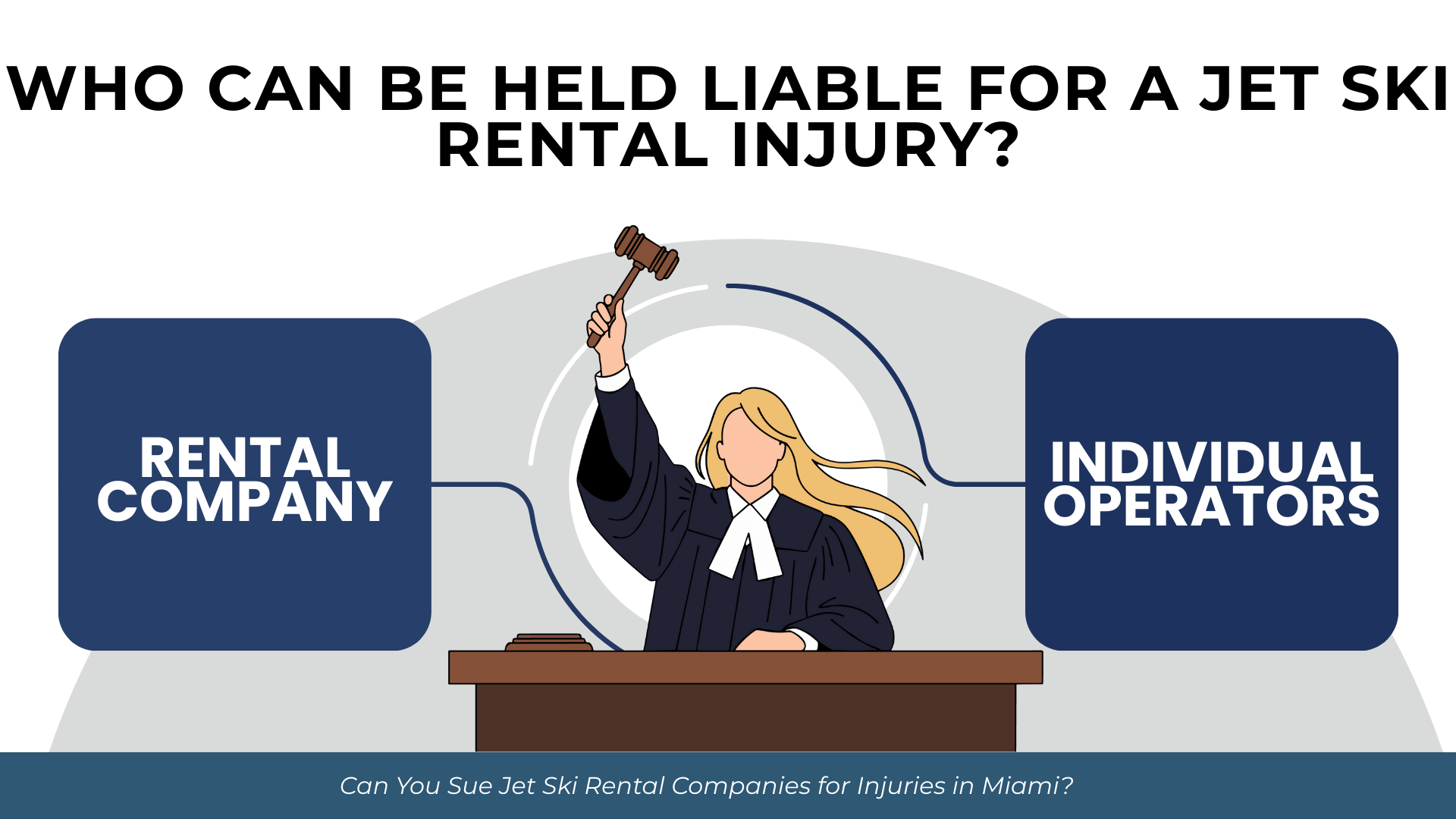
The rental company’s liability
The rental company is typically the primary defendant in jet ski injury cases. Under general maritime law, rental companies can be sued for negligent entrustment (renting to unfit or untrained operators), failure to inspect equipment, failure to warn of known hazards, and negligent hiring or supervision of employees. The company is vicariously liable for the negligence of its employees acting within the scope of employment.
When individual operators share responsibility
Individual operators who cause accidents through their own negligent conduct—such as excessive speed, violating navigation rules, or reckless operation—may be personally liable for resulting injuries. This is true regardless of the rental company’s separate duties.
Why the bareboat charter defense usually fails
Some rental companies argue they transferred complete control of the vessel to the renter under the “bareboat charter” doctrine, which would shift liability away from the owner. However, most recreational rentals are not true bareboat charters because the rental company retains operational responsibilities: conducting safety briefings, managing fuel, maintaining equipment, and imposing geographic restrictions. Because these elements of control are retained, liability typically stays with the rental company rather than shifting entirely to the renter.
What Damages Can You Recover in a Miami Jet Ski Injury Case?
If you establish that a rental company’s negligence caused your injuries, you may be entitled to substantial compensation.
Compensatory damages available
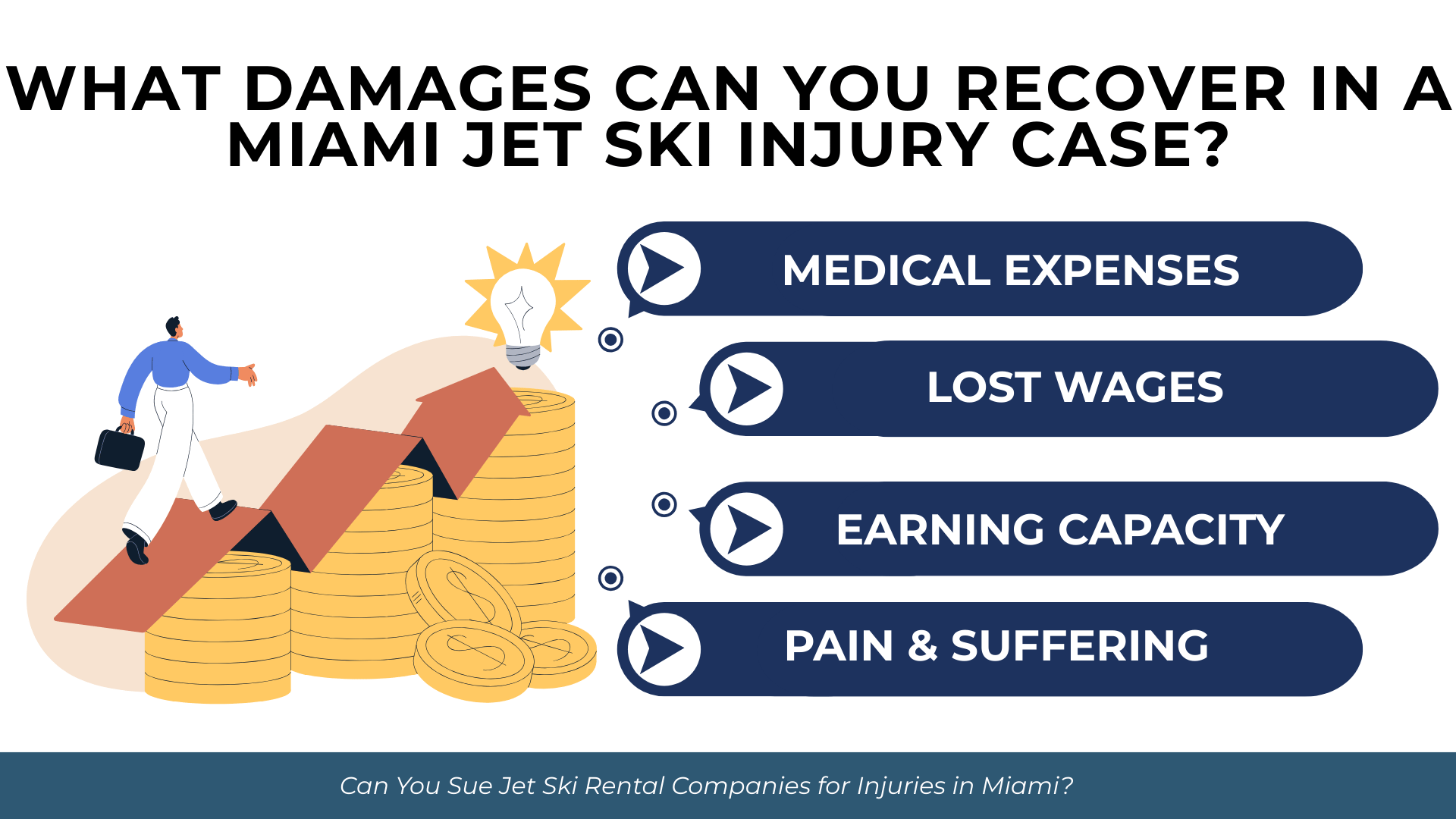
Compensatory damages in jet ski injury cases may include medical expenses (past and future), lost wages and earning capacity, pain and suffering, and other losses resulting from your injuries. Maritime law uses pure comparative negligence, meaning your damages are reduced by your percentage of fault but never completely barred—even if you were partially responsible for the accident.
Wrongful death claims in Florida waters
When jet ski accidents result in death, state wrongful death statutes typically provide the remedy for accidents occurring within three nautical miles of shore. Florida law allows surviving family members to recover damages including lost support, lost services, and loss of companionship. The Limitation of Liability Act theoretically allows vessel owners to cap their total liability, but small rental operators rarely succeed in invoking this defense because they typically have direct knowledge of maintenance issues, training failures, and equipment defects.
Frequently Asked Questions
Does signing a waiver mean I can’t sue the jet ski rental company?
Not necessarily. Waivers cannot protect rental companies from gross negligence, recklessness, or willful misconduct under maritime law. If the company failed to maintain equipment, provided inadequate instruction, or violated safety regulations, the waiver may not bar your claim. Courts examine whether the waiver was clear, conspicuous, and whether it attempts to disclaim conduct that cannot legally be waived.
What is off-throttle steering loss, and why does it matter for my case?
Jet skis require thrust to steer—when a rider releases the throttle in a panic, all steering control is lost and the craft continues on its original path into a collision. Rental companies have a duty to explain this unique hazard clearly. Failure to provide adequate instruction on off-throttle steering loss can constitute negligence that supports your claim.
How long do I have to file a jet ski injury lawsuit in Florida?
Maritime personal injury claims generally must be filed within three years under 46 U.S.C. §30106. However, acting quickly is important to preserve evidence, identify witnesses, and document the rental company’s practices before records disappear. Prompt action also allows for preservation of any surveillance footage or maintenance logs.
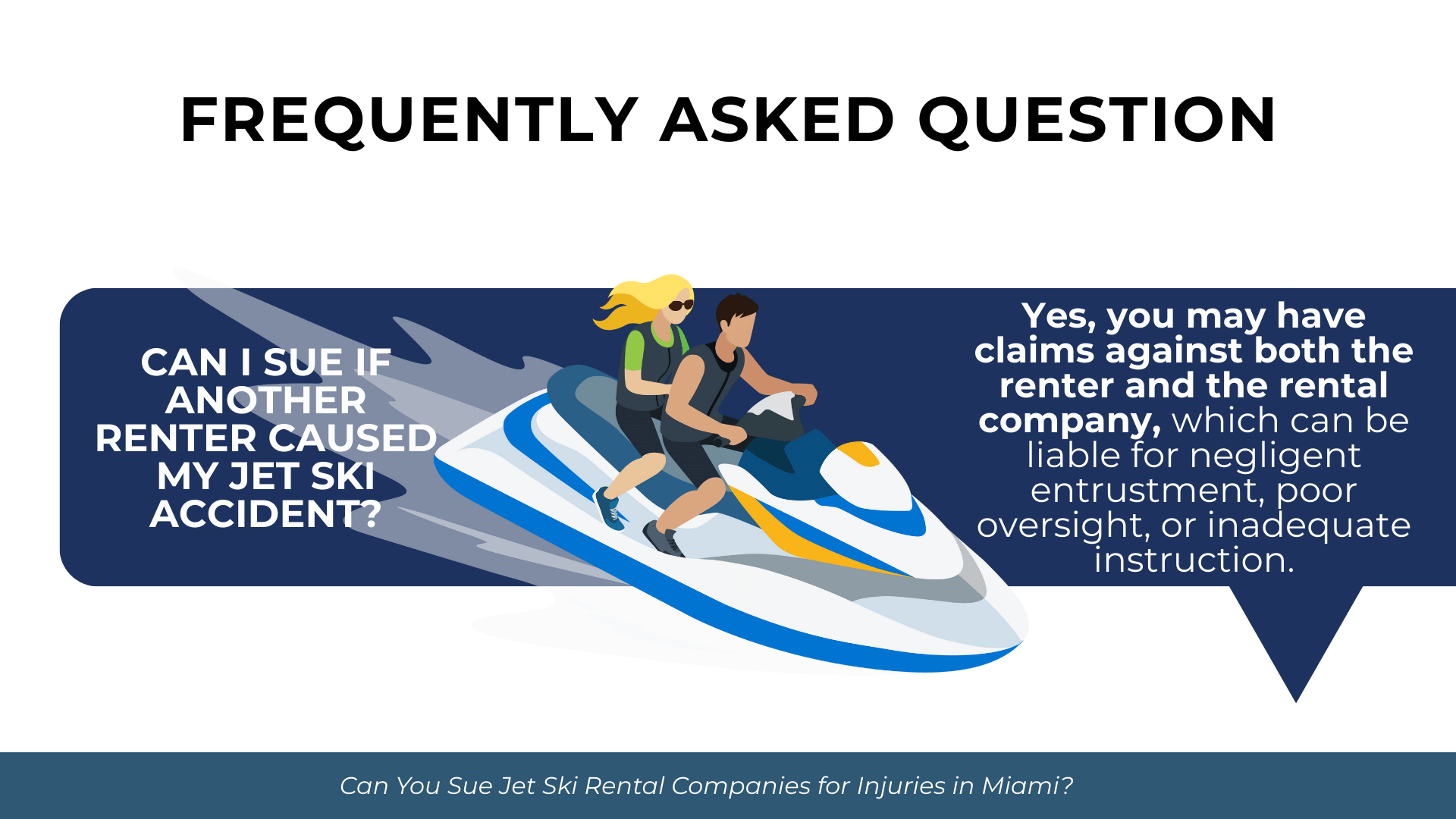
Can I sue if another renter caused my jet ski accident?
Yes, you may have claims against both the other renter and the rental company. The rental company can be liable for negligent entrustment if they rented to an unfit or untrained operator, for failing to supervise rental operations, or for inadequate instruction that contributed to the collision.
What compensation can I recover for a jet ski injury in Miami?
You may recover medical expenses, lost wages, pain and suffering, and other damages depending on your injuries. Maritime law applies pure comparative negligence, reducing your recovery by your percentage of fault but never eliminating it entirely. In wrongful death cases, Florida state law provides remedies for surviving family members.
Protecting Your Rights After a Miami Jet Ski Rental Injury
Jet ski rental injuries often result from rental company negligence—inadequate instruction, deferred maintenance, failure to warn of known hazards, or reckless disregard for customer safety. While the waiver you signed may seem like a barrier, maritime law limits what rental companies can contractually disclaim. Gross negligence, recklessness, and statutory violations remain actionable regardless of any release you signed.
If you were injured on a rental jet ski in Miami, the rental company’s conduct before, during, and after your rental matters. Documenting equipment conditions, preserving evidence of the instruction you received, and identifying witnesses can strengthen your claim.
Contact Prosper Injury Attorneys to discuss your jet ski rental injury case.