Orthopedic surgery carries inherent risks, but when a surgeon’s negligence causes preventable harm, Florida law provides a path to compensation. Understanding whether you can sue for orthopedic surgery malpractice requires examining what went wrong, whether it resulted from a breach of the standard of care, and whether that breach caused your injuries. This article explains the legal requirements for pursuing an orthopedic malpractice claim in Florida and the types of surgical errors that commonly lead to litigation.
What Is Orthopedic Surgery Malpractice Under Florida Law?
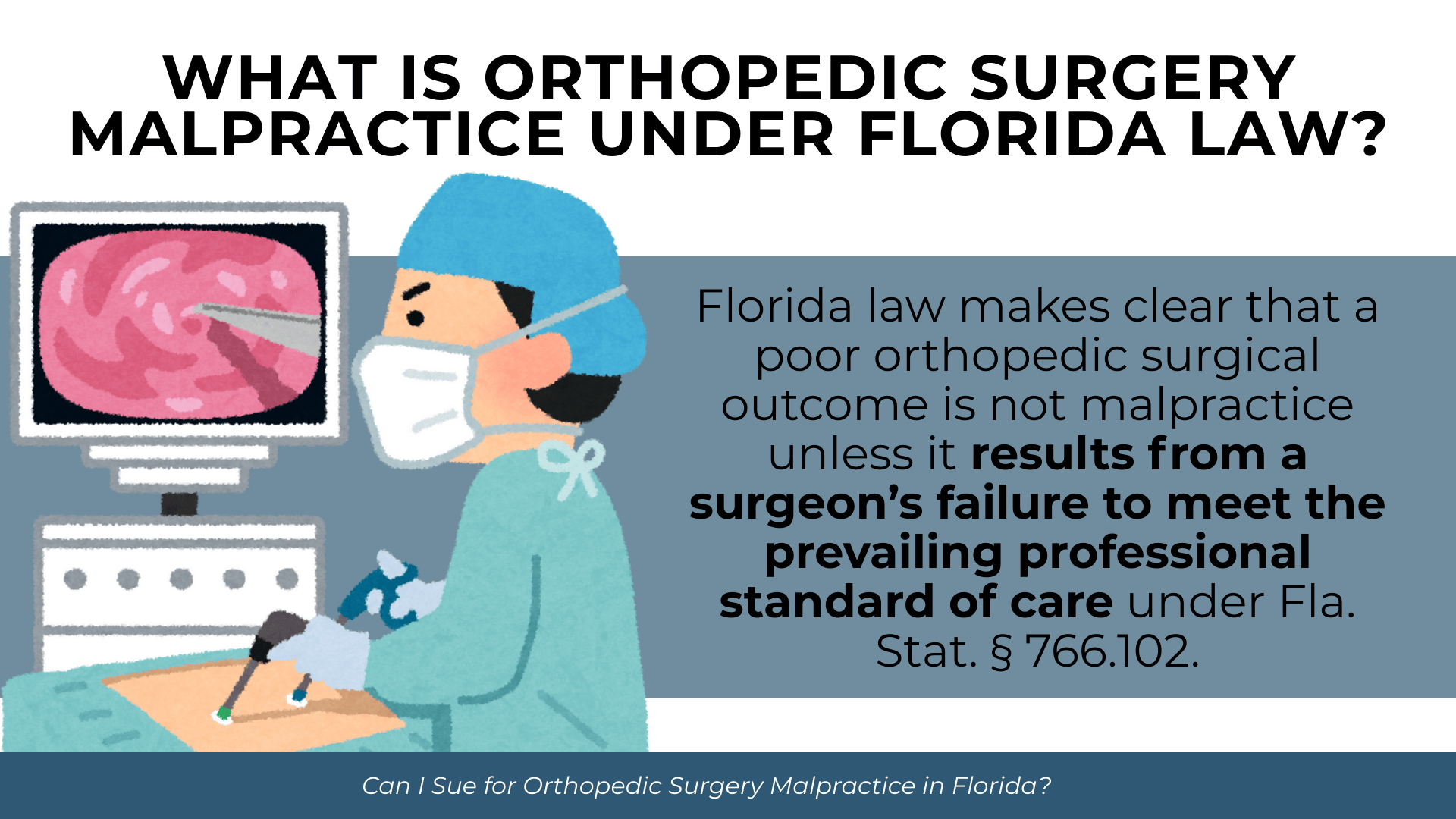
Not every disappointing surgical outcome constitutes malpractice. Florida law distinguishes between complications that occur despite proper care and injuries caused by a surgeon’s failure to meet professional standards.
How Florida Defines the Standard of Care for Orthopedic Surgeons
Under Fla. Stat. § 766.102, the prevailing professional standard of care is defined as “that level of care, skill, and treatment which, in light of all relevant surrounding circumstances, is recognized as acceptable and appropriate by reasonably prudent similar health care providers.” Florida holds specialists to a specialist standard when practicing within their specialty.
For orthopedic surgeons, this means their conduct is measured against what other qualified orthopedic surgeons would consider acceptable. Florida has largely abandoned the traditional locality rule in favor of a national professional standard for clinical care. An orthopedic surgeon in Miami is held to the same standard as one in Chicago or Los Angeles.
When a Surgical Outcome Becomes a Malpractice Claim
A poor outcome alone does not create an inference of negligence under Fla. Stat. § 766.102(3)(b). Surgery involves inherent risks, and complications can occur even when a surgeon performs flawlessly. Malpractice occurs when the surgeon’s actions or omissions deviate from what reasonably prudent orthopedic surgeons would recognize as acceptable.
The distinction matters because many patients experience post-surgical problems that, while frustrating, fall within the range of known complications. A malpractice claim requires evidence that the specific harm resulted from substandard care rather than an unavoidable risk.
Common Misconceptions About Surgical Complications
Many patients believe that any negative outcome means something went wrong. In reality, orthopedic procedures carry documented complication rates that persist even with excellent surgical technique. The question is not whether you experienced a complication but whether that complication resulted from care that fell below professional standards.
Conversely, some patients assume that because they signed a consent form acknowledging risks, they cannot pursue a claim. Informed consent protects surgeons from liability for known risks when proper care is provided. It does not shield them from negligent conduct that causes harm.
What Types of Orthopedic Surgery Errors Lead to Lawsuits?
Call us today at (305) 694-2676 or
contact us online for a free case evaluation.
Hablamos español.


According to the Journal of Arthroplasty (2023), 84.1% of orthopedic malpractice claims involve surgical errors. Understanding the most common error patterns helps identify whether your experience may support a claim.
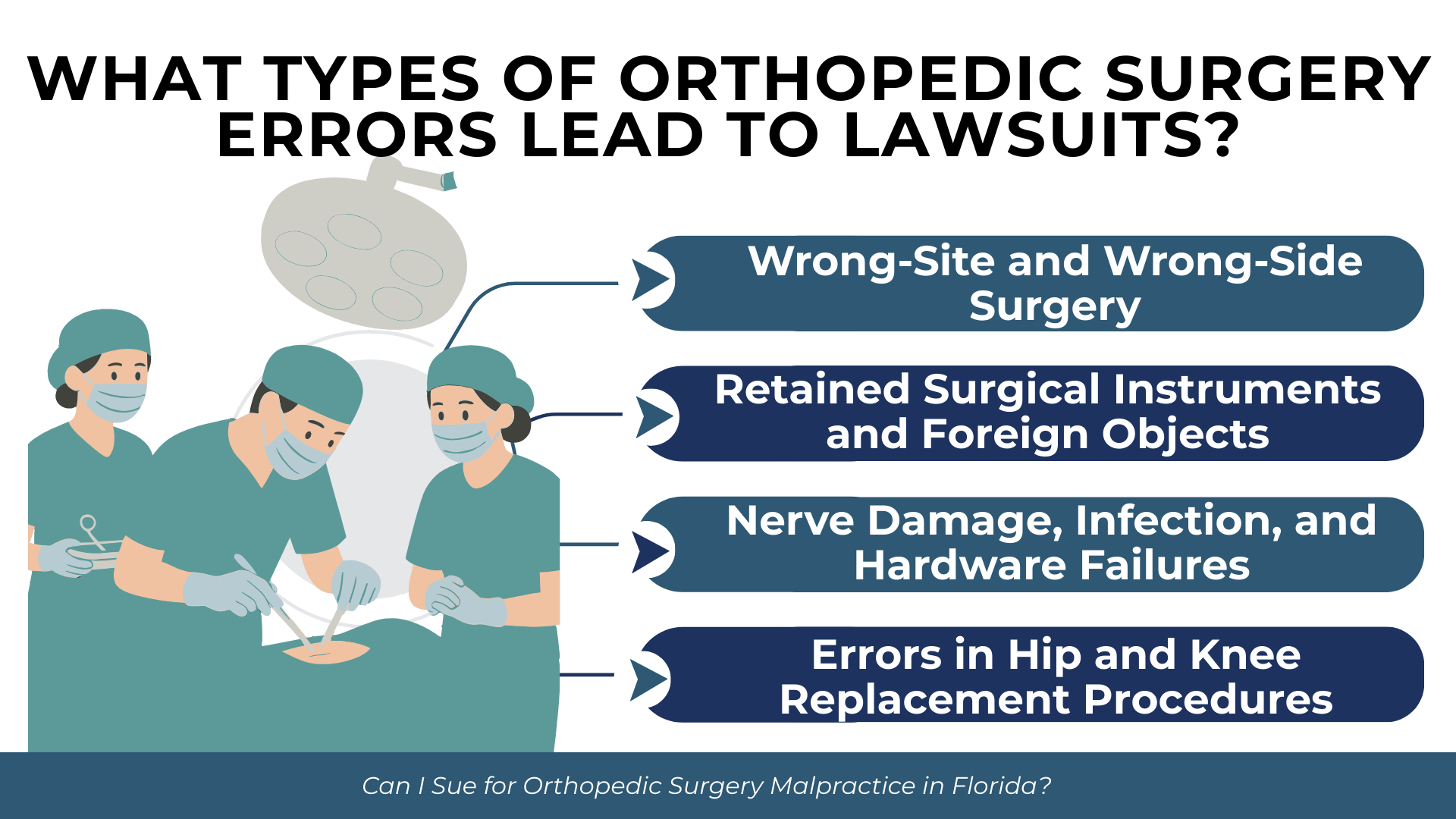
Wrong-Site and Wrong-Side Surgery
Wrong-site surgery remains a persistent problem in orthopedic care. According to the Joint Commission Sentinel Event Data 2024 Annual Review, 127 wrong surgery sentinel events occurred in 2024, with 68% occurring at the incorrect site—operating on the wrong part of the body.
The Joint Commission Journal on Quality and Patient Safety (2023) found that 83.8% of wrong-site surgery claims involved failure to follow established protocols. These cases often involve spine procedures or extremity surgeries where laterality must be verified.
Under Florida law, these errors frequently support res ipsa loquitur—a doctrine allowing an inference of negligence when the injury type would not ordinarily occur absent negligence and the instrumentality was under the defendant’s exclusive control. As established in Marrero v. Goldsmith, 486 So. 2d 530 (Fla. 1986), res ipsa loquitur applies when the patient was unconscious and the injury is to a body part remote from the surgical site.
Retained Surgical Instruments and Foreign Objects
According to the Joint Commission Sentinel Event Data 2023 Annual Review, 110 unintentionally retained foreign object events were reported nationally in 2023, with sponges accounting for 35% and instrument fragments accounting for 8%.
Under Fla. Stat. § 766.102(3)(b), discovery of a foreign body such as a sponge, clamp, forceps, or surgical needle creates prima facie evidence of negligence. This shifts the burden to the defendant to rebut the presumption of substandard care.
Nerve Damage, Infection, and Hardware Failures
According to The Doctors Company’s analysis of orthopedic malpractice claims from 2011-2021, the most common injuries alleged in orthopedic malpractice claims include:
- Nerve damage (11% of claims)
- Surgical site infection (8% of claims)
- Malunion or nonunion of fractures (7% of claims)
The same analysis identified technical performance issues as a contributing factor in 67% of orthopedic malpractice claims. Patient factors contributed to 38% of cases, which underscores why comparative negligence analysis matters in these claims.
Errors in Hip and Knee Replacement Procedures
Hip and knee cases represent the largest category of orthopedic litigation. According to the Journal of Arthroplasty (2023), hip and knee procedures account for 29.9% of all orthopedic malpractice claims.
Common allegations in joint replacement litigation include improper component positioning, failure to address leg length discrepancy, infection from inadequate sterile technique, and dislocation from improper surgical approach. Defendants prevailed in 77.6% of hip and knee cases that went to verdict, but when plaintiffs prevailed, the mean verdict was $4,866,929.
What Must You Prove to Sue for Orthopedic Malpractice in Florida?
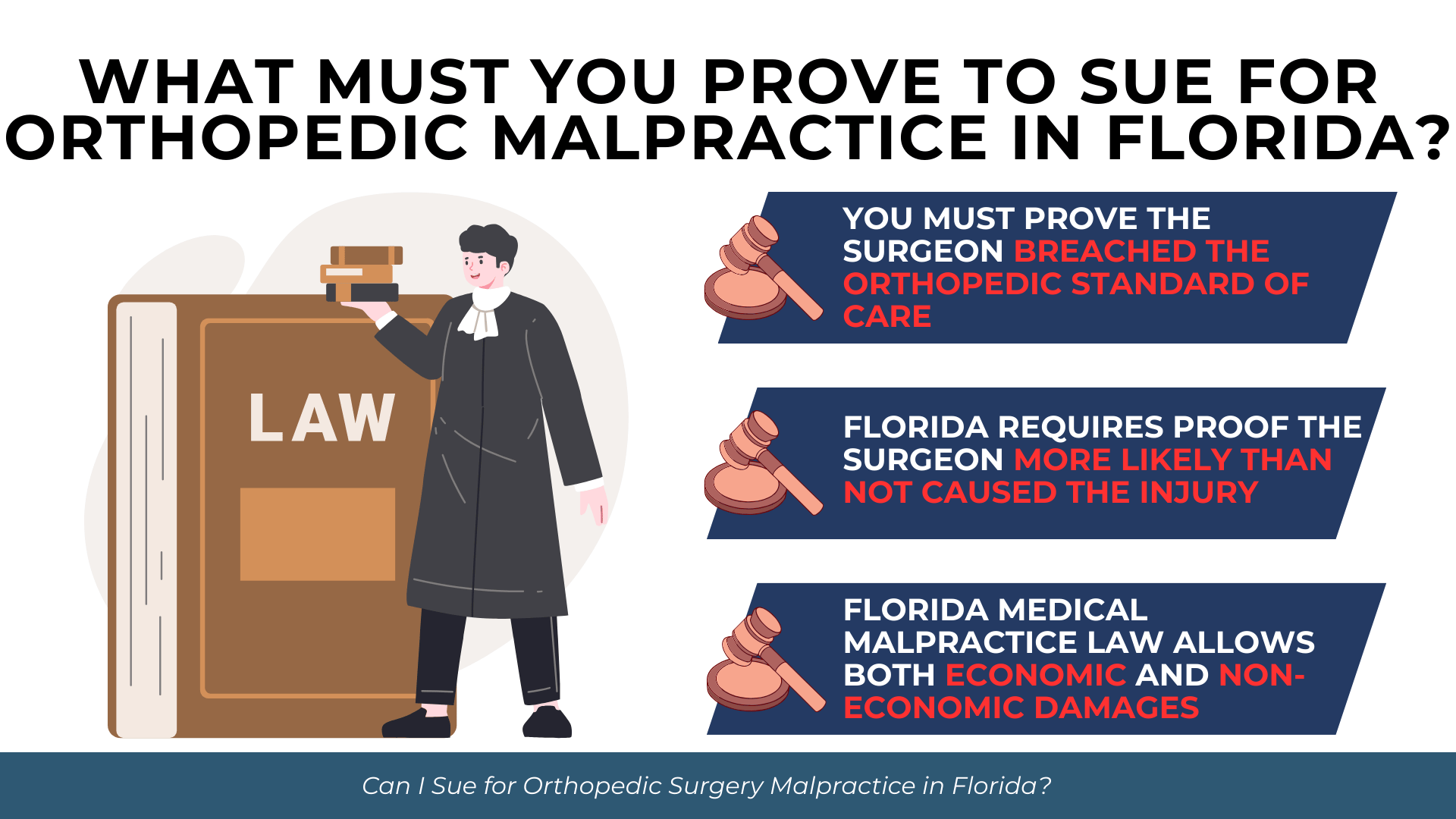
Florida medical malpractice claims require proving four elements established in Wale v. Barnes, 278 So. 2d 601 (Fla. 1973): the applicable standard of care, breach of that standard, proximate causation, and damages.
Establishing the Surgeon’s Breach of the Standard of Care
You must prove by the greater weight of evidence that the orthopedic surgeon’s conduct fell below what reasonably prudent orthopedic surgeons would recognize as acceptable. Under Fla. Stat. § 766.102(5)(a), this requires expert testimony from a physician who specializes in orthopedic surgery and has devoted professional time during the three years immediately preceding the incident to active clinical practice, instruction, or clinical research in that specialty.
The expert must hold an active and valid license and conduct a complete review of pertinent medical records. Florida’s 2013 amendments to the expert witness statute eliminated the former “similar specialty” standard—the expert must now practice in the same specialty as the defendant.
Proving Causation Under Florida’s “More Likely Than Not” Standard
Florida requires plaintiffs to prove that the surgeon’s negligence was the proximate cause of injury under a “more likely than not” standard exceeding 50% probability. As established in Gooding v. University Hospital Building, Inc., 445 So. 2d 1015 (Fla. 1984), Florida rejects the loss of chance doctrine—you cannot recover for a decreased chance of a better outcome.
Under Ruiz v. Tenet Hialeah Healthsystem, Inc., 260 So. 3d 977 (Fla. 2018), the surgeon’s negligence need not be the primary cause of your injury. It must only be a substantial factor in bringing about the result. A surgeon cannot insulate himself by pointing to subsequent treating physicians or arguing that other factors contributed.
Documenting Your Damages
Florida recognizes both economic and non-economic damages in medical malpractice cases. Following Estate of McCall v. United States, 134 So. 3d 894 (Fla. 2014) and North Broward Hospital District v. Kalitan, 219 So. 3d 49 (Fla. 2017), statutory caps on non-economic damages are currently unenforceable as unconstitutional.
Recoverable damages in orthopedic malpractice cases commonly include:
- Past and future medical expenses, including revision surgeries
- Lost wages and diminished earning capacity
- Physical pain and suffering
- Loss of enjoyment of life and recreational activities
- Permanent impairment or disability
- Loss of consortium for spouses
Economists and life care planners are commonly used to calculate future economic losses, particularly when ongoing treatment or permanent disability affects earning capacity.
Can You Sue the Hospital for an Orthopedic Surgeon’s Mistake?
Many orthopedic surgeons operate at hospitals but are not hospital employees. Florida law provides several theories for holding hospitals liable even for independent contractor physicians.
When Hospitals Are Directly Liable
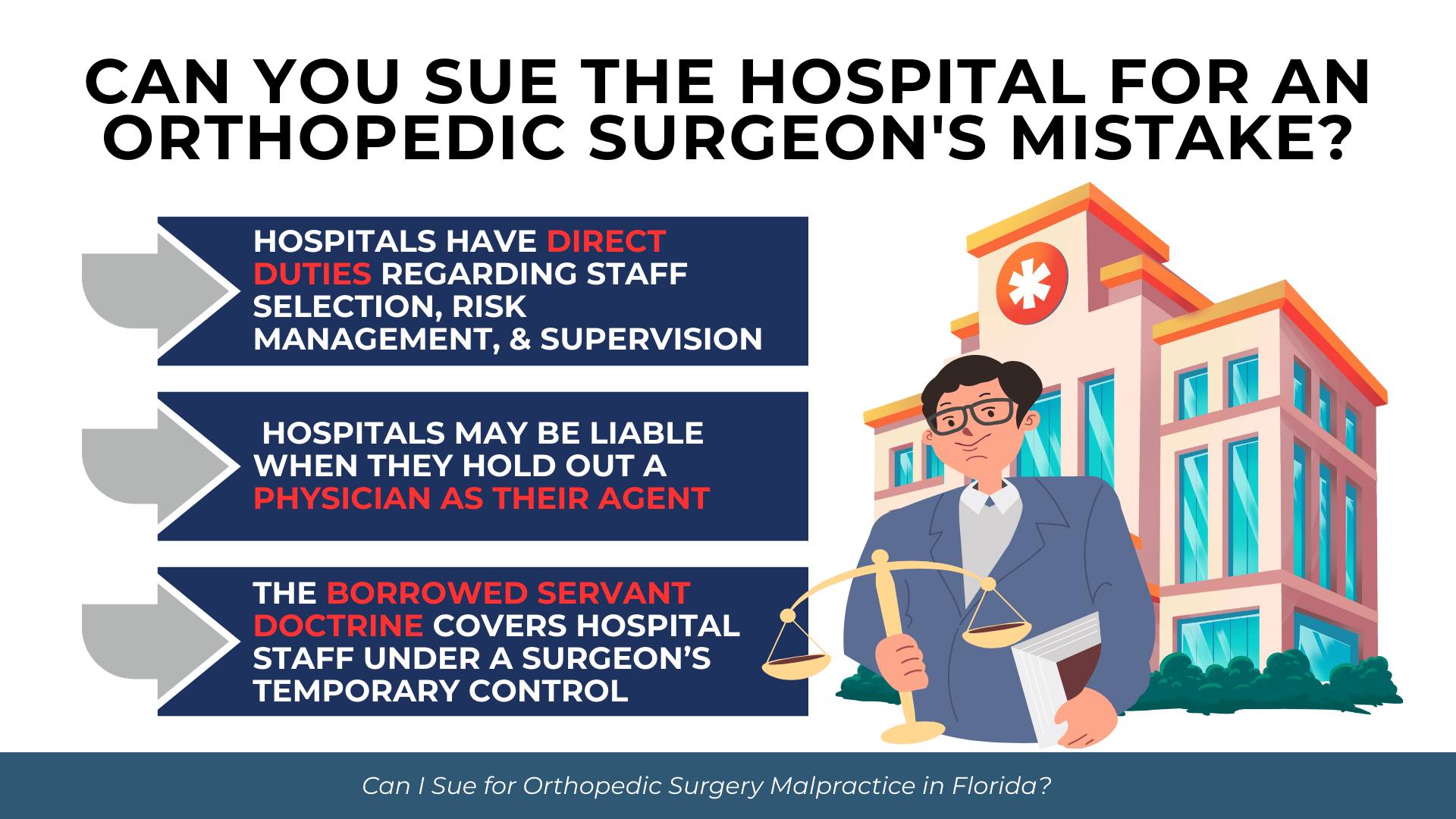
Under Fla. Stat. § 766.110, hospitals have direct duties regarding staff selection, risk management, and supervision. Hospitals may be directly liable when they:
- Fail to properly credential or verify surgeon qualifications
- Ignore red flags in a surgeon’s performance history
- Fail to maintain adequate risk management programs under Fla. Stat. § 395.0197
- Provide inadequate nursing staff or surgical support
- Fail to maintain safe and sterile operating environments
Direct corporate negligence claims focus on the hospital’s own failures rather than seeking to impute the surgeon’s negligence to the hospital.
Apparent Agency and Independent Contractor Surgeons
Even when a surgeon is technically an independent contractor, hospitals may be vicariously liable under the apparent agency doctrine. As established in Irving v. Doctors Hospital of Lake Worth, Inc., 415 So. 2d 55 (Fla. 4th DCA 1982), hospitals may be liable when they hold out a physician as their agent and the patient reasonably relies on that appearance.
Under Roessler v. Novak, 858 So. 2d 1158 (Fla. 2d DCA 2003), apparent agency requires: (1) a representation by the hospital, (2) reliance by the patient, and (3) a change in position based on that reliance. Factors creating the appearance of agency include hospital advertising presenting it as the care provider, uniforms and badges identifying staff with the hospital, hospital assignment of physicians to patients, and failure to disclose independent contractor status.
The Borrowed Servant Doctrine in Surgical Settings
The borrowed servant doctrine addresses situations where hospital employees—particularly operating room nurses—are temporarily under the control of the surgeon. Under Variety Children’s Hospital v. Perkins, 382 So. 2d 331 (Fla. 3d DCA 1980), this may shift liability for specific errors from the hospital to the controlling physician.
This doctrine typically applies in surgical settings where the surgeon directs nursing staff during the procedure. However, it is limited in scope and does not eliminate all hospital liability for operating room staff.
What Are Florida’s Deadlines and Requirements for Filing a Claim?
Get started with your complimentary case evaluation today;
call us at (305) 694-2676 or reach us online using our
secure contact form.
Florida imposes strict procedural requirements that must be followed precisely. Missing deadlines or failing to complete pre-suit requirements can bar an otherwise valid claim.
The Two-Year Statute of Limitations and Four-Year Statute of Repose
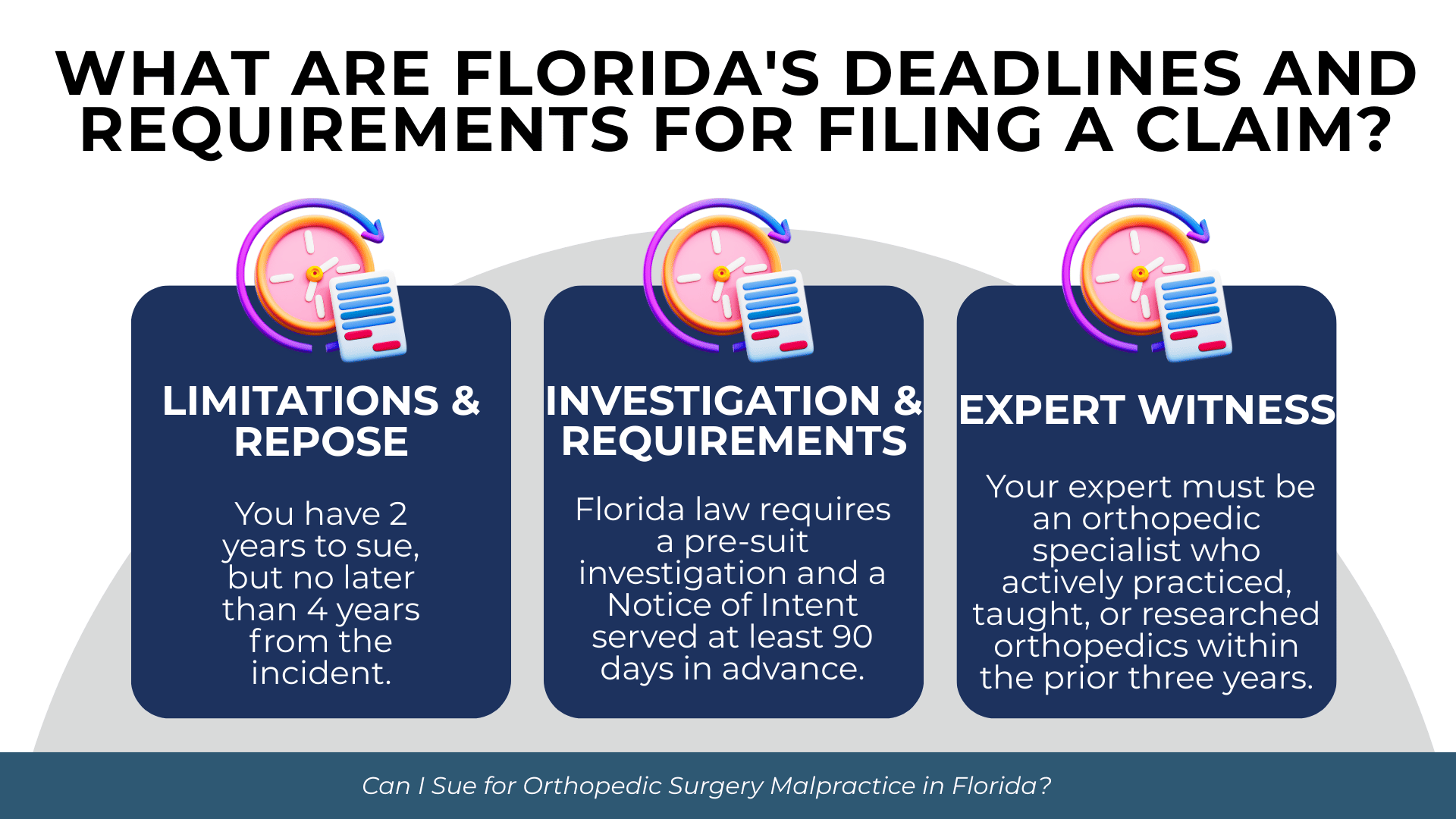
Under Fla. Stat. § 95.11(5)(c), you must commence a medical malpractice action within two years from the time the incident occurred or within two years from when you discovered or should have discovered the injury with due diligence. However, no action may be commenced later than four years from the date of the incident regardless of when you discovered the injury.
The discovery rule, as modified by Tanner v. Hartog, 618 So. 2d 177 (Fla. 1993), requires knowledge of the injury and a reasonable possibility that the injury was caused by malpractice. Simply knowing you were injured does not start the clock—you must have reason to suspect medical negligence.
Mandatory Pre-Suit Investigation and Notice Requirements
Before filing a complaint, Fla. Stat. § 766.106 and § 766.203 require you to complete a pre-suit investigation and serve a Notice of Intent to Initiate Litigation at least 90 days before filing suit. The Notice of Intent must include:
- A list of all known healthcare providers seen for injuries after the alleged negligence
- All known providers during the two years before the alleged act
- Copies of all medical records relied upon by your expert
- An executed HIPAA authorization
- A verified written expert opinion corroborating reasonable grounds to support the claim
The 90-day pre-suit period tolls the statute of limitations under Musculoskeletal Inst. Chartered v. Parham, 745 So. 2d 946 (Fla. 1999). Defendants must respond within 90 days with a rejection, settlement offer, or offer to arbitrate.
Expert Witness Requirements for Orthopedic Cases
Under Fla. Stat. § 766.102(5)(a), your expert must specialize in orthopedic surgery and have devoted professional time during the three years immediately preceding the incident to active clinical practice, instruction, or clinical research in orthopedics. The expert must review the pertinent medical records before providing the required pre-suit affidavit.
Per a 2023 amendment to Fla. R. App. P. 9.130(a)(3), denial of a motion challenging expert qualifications is immediately appealable. This means expert qualification issues can be resolved earlier in litigation rather than after a full trial.
What Compensation Can You Recover in an Orthopedic Malpractice Case?
The value of an orthopedic malpractice claim depends on the severity of your injuries, the extent of ongoing treatment needs, and the impact on your daily life and earning capacity.
Economic Damages for Medical Bills and Lost Income
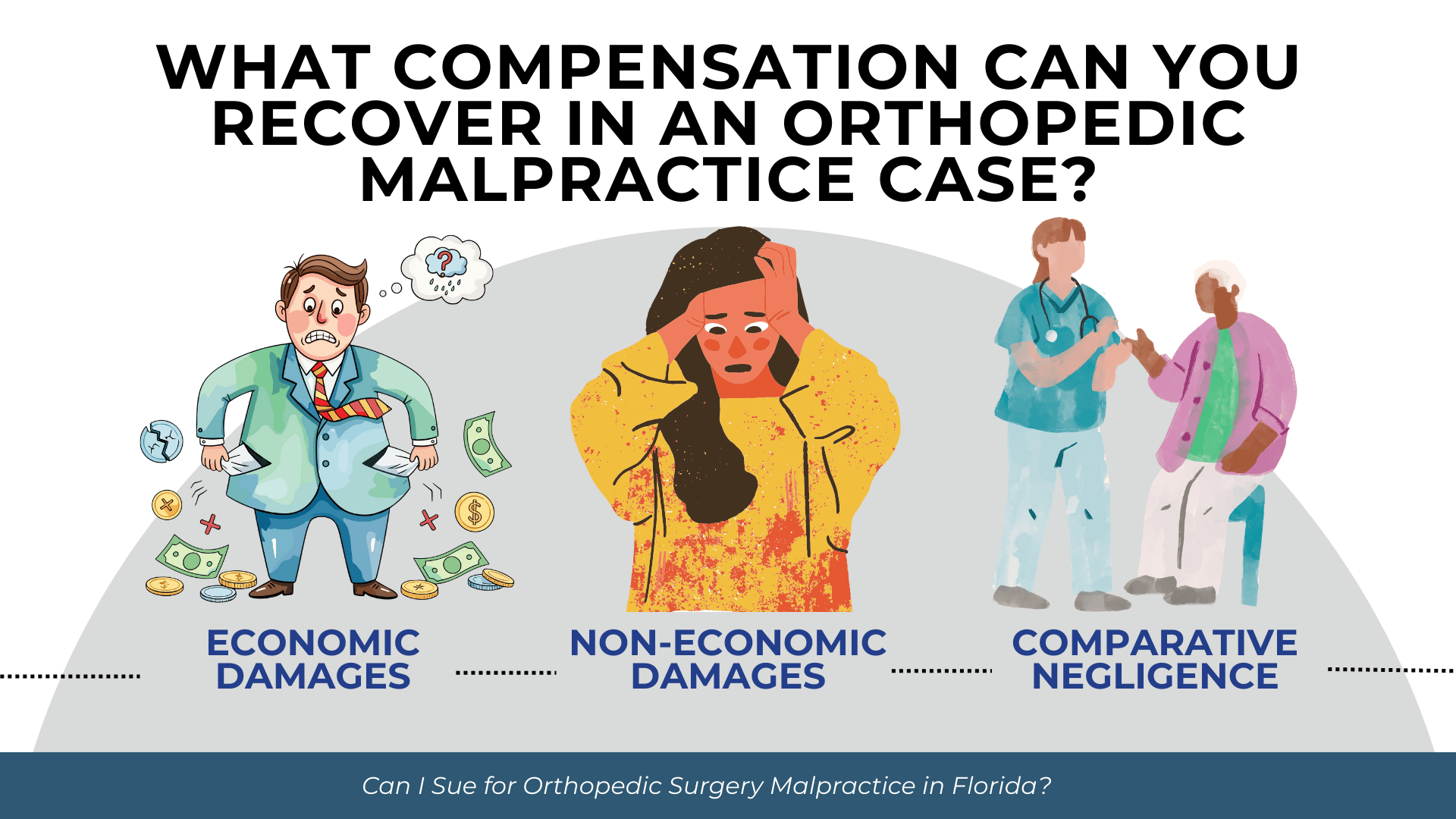
Economic damages have no cap in Florida and include all quantifiable financial losses. Past medical expenses encompass the cost of corrective surgeries, hospitalization, physical therapy, and ongoing care. Future medical expenses may include revision surgeries, pain management, assistive devices, and home modifications.
Lost income includes wages lost during recovery and, for permanent injuries, diminished earning capacity over your working life. These calculations typically involve vocational experts who assess how your injury affects employability.
Non-Economic Damages for Pain and Suffering
Following the Florida Supreme Court’s decisions in McCall and Kalitan, statutory caps on non-economic damages in medical malpractice cases are unenforceable. You may recover for physical pain and suffering, mental anguish, loss of enjoyment of life, and permanent impairment.
Florida courts may allow attorneys in medical malpractice cases to make “per diem” arguments for non-economic damages. A “per diem” argument is a time-based way to discuss pain and suffering—such as proposing a dollar amount per day (or week/month) and then multiplying it by the period the person is expected to experience the harm.
For example, if evidence supports that a plaintiff will endure pain for the rest of their life and their remaining life expectancy is 17 years, an attorney might argue that $100 per day is a reasonable way to think about future pain and suffering. Using that framework, 17 years × 365 days × $100 equals $620,500.
Florida law does not impose a set formula for non-economic damages, and whether per diem-style arguments are permitted is often within the trial judge’s discretion and may vary by court and case. When allowed, the per diem figure is an advocacy tool—not evidence—and the jury ultimately determines a reasonable amount based on the testimony, records, and the court’s instructions.
How Comparative Negligence Affects Your Recovery
Florida medical malpractice claims retain pure comparative negligence under Fla. Stat. § 768.81(6), which explicitly exempts medical malpractice from the 50% bar rule that applies to other negligence claims after HB 837 (2023). Your recovery is reduced by your percentage of fault but is not barred regardless of that percentage.
Patient non-compliance—such as failing to follow post-operative instructions, missing follow-up appointments, or failing to disclose accurate medical history—may constitute comparative fault if causally connected to your injury. However, non-compliance unrelated to the claimed injury is irrelevant to the analysis.
Frequently Asked Questions About Orthopedic Surgery Malpractice
How long do I have to file an orthopedic surgery malpractice lawsuit in Florida?
You generally have two years from when you discovered or should have discovered the injury and its connection to possible malpractice. However, no claim can be filed more than four years from the date of the surgery regardless of when you discovered the problem. The 90-day pre-suit notice requirement must also be completed before filing, which tolls the limitations period.
Can I sue if my orthopedic surgeon was an independent contractor, not a hospital employee?
Yes. You can sue the surgeon directly regardless of employment status. You may also be able to sue the hospital under the apparent agency doctrine if the hospital held the surgeon out as its agent and you reasonably relied on that appearance when seeking treatment. Factors like hospital advertising, staff uniforms, and how you were assigned to the surgeon all matter.
What if I signed a consent form before surgery?
Signing a consent form acknowledging known surgical risks does not prevent you from suing for negligent care. Informed consent protects surgeons when they properly perform a procedure and a known complication occurs. It does not protect them when substandard technique or errors cause harm that would not have occurred with proper care.
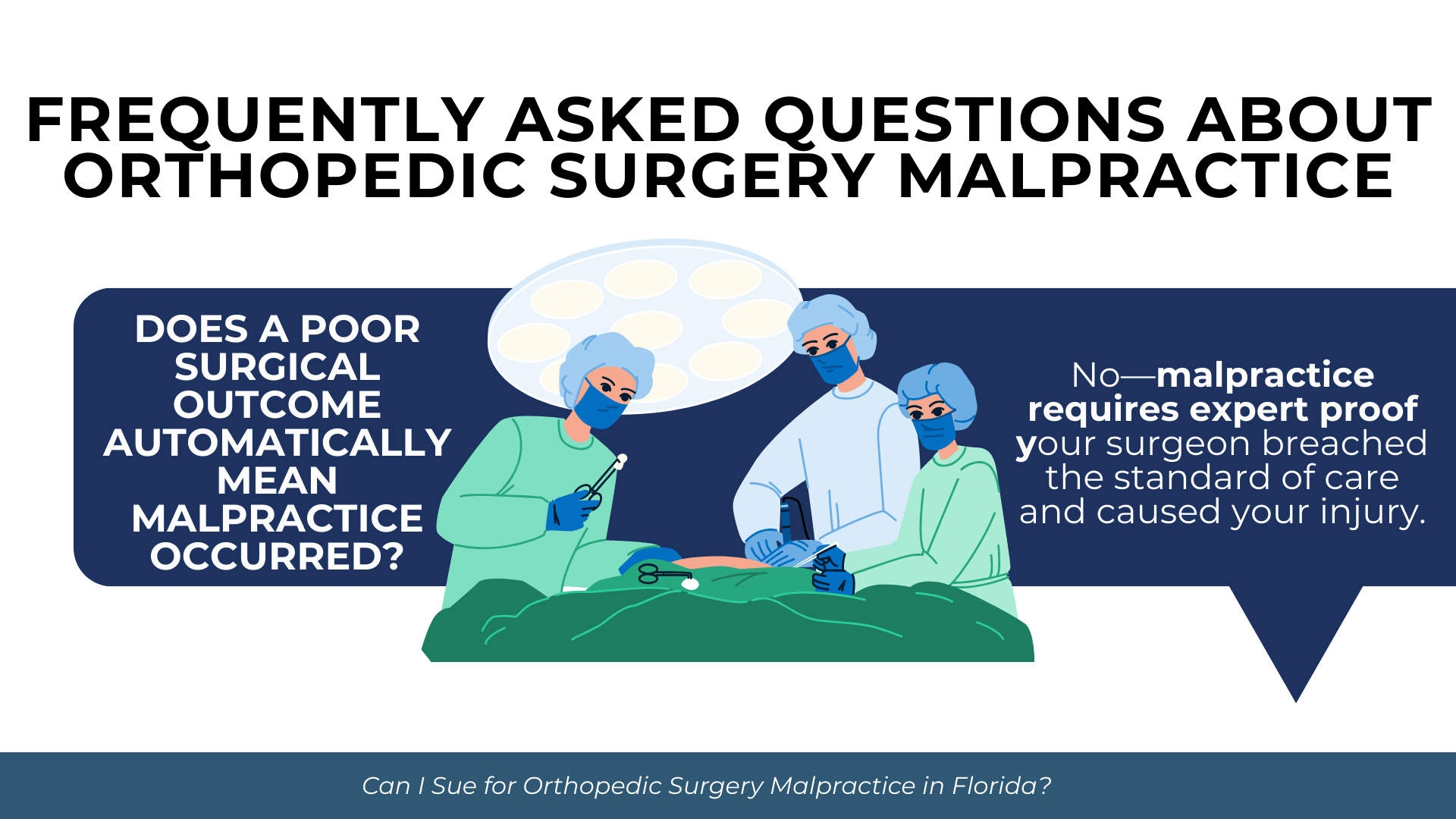
Does a poor surgical outcome automatically mean malpractice occurred?
No. Surgery carries inherent risks, and complications can occur even with excellent care. Malpractice requires proving that your surgeon’s conduct fell below the standard of care and that this breach caused your injury. A qualified expert must review your records and opine that the care was substandard before you can proceed with a claim.
How much does it cost to pursue an orthopedic malpractice claim?
Most medical malpractice attorneys work on a contingency fee basis, meaning you pay nothing upfront and the attorney receives a percentage of any recovery. However, these cases require expensive expert witnesses, medical record analysis, and extensive preparation. Attorneys evaluate cases carefully before accepting them due to these costs.
Taking Action After an Orthopedic Surgery Injury
Orthopedic surgery malpractice claims are complex but can provide meaningful compensation when surgical negligence causes preventable harm. Florida law requires proving that your surgeon’s care fell below accepted professional standards and that this breach caused your injuries. The two-year statute of limitations and mandatory pre-suit requirements make prompt action essential.
Documenting your injuries thoroughly and preserving all medical records from both the original surgery and subsequent treatment strengthens your claim. An experienced attorney can help secure qualified expert opinions and navigate Florida’s procedural requirements.
If you have questions about a potential orthopedic surgery malpractice claim, contact Prosper Injury Attorneys to discuss your situation.