If you were injured aboard a Carnival cruise ship, you may be wondering whether you have the right to take legal action against one of the world’s largest cruise companies. The short answer is yes—passengers can sue Carnival Cruise Line for injuries caused by the company’s negligence. But pursuing that claim requires understanding how maritime law works, what you must prove, and why strict deadlines make timing critical.
Carnival operates close to 30 ships and markets itself as the world’s most popular cruise line. With that volume comes a consistent pattern of passenger injuries and, inevitably, litigation. Understanding your legal rights starts with knowing what the law requires and where Carnival cases must be filed.
Can You Actually Sue Carnival Cruise Line for an Injury?
Passengers injured on Carnival ships have the legal right to pursue compensation through federal maritime law. Because cruise ships operate on navigable waters, injuries that occur aboard are governed by a distinct body of law developed specifically for maritime activities.
Why maritime law governs your claim
When an injury happens on a vessel traveling navigable waters, federal maritime law—not state personal injury law—controls the case. This means the legal standards, procedural requirements, and even the location where you can file suit are determined by federal maritime rules rather than the laws of your home state.
What Carnival owes you as a passenger
Under general maritime negligence principles, cruise lines owe their passengers a duty of reasonable care under the circumstances. The U.S. Supreme Court established this standard in Kermarec v. Compagnie Générale Transatlantique, 358 U.S. 625 (1959), holding that vessel owners must exercise reasonable care toward anyone legitimately aboard. This is not strict liability—Carnival is not automatically responsible for every injury. But when the company fails to maintain safe conditions, fails to warn of known dangers, or fails to address hazards it should have discovered, passengers have grounds for a negligence claim.
When a lawsuit becomes viable
A lawsuit becomes viable when you can establish that Carnival breached its duty of care and that breach caused your injury. Carnival has faced numerous lawsuits in federal court in Miami, with claims frequently involving failure to maintain safe conditions, failure to warn about known hazards, and failure to properly supervise activities or attractions. Some cases have resulted in significant recoveries. In a recent decision, a federal judge found Carnival liable after a passenger tripped and fell on a raised metal threshold and awarded damages approaching $350,000.
What Injuries Most Commonly Lead to Carnival Lawsuits?

Carnival’s high-volume operations and activity-intensive ships create predictable injury patterns. Understanding these common scenarios helps illustrate when negligence claims arise.
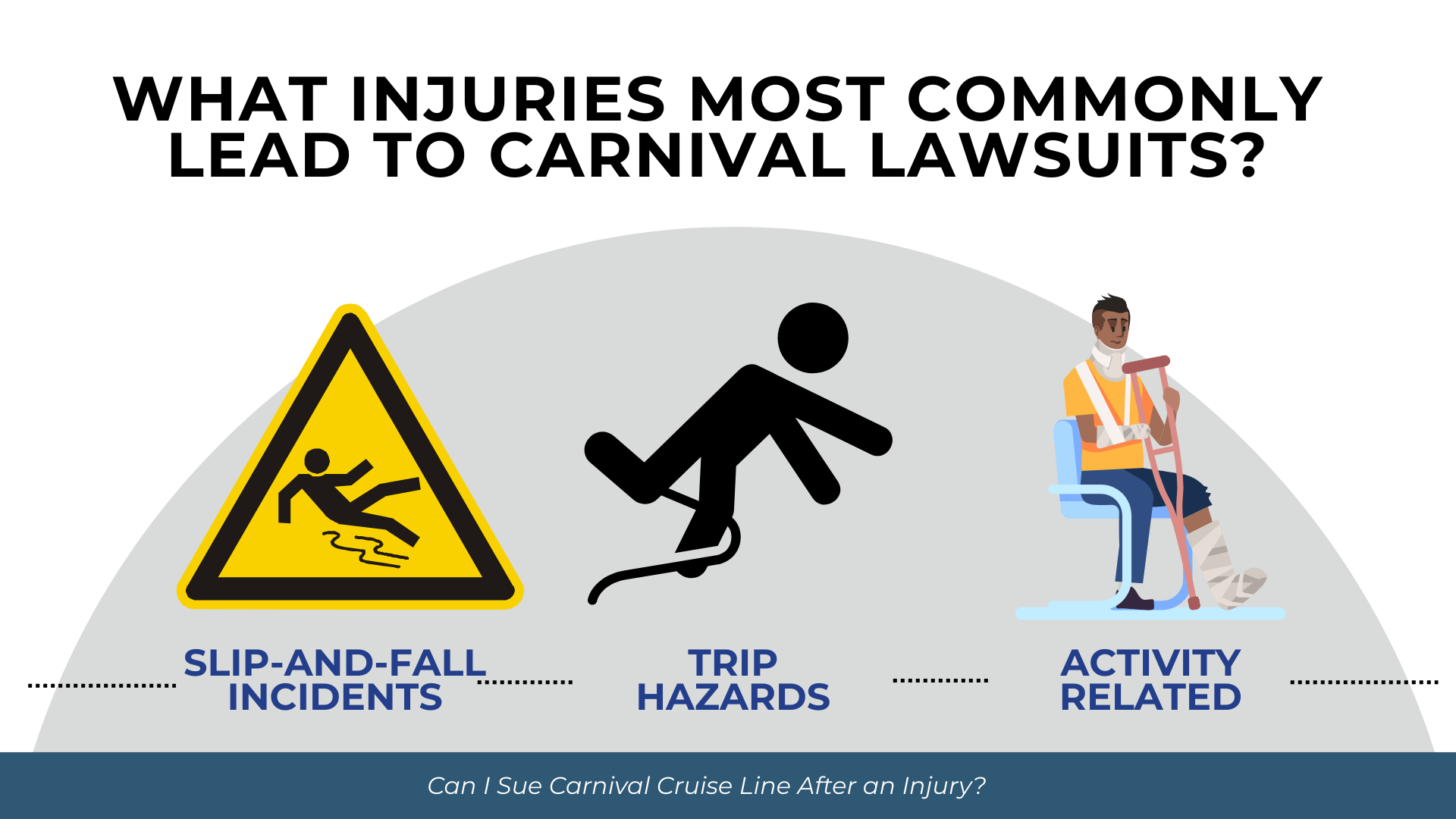
Slip-and-fall incidents on wet decks and dining areas
Pool decks, spa areas, lido decks, and dining spaces are frequent sites of slip-and-fall injuries. These areas accumulate water from swimmers, sea spray, spilled drinks, and tracked-in moisture. Buffet floors become slick from dropped food and beverages. Studies suggest approximately 45% of cruise injuries involve slips, trips, or falls—and ships with extensive wet-deck footprints create substantial exposure.
Trip hazards from raised thresholds and structural elements
Thresholds between passenger hallways and doorways—particularly the raised metal pieces designed for watertight integrity—are consistent sources of trip injuries. The Ruiz Rondon case against Carnival specifically involved a passenger who tripped on such a threshold aboard the Carnival Celebration. Other structural hazards include door lips, uneven flooring transitions, cabin step-ups, and luggage left in corridors. Gangway and ramp accidents during embarkation present similar trip hazards with added severity.
Activity-related injuries on onboard attractions
Carnival ships feature high-energy amenities including water slides, ropes courses, and sports courts. Carnival injury claims frequently arise from predictable scenarios:
- Wet-surface falls. Pool decks, splash zones, and water slide exits create slick conditions that catch passengers off guard.
- Threshold and structural trips. Raised metal doorway fixtures, uneven flooring transitions, and cabin step-ups cause missteps.
- Attraction injuries. Ropes courses, climbing walls, and water features produce sprains, fractures, and abrasions.
- Equipment malfunctions. Automatic doors, elevators, and other mechanical systems have been the subject of injury claims.
- Hot tub incidents. Overheating, fainting, and falls near slippery hot tub edges lead to injuries, especially when the ship moves unexpectedly.
These patterns reflect the risk profile of large, high-traffic ships with many mechanical systems and heavily used public spaces.
What Must You Prove to Hold Carnival Liable?
Winning a negligence claim against Carnival requires establishing specific legal elements. The most frequently contested issue in cruise injury cases is whether Carnival had notice of the dangerous condition.
Establishing a duty and breach
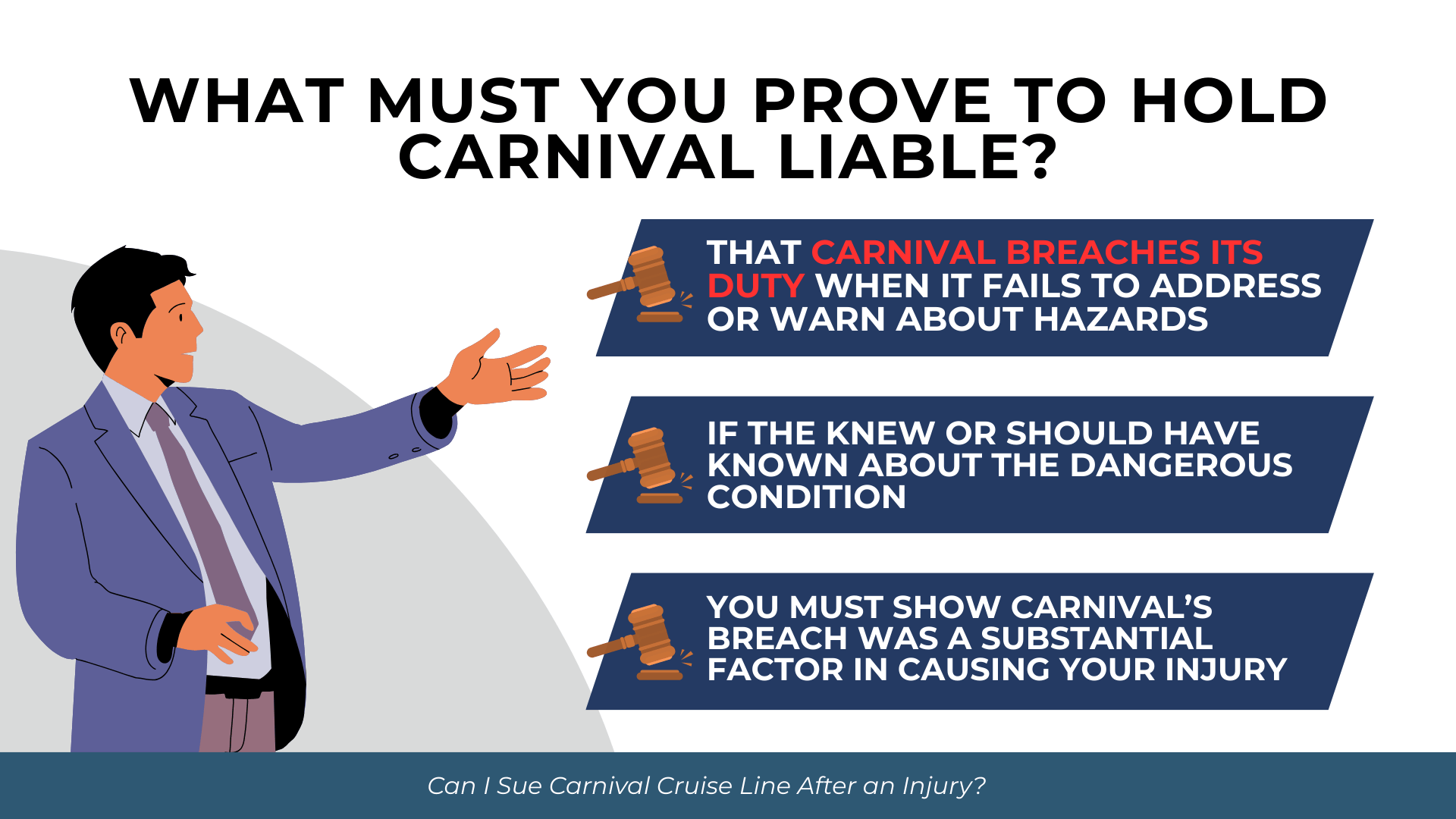
Maritime negligence claims require four elements: duty, breach, causation, and damages. Carnival owes passengers reasonable care under the circumstances. A breach occurs when Carnival fails to meet that standard—for example, by allowing a wet floor to remain unaddressed, failing to repair a known defect, or neglecting to warn passengers about a hazard.
The notice requirement explained
A cruise line is liable only if it had actual or constructive notice of the dangerous condition. This is one of the most litigated issues in maritime injury cases. The Eleventh Circuit established this requirement in Keefe v. Bahama Cruise Line, 867 F.2d 1318 (11th Cir. 1989), and clarified its application in Everett v. Carnival Cruise Lines, 912 F.2d 1355 (11th Cir. 1990).
Actual notice means Carnival created the hazard or knew about it directly. Constructive notice means the hazard existed long enough that Carnival should have discovered it through reasonable inspection, or that prior similar incidents put Carnival on notice of the risk. For example, a puddle present for 20 or more minutes may provide strong support for constructive notice.
Connecting the breach to your injury
You must also prove that Carnival’s breach actually caused your injury. Maritime negligence uses a traditional proximate cause standard, often framed as whether the breach was a “substantial factor” in producing the harm. If multiple factors contributed—including your own actions—the court will apportion fault rather than bar your claim entirely.
Can Carnival Argue You Were Partially at Fault?
Carnival will likely argue that your own conduct contributed to the injury. Understanding how maritime law handles shared fault is essential to evaluating your claim.
How pure comparative negligence works
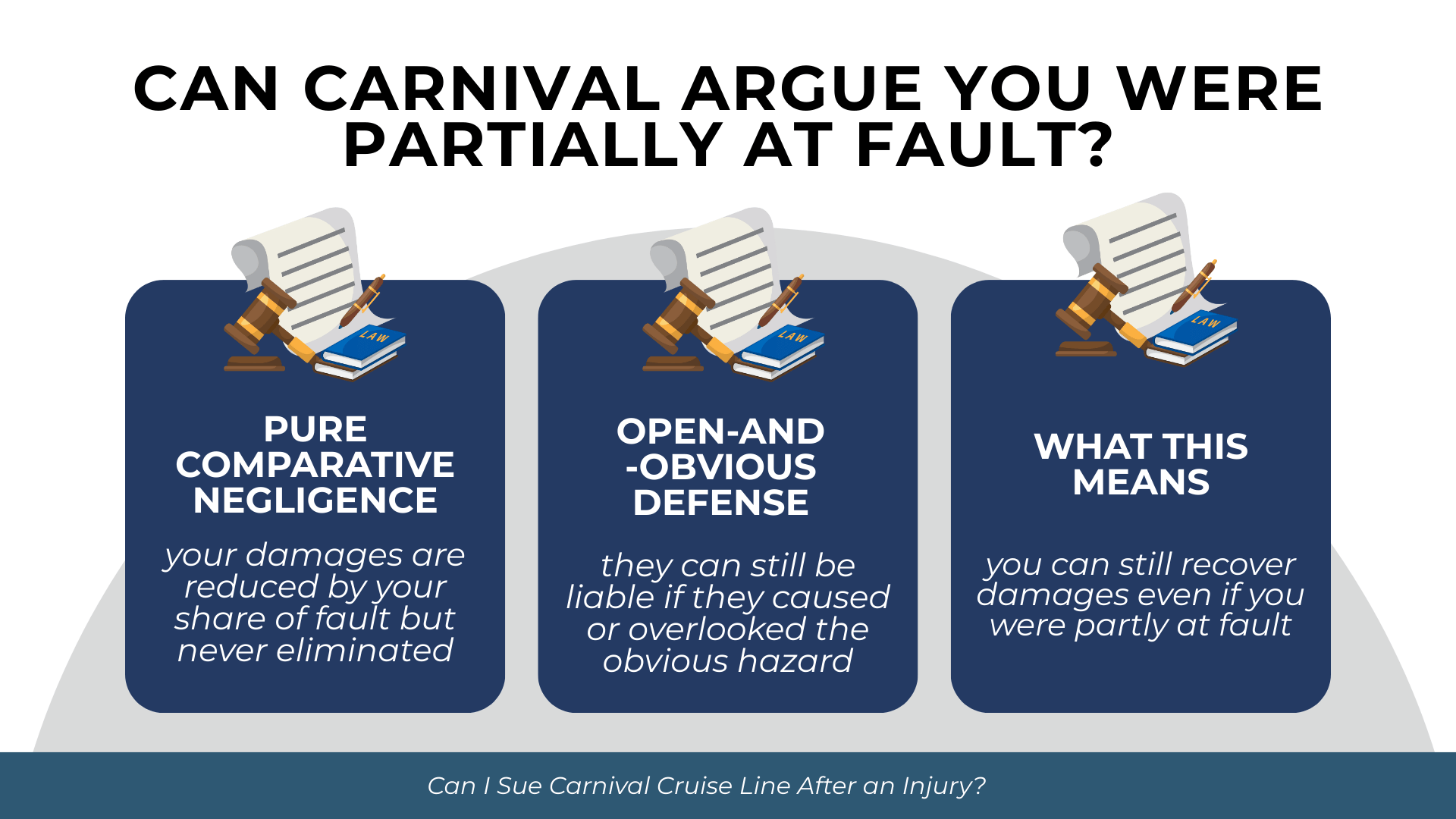
Maritime tort law uses pure comparative negligence, as established in United States v. Reliable Transfer Co., 421 U.S. 397 (1975). Under this rule, your damages are reduced by your percentage of fault—but you are never completely barred from recovery, even if you were 99% responsible. If a jury finds you 30% at fault for running on a wet deck, your damages would be reduced by 30%, not eliminated.
The open-and-obvious defense—and its limits
Carnival may also argue that the hazard was open and obvious, meaning it had no duty to warn you about something a reasonable passenger would have noticed. This doctrine can defeat claims based solely on failure to warn. However, it does not eliminate liability if Carnival created the hazardous condition, failed to maintain safe premises, or had noticed that the condition posed an unreasonable risk despite being visible.
What this means for your recovery
Even if you share some responsibility for the accident, you can still recover damages. The question becomes how much your recovery will be reduced, not whether you have a claim at all, and understanding what factors affect settlement value helps you evaluate your claim’s potential..
What Deadlines Apply to Carnival Injury Lawsuits?
Missing a filing deadline can destroy an otherwise valid claim. Carnival’s ticket contract imposes strict time limits that are significantly shorter than most people expect.
The contractual one-year deadline
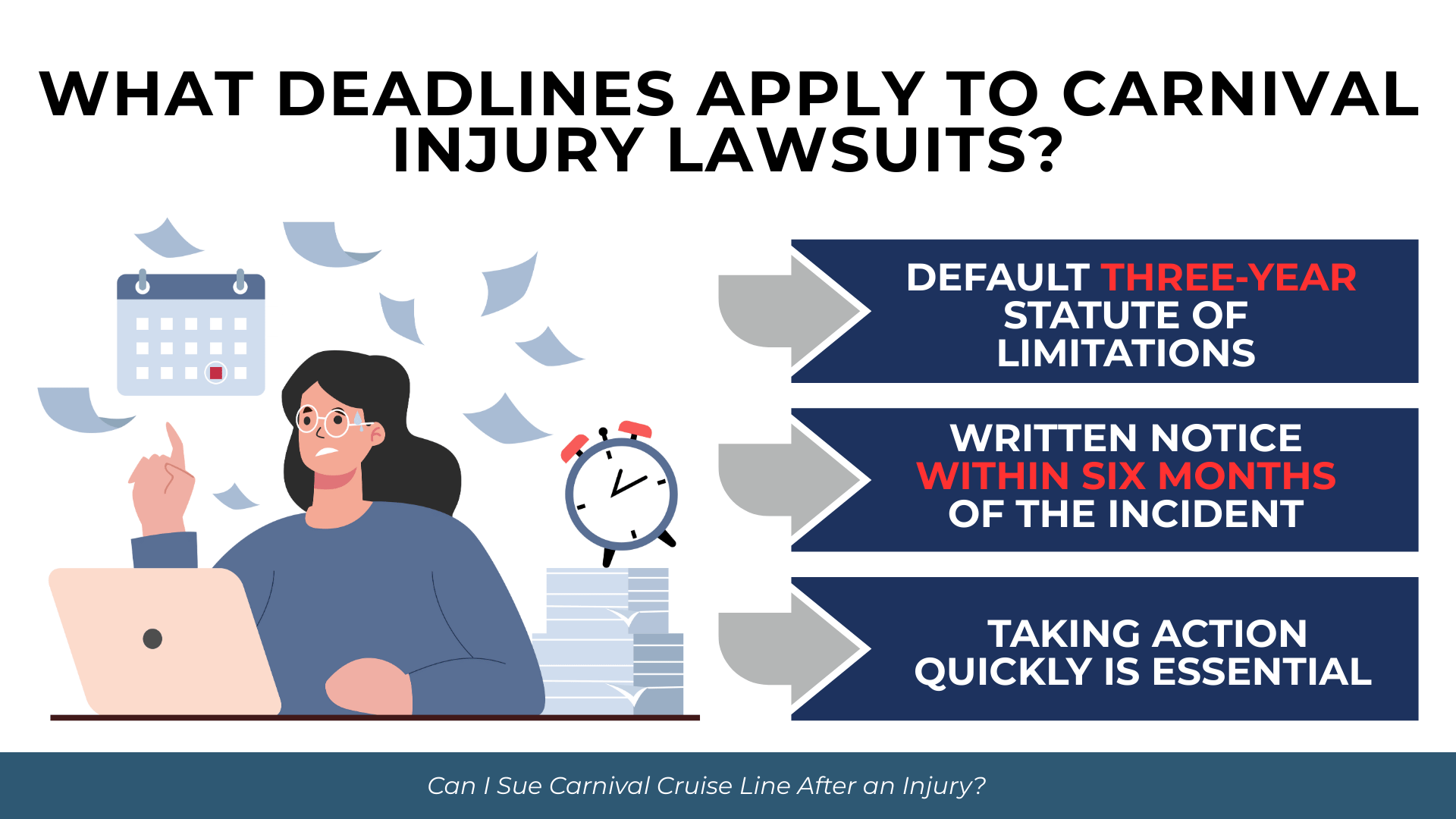
While federal maritime law provides a default three-year statute of limitations under 46 U.S.C. § 30106, cruise lines routinely shorten this period through their ticket contracts. Carnival’s passenger contract requires lawsuits to be filed within one year of the incident—not three years. Courts consistently enforce these shortened deadlines.
The six-month notice requirement
Before you can even file suit, Carnival’s contract typically requires written notice of your claim within six months. Failure to provide this notice can bar your claim regardless of how strong your case might be. This requirement exists in the fine print of your cruise ticket, and courts have upheld it repeatedly.
Why early action protects your claim
Given these compressed deadlines, taking action quickly is essential. Speaking with a maritime injury attorney soon after your injury helps ensure you meet notice requirements and preserve your right to sue.
Why Must Carnival Lawsuits Be Filed in Miami?
If you were injured on a Carnival cruise, you will almost certainly need to file your lawsuit in Miami—regardless of where you live or where the ship sailed from.
How ticket contracts control where you sue
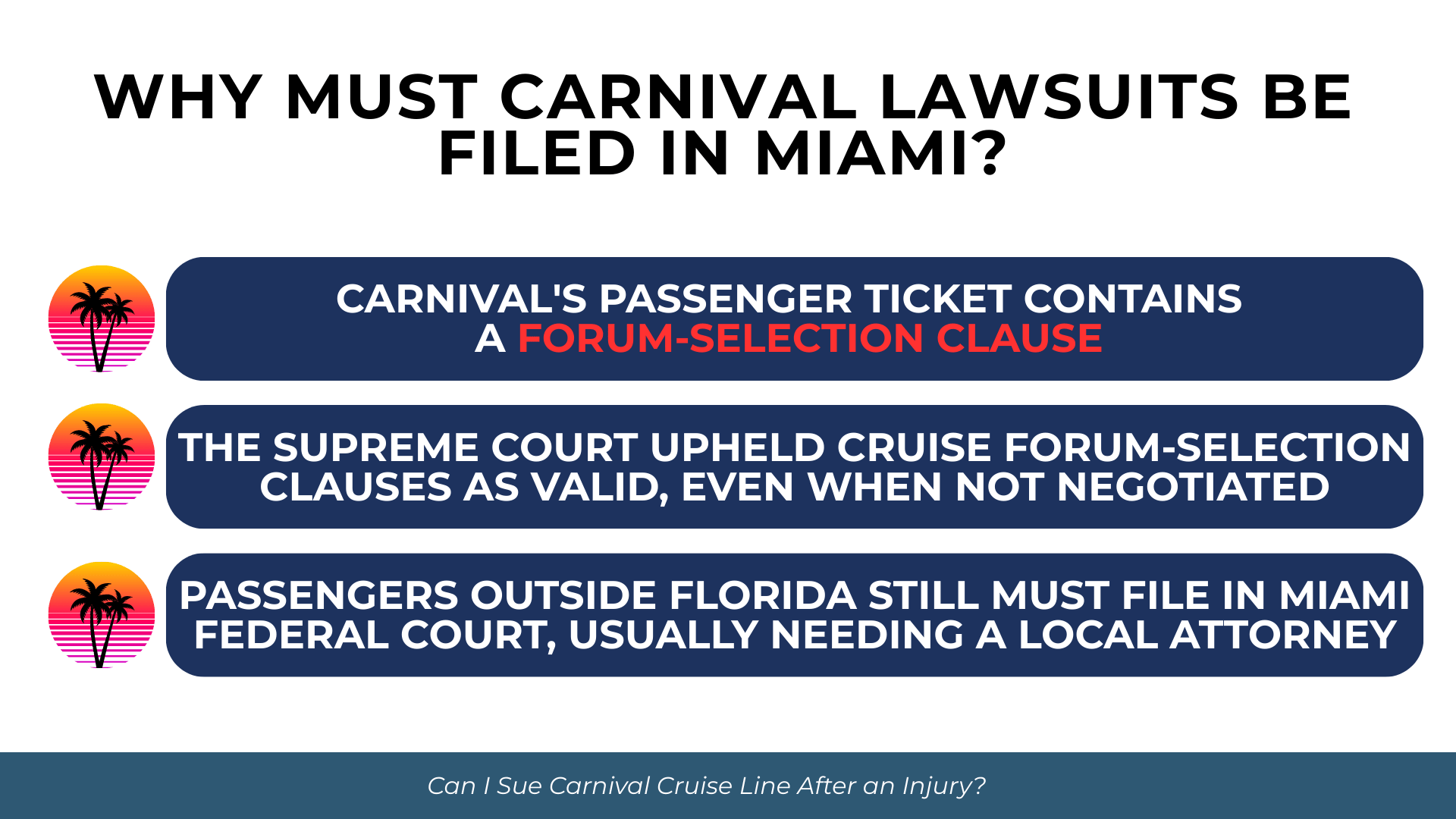
Carnival’s passenger ticket contains a forum-selection clause requiring all lawsuits to be filed in the U.S. District Court for the Southern District of Florida, Miami Division. This means a passenger from Seattle, Chicago, or anywhere else must litigate in Miami if they want to pursue a claim against Carnival.
The Supreme Court’s ruling on enforceability
The U.S. Supreme Court upheld the enforceability of cruise line forum-selection clauses in Carnival Cruise Lines, Inc. v. Shute, 499 U.S. 585 (1991). The Court held that such clauses are valid even when passengers did not negotiate them, as long as they are fair and reasonable. Courts will invalidate these clauses only if they were obtained through fraud, are fundamentally unjust, or effectively prevent passengers from pursuing their legal rights—a high bar that is rarely met.
What this means if you live elsewhere
For passengers outside Florida, this creates logistical challenges. You will likely need to work with an attorney who practices in Miami federal court or can associate with local counsel. The distance and expense do not excuse you from complying with the venue requirement.
What Evidence Should You Preserve After a Carnival Injury?
Strong evidence can make or break your claim. Taking immediate steps to document the incident and preserve proof is critical.
Documenting the scene and your injuries
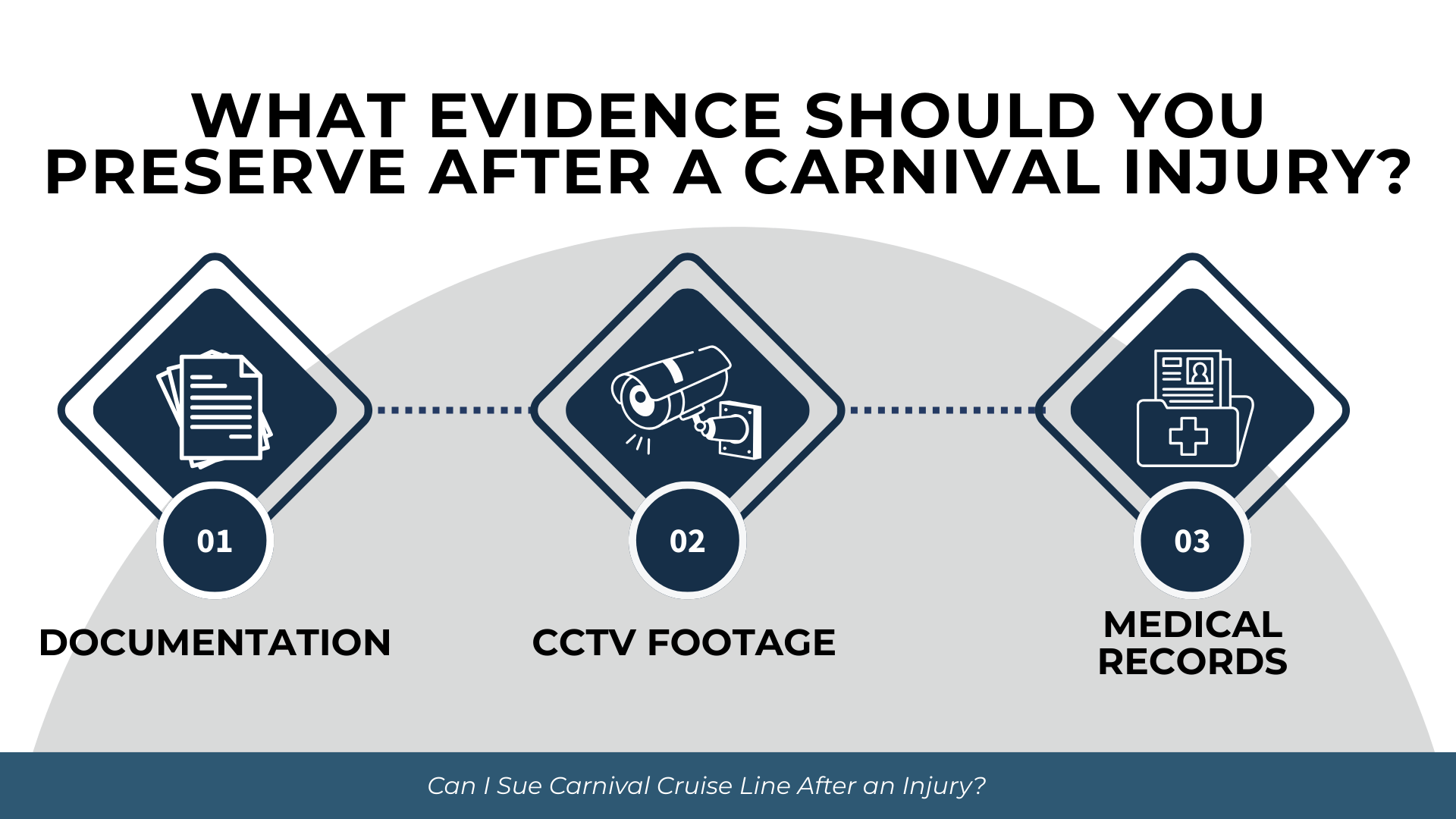
Key evidence to gather immediately after an injury includes:
- Photographs. Capture the hazard, surrounding area, lighting conditions, and any visible injuries as soon as possible.
- Incident reports. Request a copy of any report filed by crew members who responded to your accident.
- Witness information. Collect names and contact details of anyone who saw what happened.
- Medical records. Obtain documentation from the ship’s medical center and all subsequent treatment.
- Your own notes. Write down exactly what happened while details are fresh—conditions, timing, what you observed.
- Clothing and footwear. Preserve what you were wearing, as it may become relevant to the defense’s arguments.
Demanding CCTV footage before it disappears
Cruise ships maintain surveillance cameras in key public areas. However, this footage is typically auto-overwritten within 7 to 30 days. If you do not demand preservation promptly, critical video evidence may be lost. A formal litigation hold letter—sent by an attorney—puts Carnival on notice that it must preserve footage, incident reports, maintenance logs, and other relevant evidence.
Medical records and witness statements
Cruise lines have an affirmative duty to preserve evidence when litigation is reasonably foreseeable. Failure to retain CCTV footage or other critical evidence may lead to an adverse inference instruction, allowing a jury to presume the missing evidence was unfavorable to Carnival’s defense. Acting quickly maximizes your chances of obtaining this evidence before it disappears.
Frequently Asked Questions About Suing Carnival
Has Carnival been held liable for passenger injuries in court?
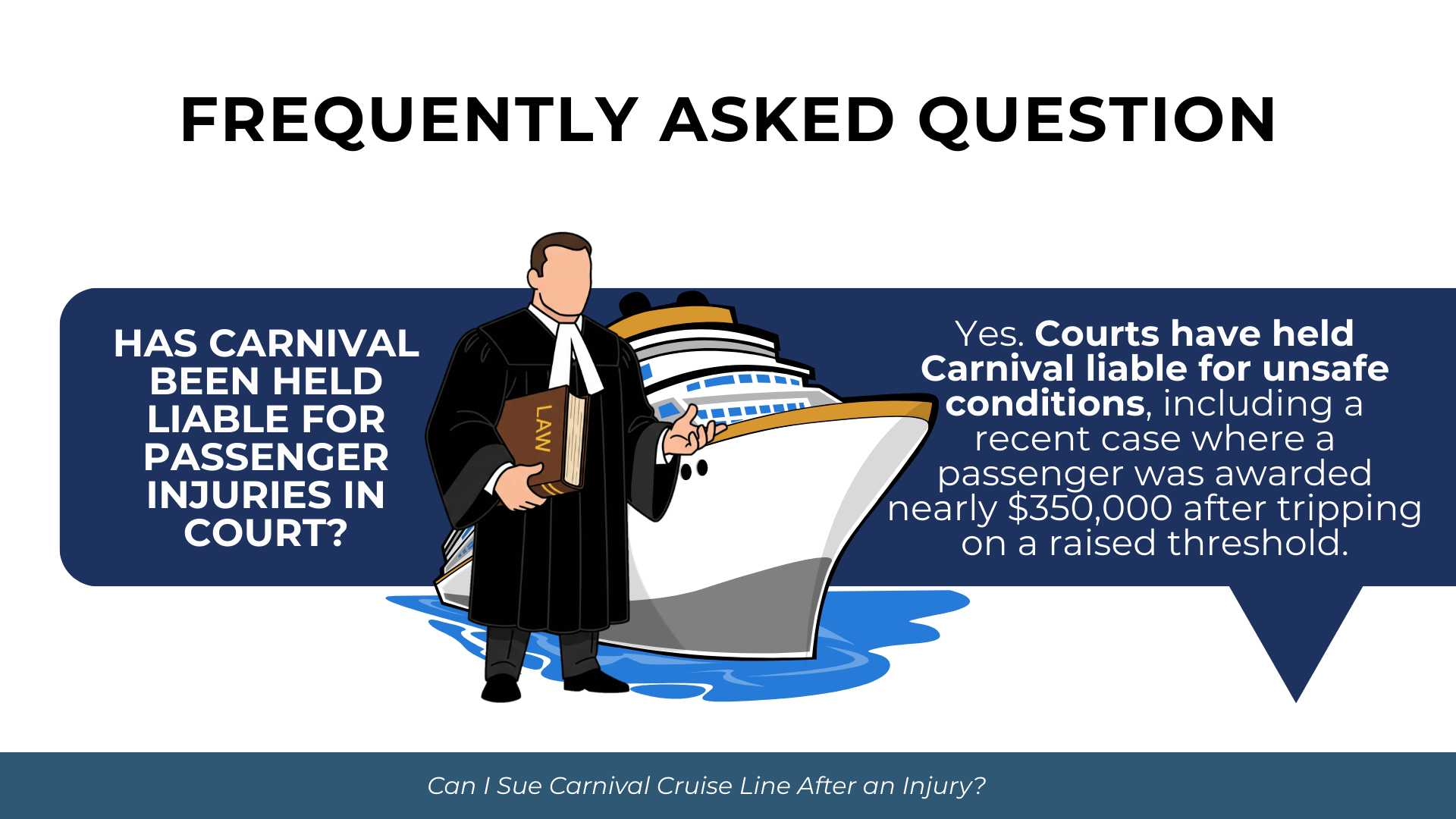
Yes. Although most cruise injury cases settle before trial, courts have found Carnival liable when the evidence supports negligence. In a recent federal court decision, a judge ordered Carnival to pay a passenger nearly $350,000 in damages after she tripped and fell on a raised threshold aboard the Carnival Celebration in May 2023. The ruling confirmed that Carnival can be held accountable when it fails to maintain safe conditions.
Can I sue Carnival if the injury was partly my fault?
Yes. Maritime law uses pure comparative negligence, meaning your damages will be reduced by your percentage of fault but you are not barred from recovery. Even if you were partially responsible—such as by not holding a handrail or walking quickly on a wet surface—you may still recover compensation proportional to Carnival’s share of fault.
What happens if I miss the one-year deadline?
Missing the contractual deadline typically bars your claim entirely. Courts have consistently enforced Carnival’s one-year limitation period, and there are very limited exceptions. The six-month notice requirement is equally strict. If you are approaching either deadline, consult with an attorney immediately.
Do I need a lawyer to sue Carnival Cruise Line?
While you have the legal right to represent yourself, pursuing a claim against Carnival presents significant challenges. Cases must be filed in Miami federal court, maritime law has specialized rules, and Carnival has experienced legal teams defending these claims. Working with an attorney who understands maritime injury litigation can help you navigate procedural requirements and build the strongest possible case.
Taking Action After a Carnival Cruise Injury
Passengers injured on Carnival cruises can pursue legal claims when the company’s negligence caused their harm. Carnival owes you reasonable care, and when it fails to maintain safe conditions, warn of known hazards, or preserve evidence after an incident, you have the right to seek compensation.
The path forward requires understanding maritime law’s unique requirements: proving notice, complying with shortened deadlines, and filing in Miami federal court. The one-year limitation period and six-month notice requirement leave little room for delay.
If you were injured on a Carnival cruise, acting quickly protects both your evidence and your legal rights. Contact Prosper Injury Attorneys to discuss your Carnival cruise injury case.